
Traffic management in Mirpur area in a mess
Kamrun Nahar | Sunday, 20 September 2015
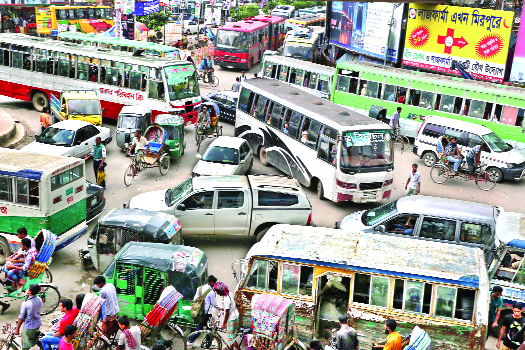
The traffic system in city's Mirpur area has virtually collapsed in recent times largely due to unplanned development works round the year and indifference on the part of on-duty traffic police.It takes almost an hour to reach Mirpur-10 from Mirpur-12 and vice-versa. The traffic congestion from Kalshi Road crossing to Senpara has taken a permanent shape recently due to the soil tests being conducted for the metro-rail project.
This correspondent found that one relevant agency has dug up the road at three points at Mirpur-10 circle, creating a long tailback. Although there is enough space for movement, the traffic police's mismanagement makes the vehicles wait in a long queues for hours.
The traffic authority, however, blamed the inadequate road space for the traffic congestions. But urban planners while differing with the views of police blame inefficiency, mismanagement and ad-hoc solution for the traffic problems.
Talking to the FE, a staffer of Swadhin Express Samiullah Ratan said it takes them an hour to reach Mirpur-10 from Mirpur Section-12, three and a half hours to reach Babubazar and an hour to cross 32 kms to reach Mawa.
Sujon, another staffer of Haji Paribahan plying between Mirpur-12 and Motijheel, said about 900 new transports were added by 12 companies after the construction of Kalshi Road. Each company has minimum 50 buses.
Commuters and transport workers said it took three hours to reach Motijheel from Mirpur-12 even on Fridays. Half of the time is spent to reach Taltola of Agargaon from Mirpur-12, a distance of hardly 6 kms.
Nazrul Islam, a private service holder, said if he hires a CNG-auto-rickshaw from Mirpur original 10 at 8:30 am to reach his office at Dhanmondi 27, it takes an hour to reach Taltola. The rest of the distance, it takes only 10-15 minutes.
According to experts, the transport system of Dhaka is predominantly road based and non-motorised transport (mainly rickshaws) has a substantial share.
Dhaka's road network is nearly 3,000 kms (of which 200 kms primary, 110 kms secondary, 50 kms feeder and 2,640 kms narrow roads).
It represents the proportion of road surface to built-up area hardly 7.0 per cent as against 25 per cent recommended for a modern city. Only 400km footpath is available for pedestrians of which 40 per cent are being occupied illegally by vendors and others.
The primary mode of transport is about one-third (34 per cent) using rickshaws, almost half (44 per cent) using transit/buses; nearly a quarter (22 per cent) comprised of walk, 14 per cent non-transit motorised and 8.0 per cent private car modes (STP, 2005).
Additional commissioner of traffic Khondoker Golam Faruk told the FE Saturday that it may not be possible to free the residents of Mirpur free from present sufferings created out of traffic congestion.
"The city has a road capacity of accommodating only 200,000 vehicles whereas 900,000 motorised and 900,000 non-motorised vehicles ply here every day. In such situation, if you even increase traffic manpower from 1,000 to 10,000, you will not be able to manage the situation," he said.
Mr Faruk said Dhaka has a road network of 7.0 per cent against the recommended 25 per cent and of the 7.0 per cent, buses can ply only on 12 per cent roads which means the city has been overburdened with rickshaws.
Regarding the long waiting time at some of the signals, he said traffic police have to keep vehicles at some points for a longer time for road management.
Eminent architect and urban planner Iqbal Habib differed with the police official and said traffic management is an engineering and planning-related issue which has to be solved with proper planning and engineering.
The authority tries to resolve the overall traffic related problems on an ad hoc basis without proper planning, correct data and information, he added.
"It is correct that we have insufficient road network in Dhaka. But road scarcity is not only the problem for traffic congestion," said Iqbal Habib, adding: "We have to decide who will be primary users of these roads, 8.0 per cent private cars or 34 per cent passengers of mass transport."
He said the mass transport system must be refurbished where mass transports will get top priority.
"Whatever road we have, we have to ensure maximum use of it for the majority of people," said the joint secretary of Bangladesh Paribesh Andolon (BAPA).
msshova@gmail.com