
Treatment of Prof Yunus disappointing: USAID chief
A.Z.M. Anas, back from USA | Sunday, 30 November 2014
A senior U.S. official has voiced his dismay at the government's treatment of Prof Muhammad Yunus, saying the microfinance bank the Nobel laureate founded has played a critical role in paring back extreme poverty in Bangladesh.
"He (Yunus) is an important leader. He should have been treated fairly," said Dr Rajiv Shah, administrator of the United States Agency for International Development (USAID).
"We've communicated our concerns with the government several times since his removal from the bank. The decision has disappointed us," he told this correspondent at a media roundtable in the just-concluded Cookestoves Future Summit held in New York. The UN-led Global Alliance for Clean Cookestoves organised the summit.
The latest reaction from a top U.S. official comes as the government has amended rules to make sure that it has full control over who sits on the Grameen Bank's board.
The government pushed the micro-lending pioneer out of Grameen Bank in 2011--a controversial decision that sparked condemnation from world leaders, celebrities, activists, fans and backers.
The acrimonious relations Prof Yunus had with the government top brass were rooted in his attempt to join politics in 2007.
While the Grameen's way of lending was mimicked by dozens of countries around the world, prime minister Sheikh Hasina publicly demeaned microfinance institutions, accusing them of "sucking blood from the poor borrowers."
The USAID boss made a powerful defence, insisting that microfinance had helped pull millions out of ultra-poverty and foster social progress in a country once derided as a 'basket case'.
"We've seen lots of important progress in reducing extreme poverty correlated with microcredit. It was possible due to the outstanding work of Grameen Bank and brac for decades," he said.
His comments are reinforced by data from the World Bank, which said nearly 15 million people left poverty in Bangladesh between 2000 and 2010, helped partly by tiny loans offered to the impoverished people, mostly women.
Grameen, where the government holds a quarter of its stakes, doles out collateral-free tiny loans to eight million borrowers, who are also its shareholders.
The bank started life in 1976 in a Chittagong village and the Vanderbilt-trained economist helped it flower into a business empire-from telecom to food, from information technology and to renewable energy. The combined asset value of Grameen and its associated enterprises was estimated at $1.6 billion in 2010.
Grameen Shakti, an affiliate of Grameen, sells solar panels, bio-gas plants and clean cookstoves in areas outside the network of national energy grid.
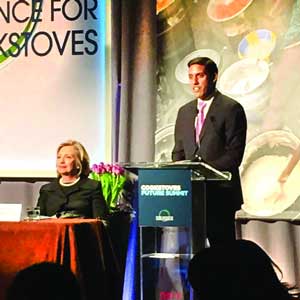
The Cookstoves Future Summit was co-hosted by former U.S. secretary of state Hillary Rodham Clinton, the UK's parliamentary undersecretary of state for international development Lindsay Northover, Norwegian foreign minister Børge Brende, foreign minister of Ghana Hanna Tetteh, and USAID administrator Dr Shah.
"USAID is pioneering a new model of development - one grounded in a focus on harnessing innovation, public-private partnerships, and local leadership to deliver real, measurable results," said Dr Shah.
"Working in partnership with the Global Alliance for Clean Cookstoves, we are creating game-changing solutions in energy, finance, and business that will unlock a brighter future for the world's most vulnerable people," he said.
Donors, banks and private investors committed a record $400 million in investments to help the Alliance provide clean cookstoves to 100 million households by 2020.
azmanas1@gmail.com