
PARLIAMENT, 50-MEMBER CABINET SWORN IN
Triumphant Tarique takes oath as 11th PM
MIR MOSTAFIZUR RAHAMAN | Wednesday, 18 February 2026
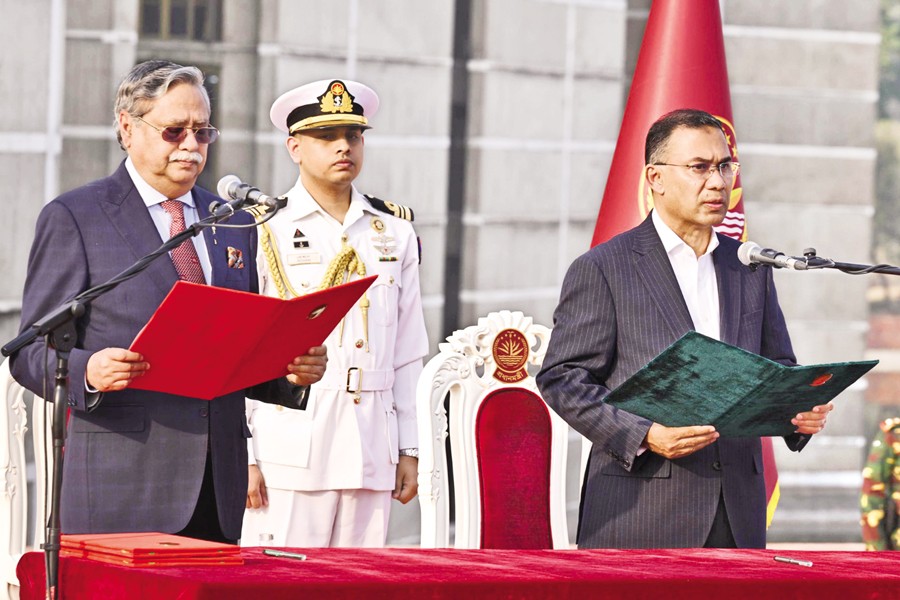
Zia-family heir Tarique Rahman, who led his party to a sweeping electoral victory, becomes prime minister of Bangladesh to usher in what supporters describe as a new political era.
The swearing-in ceremony of the Bangladesh Nationalist Party (BNP) chair and his cabinet members was held Tuesday at the South Plaza of the Jatiya Sangsad Bhaban under a clear spring sky -- first such investiture in Bangladesh's history, in a break with longstanding tradition of oath-taking at the Bangabhaban presidential palace.
President Mohammed Shahabuddin administered the oath at the open-air ceremony largely attended by foreign dignitaries.
After Rahman was sworn in, 49 members of the new cabinet took their oath of office and secrecy -- 25 as full minister and 24 as state minister. With this, a BNP-led government formally began its tenure, returning the party to power for the first time since 2006.
Tarique Rahman arrived at 3:58pm, accompanied by his wife Zubaida Rahman and daughter Zaima Rahman, to a standing ovation. President Shahabuddin entered shortly afterwards, and the ceremony began with recitation from the Holy Quran.
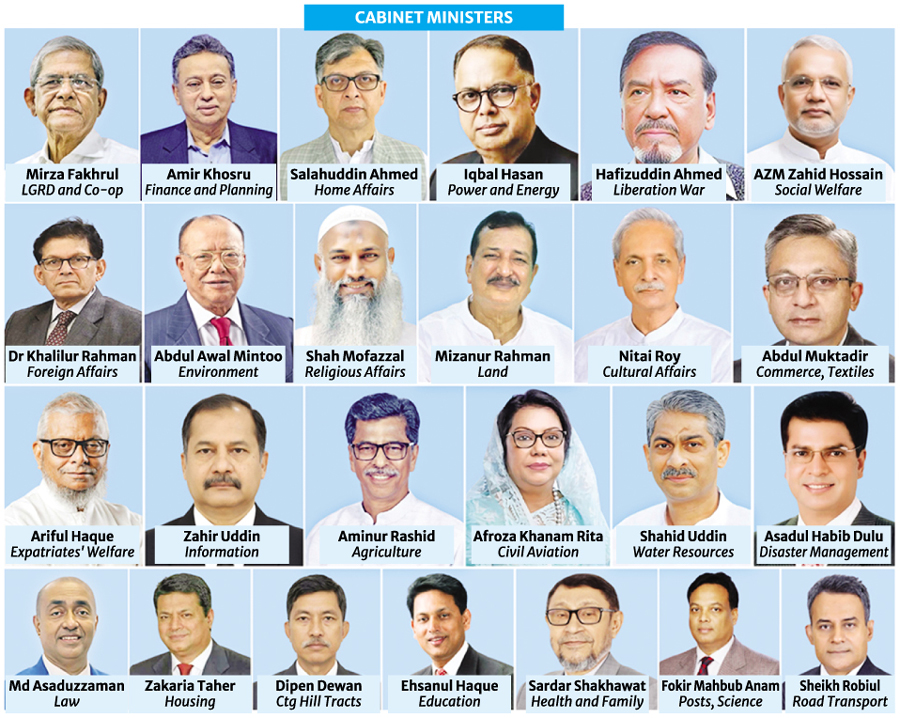
Of the 50-member cabinet, which includes three technocrats, 41 are new faces. Sixteen of the 25 ministers are first-timers, while all 24 state ministers are new to executive office. Rahman himself is serving in a cabinet position for the first time.
The 25 ministers and their allocated portfolios are: Mirza Fakhrul Islam Alamgir, local government, Amir Khoshru Mahmud Chowdhury, finance and planning, Salahuddin Ahmed, home affairs, Iqbal Hasan Mahmud, power and energy, Maj (retd) Hafiz Uddin Ahmed Bir Bikram, liberation war affairs , Abu Jafar Md Zahid Hossain, social welfare, Dr Khalilur Rahman (technocrat), foreign affairs, Abdul Awal Mintoo, forest and environment, Kazi Shah Mofazzal Hossain Kaikobad, religious affairs, Mizanur Rahman Minu, land affairs, Nitai Roy Chowdhury, cultural affairs, Khandaker Abdul Muktadir, commerce and industries, Ariful Haque Chowdhury, labour and overseas employment, Zahir Uddin Swapon, information and broadcasting, Mohammad Amin Ur Rashid (technocrat), agriculture, fisheries and livestock, Afroza Khanam Rita, civil aviation, Shahid Uddin Chowdhury Annie, water resources, Asadul Habib Dulu, Disaster Management, Md Asaduzzaman, law affairs, Zakaria Taher, housing and public works, Dipen Dewan, Chottogram Hill Tracts, ANM Ehsanul Hoque Milon, education , Md Sakhawat Hossain, health, Fakir Mahbub Anam, Telecom and ICT, and Sheikh Rabiul Alam, communications and railways.
The 24 state ministers are-M Rashiduzzaman Millat, Anindya Islam Amit, Md Shariful Alam, Shama Obaed Islam, Sultan Salahuddin Tuku, Barrister Kaiser Kamal, Farhad Hossain Azad, Md Aminul Haq (technocrat), Mir Mohammad Helal Uddin, Habibur Rashid, Md Rajib Ahsan, Md Abdul Bari, Mir Shahe Alam, Zonayed Abdur Rahim Saki, widely known as Zonayed Saki, Ishraque Hossain, Farzana Sharmin, Shaikh Faridul Islam, Nurul Haque Nur, Yasser Khan Chowdhury, M Iqbal Hossain, MA Muhith, Ahammad Sohel Manjur, Bobby Hajjaj and Ali Newaz Mahmud Khaiyam.
Among the senior figures in the cabinet are BNP secretary-general Mirza Fakhrul Islam Alamgir and standing committee members Amir Khosru Mahmud Chowdhury, Salahuddin Ahmed, Iqbal Hasan Mahmud and Maj (retd) Hafiz Uddin Ahmed Bir Bikram, as well as vice-chairmen Kazi Shah Mofazzal Hossain Kaikobad and Nitai Roy Chowdhury. Asadul Habib Dulu and international affairs secretary ANM Ehsanul Hoque Milon are also among the experienced hands included.
Diplomatic sources say leaders from 13 countries, including China, India, Pakistan, Saudi Arabia, Turkey, the United Arab Emirates, Qatar, Malaysia, Brunei, Sri Lanka, Nepal, the Maldives and Bhutan, were invited to attend. India was represented by Lok Sabha Speaker Om Birla.
Also present were outgoing chief adviser of the post-uprising interim government Professor Muhammad Yunus, Chief Justice Zubayer Rahman Chowdhury, the chief election commissioner, senior judges, members of parliament, armed forces chiefs, diplomats and senior civil and military officials.
Rahman assumed full leadership of the BNP barely a month before the election, following the death of his mother, former prime minister Khaleda Zia. Riding a wave of public sympathy and renewed organisational drive, he guided the party into victory in the 13th parliamentary elections, securing 209 seats, with alliance partners winning three more.
Despite the emphatic mandate, Rahman struck a conciliatory tone after the polls, calling for national unity rather than partisan triumph -- a posture analysts say is aimed at projecting himself as a statesman for a polarised nation.
His path to power has been marked by turbulence. In 2007, during the army-backed caretaker government, Rahman was arrested on corruption charges and spent 18 months in prison before being released in September 2008. He then relocated to London, directing party affairs from exile for nearly 17 years.
He returned to Dhaka on December 25 last year as his mother's health deteriorated. A day later, he paid respects at the grave of his father, Ziaur Rahman, Bangladesh's first military ruler-turned elected president.
Ten days after Khaleda Zia's death, on 9 January, Rahman was formally appointed chairman of the BNP at a meeting of its national standing committee, consolidating a leadership role he had effectively held since 2018, when he began serving as acting chairman following her imprisonment.
Born on 20 November 1965, according to the BNP's official website -- though his election affidavit lists 1968 -- Rahman is the elder son of Ziaur Rahman and Khaleda Zia, heir to one of Bangladesh's most powerful political legacies. He studied at BAF Shaheen College and later enrolled in the department of international relations at the University of Dhaka.
He became politically active during the anti-Hussain Muhammad Ershad movement in the 1980s, formally joining the BNP in 1988. He rose steadily through the ranks, becoming senior joint secretary- general in 2002 and senior vice-chairman in 2009.
With a commanding majority in parliament and a cabinet dominated by new entrants, Rahman begins his premiership amid high expectations. Whether the promise of renewal translates into political stability and reform will shape the contours of Bangladesh's next chapter.
mirmostafiz@yahoo.com