
Turmoil takes 0.5pc toll on country\\\'s GDP
FE Report | Monday, 6 April 2015
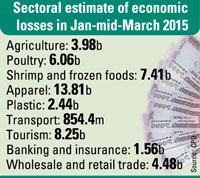
Waves of political violence ate up some 0.5 per cent of country's gross domestic product (GDP) or an estimated amount of Tk 49 billion from January to mid-March of the current fiscal year, according to estimates done by a private policy think tank.
The Centre for Policy Dialogue (CPD) revealed its study findings based on some major selected sectors like agriculture, poultry, shrimp and frozen foods, apparels, plastic, transport, tourism, banking and insurance, wholesale and retail trading, real estate, education and labour-related fields.
The private think tank suggests the upcoming national budget should address the issue of economic losses through appropriate fiscal and budgetary supports.
The CPD made a set of recommendations, pointing out the key challenges in the upcoming budget for fiscal year (FY) 2015-16, at a press briefing at city's BRAC Centre Inn Sunday.
In its study titled 'navigating the troubled waters', the CPD presented an overall outlook for the upcoming budget in line with the economic trends in the current FY.
Independent Review of Bangladesh's Development (IRBD) team of CPD conducted the study and prepared the research paper on the economics of confrontational politics.
Towfiqul Islam Khan, research fellow and coordinator of the CDP IRBD 2015 team, presented the keynote at the programme.
Professor Mustafizur Rahman, Executive Director, and Dr Debapriya Bhattacharya, distinguished fellow, and Dr Khondaker Golam Moazzem, additional research director of the CPD, also spoke at the meet.
"A loss of almost half-a-percentage-point equivalent of the GDP, as our preliminary estimates show, is a substantial dent on the economic prospects of the country," Towfiqul Islam said in the keynote paper.
A total of 81 days blockade and 67 days of strike disrupted supply chains, severed the rural - urban and domestic and international market links, the CPD noted.
Slowdown in remittance flow, falling economic growth in the EU and sluggish demand for Bangladesh RMG products on the US market, significant decrease in export growth and higher appreciation of the taka against the euro have been pointed out as 'fault line' appearing in the global economy.
"All this makes the effort to break out from the six-percent GDP-growth trap a more challenging task," the study report says.
The CPD analysis recommended for the government to address some key areas in the FY 2016 budget. The dos include more regulative efforts towards domestic resource mobilization, invigorating and incentivizing private investment, smooth functioning of the supply chains and removing the obstacles to higher growth of human- resource export.
Implementation of different reform initiatives of the government is not satisfactory, the policy think tank noted and aired the fear that it may cause difficulties in complying with the conditions tagged with the World Bank and the International Monetary Fund (IMF) programmes.
"It is also expected that future direction of economic policies in Bangladesh will be influenced by the ongoing reform programmes under IMF-ECF arrangements and the budgetary support programme with the World Bank which is under negotiation," the CPD said.
The research organization foretells that total revenue collection, both tax and non-tax, may fall short of target by an aggregate amount of Tk 250 billion in the current FY.
It said the National Board of Revenue (NBR) could miss its target for a third consecutive year.
"The large amount of revenue shortfall was likely to be offset by unutilised budgetary allocation," the keynote says.
The government is advised to set revenue-earning target and revise the current one more realistically.
A discrepancy between revenue earning data reported by the NBR and the finance ministry has been pointed out in the analysis.
To increase revenue collection, the CPD suggested giving focus on non-tax revenue collection, execution of modernization plan, settling pending court cases through Alternative Dispute Resolution (ADR), curbing tax evasion, emphasis on wealth-tax collection, strengthening transfer pricing cell, implementing new VAT and SD law within the scheduled time in FY 16.
A major challenge, according to the CPD, would be implementation of the forthcoming pay scale for government employees.
The Pay Commission estimated an additional financial requirement of Tk 229.53 billion for the new pay scale, 63.7 per cent higher than the figure earmarked for FY15, the CDP mentioned.
"It is important that, while finalizing and implementing the new pay scale, the government takes note of the fiscal viability and may consider phased implementation," the policy analyst said.
It noted that political unrest and "illiberal political environment" made the private investors shy.
"Effective settlement of political issues is needed to be resolved to boost investment," said Dr Debapriya Bhattacharya.
He noted that investors are quite 'uncomfortable' as administration and state machinery are serving interest of some parties and being used to protect their interest.
"There are inconsistencies in institutional reform. No significant development is visible on banking sector reform, Public Private Partnership (PPP) initiative, strengthening local government, decentralization of budget, subsidy management, pricing method of power and gas," he said.
Responding to newsmen's query, Dr Debapriya said different estimations on economic loss for political unrest had been made by different sectors--both public and private--but methods of those estimations should be explained to make it realistic.
Earlier, Prime Minister Sheikh Hasina gave an estimation of Tk 1.20 trillion losses in the economy due to political unrest while 16 business associations reported a daily loss of Tk 22.78 billion.
Mustafizur Rahman said the GDP growth would be negative 2.5 per cent in case of Tk 1.20 trillion reported economic loss. It is around 3.0 per cent of the size of current GDP.
The CPD paper said central bank may consider providing rescheduling facilities for repayment of agriculture credits, particularly concerning non-crop cultivation, and create window to provide low-cost credit facility to the vehicle owners.
Global trends, including declining fuel price, would provide more fiscal space for the FY16 budget as demand for subsidy to Bangladesh Petroleum Corporation (BPC) would be reduced. CPD estimates Tk 30 billion savings in FY 16 due to rock-bottom oil prices.
It recommends that the government revisit incentives for national saving certificates, strengthen the monitoring of ADP and frame meaningful district budgets.
CPD fellows, however, pointed out several positive economic indicators, above all else.
The positives include macroeconomic stability due to exchange rate against the US dollar, foreign-exchange reserves, inflationary trend and budget-deficit situation.
doulot_akter@yahoo.com