
UCVs' work towards community resilience
Sunday, 18 June 2023
In the bustling city-life of Bangladesh, a group of unsung heroes emerged amidst the risks of urban hazards like fire outbreaks, waterlogging, earthquakes, dengue and landslides. These heroes are the Urban Community Volunteers (UCVs) who dedicated themselves to helping those in need. When disasters struck, they were the first to respond, providing immediate assistance to affected individuals and communities.
Recognizing the vital role of UCVs, Save the Children's PROYASH II project, in partnership with Social and Economic Enhancement Programme (SEEP) and Young Power in Social Action (YPSA), aimed to strengthen community resilience by developing UCVs as first responders during local emergencies. The initiative ensured capacity-building sessions with technical support of the Fire Service and Civil Defense (FSCD) in 12 wards of Dhaka, Savar, and Chattogram city area, covering topics such as emergency response, search and rescue techniques, fire safety, first aid, etc. Since 2018, PROYASH II has not only demonstrated the pivotal role of UCVs but also provided them with the necessary support and resources to continue their voluntary work.
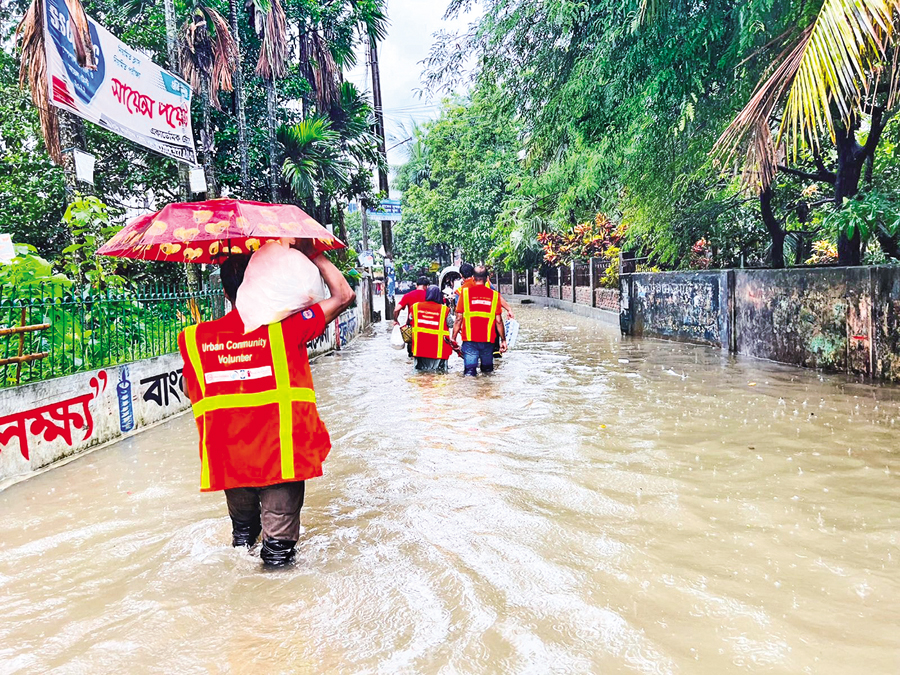
Members of the Urban Community Volunteers (UCVs) working to reach relief materials to the doorsteps of the victims in a disaster-hit area
A significant milestone in this direction has been the development and endorsement of the UCV Management Guideline back in 2019 led by the project's successful advocacy with the Ministry of Disaster Management and Relief. This guideline established UCVs as a key part of the local disaster management mechanism. This guideline provided a clear and comprehensive framework for managing UCVs, enhancing their capacity, and promoting risk reduction efforts in urban areas.
Beyond their immediate response throughout different emergencies like fire outbreak, waterlogging, landslide and COVID-19, these volunteers actively contributed to social welfare by spearheading awareness campaigns and supporting local councilors and assisting in governance. Their efforts came to the forefront during the COVID-19 pandemic when they fearlessly provided vital assistance, distributing essential supplies, medical aid, dead body management, vaccination support and even transporting patients to hospitals.
Inspired by the dedication of UCVs, Chattogram Mayor Md. Rezaul Karim Chowdhury took a step to have UCVs in all 41 wards of the city to ensure effective response during all sorts of emergencies. Each ward in Chattogram now has trained UCVs, equipped with identification cards and uniforms. This recognition significantly enhanced the UCVs' operational capacity and motivation.
As urban hazards evolved, the UCVs found themselves lacking the necessary skills to respond effectively. In response, Save the Children collaborated with the FSCD to develop an advanced training module. This module addressed new and complex threats such as building collapse and chemical fire. In 2022, the FSCD officially endorsed this module, marking a milestone in the journey of UCVs and the first batch of UCVs was also trained on this advanced module.
This incredible journey of strengthening the local disaster management system and mobilising UCVs was made possible through Proyash II, a project focused on building urban resilience. The UCVs set a shining example of unity, compassion, and resilience in the face of adversity. Considering the urban growth of Bangladesh, there is still a long way to go before we can ensure preparedness for effective response during urban emergencies in all the cities. The dedication of the UCVs under Proyash II project left an indelible impact on their communities, ensuring safety and well-being for generations to come.
It is now time to build on their success and follow the example across the cities all over the country.