
Ukraine, pro-Russia rebels \\\'sign ceasefire deal\\\'
Saturday, 6 September 2014
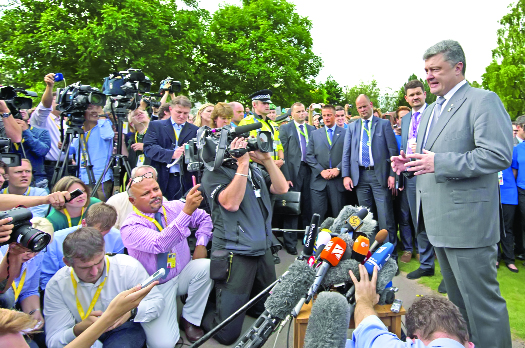
The Ukrainian government and pro-Russia rebels meeting in Minsk have signed a preliminary protocol to start a ceasefire, Ukrainian President Petro Poroshenko says, report agencies.
He said that the truce would start at 14:00 GMT. The announcement came after reports of further clashes in the east.
Western countries are meanwhile working on further sanctions against Russia. The West accuses Russia of sending arms and troops to back the rebels in eastern Ukraine. Moscow denies this.
The talks in Minsk, capital of Belarus, involve former Ukrainian President Leonid Kuchma, Russian ambassador to Ukraine Mikhail Zurabov and leaders of the self-proclaimed "people's republics" in Donetsk and Luhansk.
They come after Russian President Vladimir Putin put forward a seven-point peace plan.
The plan includes a halt to "active offensive operations" by the Ukrainian military and pro-Russia rebels, international ceasefire monitoring, unconditional prisoner exchanges and humanitarian aid corridors.
As the peace talks in Minsk began, fighting in eastern Ukraine continued.
Ukrainian government forces and volunteers are trying to hold on to Mariupol on the Azov Sea. The BBC's Fergal Keane, in Mariupol, tweeted that pro-Russia forces seemed to be hitting Ukrainian positions some 4km (2.5 miles) outside the city.
Another report adds, NATO leaders agreed Friday to set up a new rapid reaction force and to maintain a "continuous" presence in an eastern Europe rattled by Russian moves in Ukraine.
The new "spearhead" force, comprising several thousand troops and ready to deploy in a few days, means "we can deal swiftly and firmly with any threat," NATO head Anders Fogh Rasmussen said.
"This decision sends a clear message -- NATO protects all allies, at all times," he said.
At the same time, NATO's 28 leaders adopted a Readiness Action Plan to strengthen collective defence, he said on the second day of a NATO summit.
"This is a demonstration of our solidarity and our resolve," he said, and would help reassure allies spooked by the Ukraine crisis and gains by Islamic radicals in the Middle East.
Building on previous measures of support, NATO leaders agreed also to "maintain a continuous presence in the air, on land and at sea in eastern parts of the alliance on a rotational basis," Rasmussen said.
NATO has rotated troops and aircraft through newer member states such as Poland and the Baltic states, which were once ruled from Moscow and have called for help in the face of a more assertive Russia.
NATO's relations with Russia are based on the 1997 Founding Act which fixed eastern Europe's post-Cold War borders and prohibited both parties from stationing their troops there permanently.