
Uncertainty feared in power sector for payment backlog
FE REPORT | Tuesday, 30 May 2023
Oil import by Bangladesh’s private power-plant owners may face uncertainty at least for next two months, risking deterioration in the electricity-supply situation, if the government couldn’t clear their pending payments.
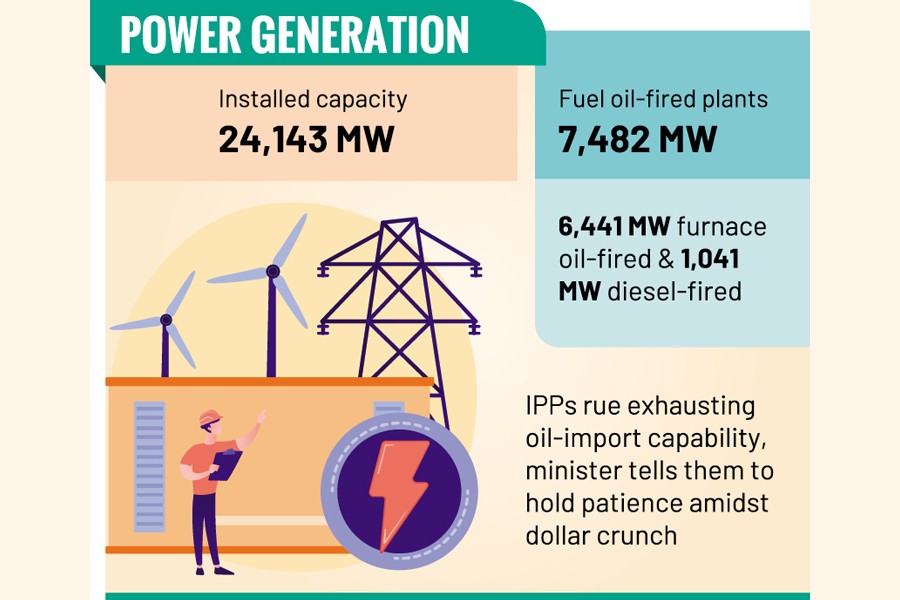
The private-sector power producers rue that they have exhausted furnace oil-import capability for dollar crunch while the minister concerned tells them to hold patience for some more days. “Given a lead time of 40 days, there is no clear line of sight for June and July 2023 fuel imports,” vice president of Bangladesh Independent Power Producers Association (BIPPA) Md Mozammel Hossain said during an FERB dialogue at Biddyut Bhaban in Dhaka Monday.
State Minister for the Ministry of Power, Energy and Mineral Resources (MPEMR) Nasrul Hamid was the chief guest at the dialogue jointly organized by the Forum for Energy Reporters Bangladesh (FERB) and BIPPA under the title ‘FERB Dialogue: Budget FY2023-24, Challenges and Expectations for Stakeholders in Power and Energy Sector’.
The country’s overall power-generation capacity from oil-fired power plants is around 7,482 megawatts (MWs), of which 6,441 MWs are furnace oil- fired and 1,041 MWs diesel-fired power plants, which accounts for around 31 per cent of overall installed capacity of 24,143 MWs, according to statistics of state-run Bangladesh Power Development Board (BPDB).
Private sector owns around 80 per cent of the total oil-fired power plants in the country.
“We are importing to the best of our abilities and US dollar availability,” BIPPA president Faisal Khan said.
“We need bill payments from BPDB and US dollar support from Bangladesh Bank,” he clarified.
According to BIPPA, payment backlog to privately-owned independent power producers (IPPs) had amounted to around Tk 180 billion until March 2023, which is equivalent to six months’ dues.
The amount of dues would be higher if the payments for the months of April and May were taken into account.
The IPPs have exhausted their credit limits with banks due to BPDB’s inability to make payment in time, the BIPPA leader said in its presentation.
Foreign confirmation banks have, too, exhausted country limit, the BIPPA noted in its presentation.
During the dialogue, the BIPPA demanded that government’s allocated subsidy amount be disbursed as per budget for monthly payout to IPPs.
Banks need to ensure availability of the US dollar for import of primary fuels as well as spare parts, they demanded.
The government’s subsidy allocation for power sector during fiscal year (FY) 2022-23 is Tk 270 billion of which only 10 billion has been disbursed and Tk 260 billion remained unspent.
They also demand uniform import-tax measures for all types of energy, including coal, liquefied natural gas (LNG) and furnace oil.
Currently, there are 34-percent import tax on furnace oil, 22-percent import tax on LNG and 5.0-percent tax on coal.
Speaking at the event as the chief guest Mr Hamid asked the country’s private power-plant owners to hold patience over the dues, in view of the crunch time.
“The private sector will be required to have patience for some more days, as they did in the past,” he said to pacify the private power producers.
He noted that the private power-plant owners had supported the country during bad times.
“No anxiety over payment is required…they will certainly get the dues— if not today, by tomorrow.”
The minister shared with his audience a hard fact that the government has been facing double-pronged challenges: the corona-virus pandemic and the Russian-Ukraine war.
“We are facing economic crisis as well of dearth of foreign currency as the consequences,” he said.
The country will require investments worth around US$180 billion until 2041 where the private sector will have to come up, he said about the potential business.
The government has recently decided to utilize the untapped gas of Bhola island by Intraco Refuelling Station to increase the country’s overall natural gas supplies.
Sources said most of the oil-fired power plants were awarded to private sector based on unsolicited offers under the Speedy Supply of Power and Energy (Special Provision) Act 2010.
The law has a provision of immunity to those involved with a quick fix for the power-deficient country.
The government allowed private entrepreneurs duty-free import of furnace oil to run plants with a 9.0-percent service charge along with import costs as an incentive, which has also added up to a mounting burden for the BPDB.
Azizjst@yahoo.com