
Uncontrolled use of antibiotics endangers life
FE REPORT | Monday, 12 June 2023
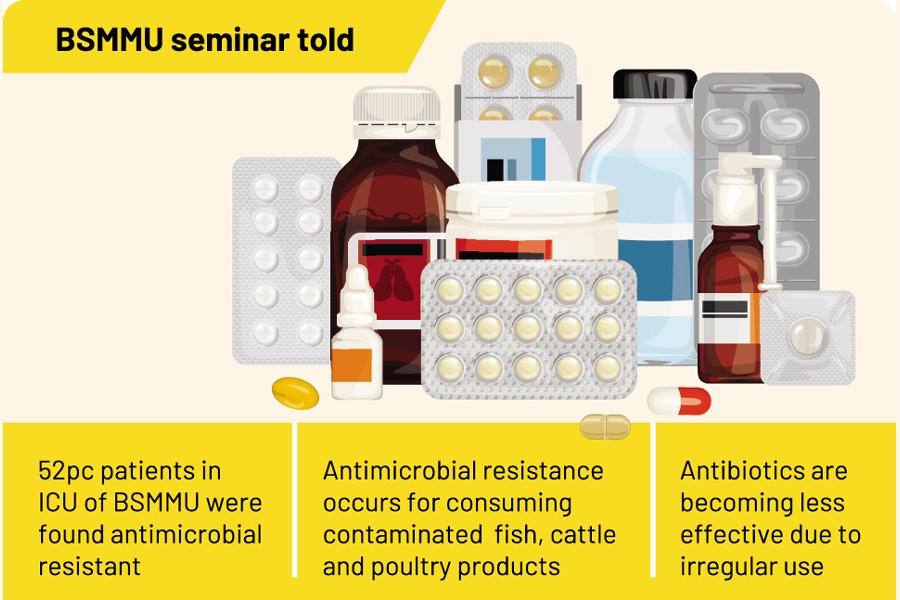
Uncontrolled use of antibiotics has made so many types of the life-saving medicine incapable of fighting severe bacterial diseases, thus necessitating strict policy to stop its indiscriminate intake for both humans and animals.
Irregular and indiscriminate use of antibiotics has led to a worrying situation in which as many as 52 per cent patients in the intensive care unit (ICU) of Bangabandhu Sheikh Mujib Medical University (BSMMU) were found to have developed antimicrobial resistance.
This resistance occurs not only because of human consumption but also because of consuming contaminated fish, cattle, poultry products, etc.
Health and medicine specialists said those at a seminar titled "Antimicrobial Stewardship" held at BSMMU in the city on Sunday.
Associate Professor Dr Shaheda Anwar, Dr Nazmul Hasan and Dr Zahidul Islam presented three separate articles on antibiotics at the seminar.
BSMMU Vice-Chancellor Prof Dr Md Sharfuddin Ahmed addressing the seminar as the chief guest said the matter of concern is that the reserve antibiotics kept in the ICU such as Meropenem is not working in the patients.
"We must prevent the misuse of antibiotics and raise awareness," he underlined.
"If this is not implemented (stopping misuse of antibiotics) by the year 2050, human bodies will become resistant to antibiotics and twice as many people will die from the coronavirus," he cautioned.
"So, we have to ensure that no one can buy and sell antibiotics without consulting a doctor," he warned.
Dr Zahidul Islam, in his paper, said 52 per cent of patients were found to have become antimicrobial resistant in the ICU of BSMMU.
The rate was 21.5 per cent among the patients of cardiac, renal, pediatric and neonatal departments, he added.
At present, the annual death rate of patients suffering from antimicrobial resistance is 700,000 in the world.
By the year 2050, the World Health Organization has predicted that the death rate will rise to 10 million.
Preventing antimicrobial resistance is not possible for doctors alone as 55 per cent of food products produced in the poultry industry, especially chicken meat, are infected with antibiotic resistance bacteria, Dr Islam said.
A total of 19 types of antibiotics are used in the fish, animal and poultry industries, he added.
The agricultural sector is also not exempt from its apprehension.
Human body easily becomes resistant to antibiotics for consuming these foods. As a result, the disease is not cured by taking antibiotics.
As a result, patients die even after taking life-saving antibiotics, the health specialist warned.
Meanwhile, around $20 billion is spent as additional money for patients worldwide for the irregular use of medicines.
WHO fears that this cost will reach $100 trillion by 2050.
Dr Shaheda Anwar said Antimicrobial Stewardship Programme has been launched in hospitals of developed countries.
BSMMU also needs to start this programme as soon as possible, Dr Anwar added, saying, "If we can successfully introduce it, it will be possible to reduce in-hospital patient mortality rate, length of patients' stay in hospital and the tendency to develop antibiotic resistance."
For this, it is necessary to identify the pathogen and determine the effectiveness of the antibiotic and apply the correct antibiotic.
"Proper use of antibiotics must be ensured. Because there will be no new antibiotics in the market in the near future," Dr Anwar warned.
Dr Md Nazmul Hasan in the article entitled 'Rational Use of Antibiotics: Clinicians' Role in Antimicrobial Stewardship', emphasised banning the use of antibiotics in animal husbandry and agriculture.
nsrafsanju@gmail.com