
Understanding sustainable consumption and production
Shahabuddin Rajon | Sunday, 5 April 2015
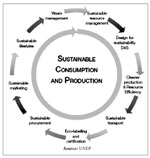
Sustainable consumption and production (SCP) is about promoting resource and energy efficiency, sustainable infrastructure and providing access to basic services, green and decent jobs and a better quality of life for all. Implementation of SCP as an integrated approach helps achieve overall development plans, reduce future economic, environmental and social costs, strengthen economic competitiveness and reduce poverty.
The SCP is defined as "the use of services and related products, which respond to basic needs and bring a better quality of life while minimising the use of natural resources and toxic materials as well as the emission of waste and pollutants over the life cycle of the service or product so as not to jeopardise the needs of future generations," according to the Norwegian Ministry of Environment, Oslo Symposium, 1994.
The SCP is aimed at "doing more and better with less," increasing net welfare gains from economic activities by reducing resource use, degradation and pollution along the whole lifecycle, while increasing quality of life. This change towards SCP involves different stakeholders, including business, consumers, policy makers, researchers, scientists, retailers, media and development cooperation agencies, among others. It requires a systemic approach and cooperation among actors operating in the supply chain, from producer to final consumer. It involves engaging consumers through awareness-raising and education on sustainable consumption and lifestyles, providing consumers with adequate information through standards and labels and engaging in sustainable public procurement, among others.
Sustainable consumption has been recognised as an integral element of sustainable development and an issue of paramount importance. The UN Conference on the Environment and Development held in Rio de Janeiro in 1992 recognised sustainable consumption and production as an overarching theme to link environmental and developmental challenges. The Agenda 21 states that the major cause of the continued deterioration of the global environment is the unsustainable patterns of consumption and production. Ten years later in 2002 world leaders signed the Johannesburg Plan of Implementation at the World Summit on Sustainable Development (WSSD). Chapter 3 of the Plan was devoted to "Changing Unsustainable Patterns of Consumption and Production" and declared that "fundamental changes in the way societies produce and consume are indispensable for achieving global sustainable development. All countries should promote sustainable consumption and production patterns." In 2012 at the UN Conference on Sustainable Development (Rio +20) countries recognised that fundamental changes in the way societies consume and produce are indispensable for achieving global sustainable development and adopted the 10-year framework of programmes on sustainable consumption and production patterns.
The SCP is an overarching objective of and an essential requirement for sustainable development, as recognised in the Johannesburg Plan of Implementation (JPOI) of the World Summit on Sustainable Development in 2002. That Summit called on all stakeholders to "encourage and promote the development of a 10-year framework of programmes (10YFP) in support of regional and national initiatives to accelerate the shift towards sustainable consumption and production to promote social and economic development within the carrying capacity of ecosystems by addressing and, where appropriate, delinking economic growth and environmental degradation through improving efficiency and sustainability in the use of resources and production processes and reducing resource degradation, pollution and waste."
During the last two decades, much progress had been made towards sustainable consumption and production, following action by governments and a wide range of other stakeholders. For example, the Marrakech Process - a bottom-up multi-stakeholder process-was launched in 2003 in order to respond to the JPOI call. It identified regional SCP needs and priorities, and supported the development of regional SCP strategies and the implementation of 70 SCP initiatives worldwide, including many national SCP policies and action plans. Capacity building, training and SCP tool kits in the areas of sustainable procurement, tourism, buildings and construction, products, education and lifestyles, as well as various communications tools and awareness raising activities have also been undertaken.
Businesses and civil society have also been shown to be dynamic actors in the promotion of SCP. Indeed, many information-based policies and schemes are voluntary and based on principles of corporate social and environmental responsibility (CSER). An increasing number of businesses have implemented resource efficiency, safer and cleaner production and environmental management programmes. Similarly, civil society and worldwide civil society organisations are important channels for informing, training, enabling and empowering citizens.
The Global Outlook on Sustainable Consumption and Production Policies provides a non-exhaustive review policy and initiatives that are promoting the shift towards SCP patterns. It is illustrated by 56 case studies ranging from global multilateral agreements and regional strategies to specific policies and initiatives being implemented by governments, businesses and civil society organisations. The report shows that from Mauritius to Colombia, and from Indonesia to the Czech Republic, more than 20 countries have adopted national SCP strategies identifying key priorities, opportunities and action plans. Business and industry have engaged in a broad range of initiatives to reduce resource depletion and environmental impacts, promoting, for example, corporate social responsibility, sustainable value chains and innovation. Civil society organisations have played a tremendous role in promoting SCP, capacity building, as well as establishing effective eco-labeling and certification schemes to ensure wiser consumer choices.
UNEP works to promote resource efficiency and SCP in both developed and developing countries. The focus is on achieving increased understanding and implementation by public and private decision makers, as well as civil society, of policies and action for resource efficiency and sustainable consumption and production. This includes the promotion of sustainable resource management in a life cycle perspective for goods and services.
International scientific assessments, such as the Millennium Ecosystem Assessment, the Global Environmental Outlook and the 4th Assessment Report of the Intergovernmental Panel on Climate Change, make it increasingly evident the world cannot achieve sustainable economic growth without significant innovation on both supply (production) and demand (consumption) sides of the market.
Decoupling economic growth from resource use and environmental degradation and creating the 'space' for poor people to meet their basic needs will require producers to change design, production, processes and marketing activities. Consumers will also need to accommodate environmental and social concerns - in addition to price, convenience and quality - in their consumption decisions.
Economic growth and the development and human welfare gains, it contributes to, cannot be sustained with current consumption and production patterns. At the same time, a large share of the world population is still consuming too little to meet even their basic needs. Responding to this dual challenge will require a combination of new policies, redirected investment, application of environmentally sound technologies, international cooperation, and capacity building to reshape national economies as well as the global economy. UNEP is well positioned to facilitate and accelerate the shift to more resource efficient and sustainable consumption and production patterns. UNEP is building on its existing mandates, securing more synergies within the organisation itself, and strengthening and extending partnerships with a broad range of public and private institutions and stakeholders.
A key approach to resource efficiency is the life cycle perspective. By reducing the environmental impact of goods and services at every stage, from raw material extraction and transportation to manufacturing, distribution, use and disposal, we can achieve more wellbeing with less material consumption. This enhances our potential to meet human needs while respecting the ecological carrying capacity of the Earth.
Information about the environmental and social impacts of processes and products helps identify what needs to be improved to make products more sustainable. To be meaningful in achieving an overall improvement, such information needs to be properly quantified based on life-cycle assessment with the aim of avoiding burden shifting - seemingly solving one problem while creating another - which may happen from one stage of a life cycle to another, from one region to another or from one environmental impact area to another.
The product's life cycle information brings benefits across the whole value chain in terms of resource efficiency gains, reduction of production costs, manageability of the chain, trustful relation with suppliers, credibility of the brand and company reputation along with environmental and social improvements.
So this information is of immense value if we want to know where to move and how to do it in the transition to more sustainable models of development. But this value depends on the degree of its availability to decision-makers (governments, businesses and consumers) in a format that is understandable to them.
The writer is Assistant Secretary of BKMEA and also works at the Green Industry Development Cell.
rajonbkmea@gmail.com