
Uniform tax rate for all cigarettes to boost revenue, discourage smoking
Hisham Uddin Khan | Wednesday, 21 May 2014
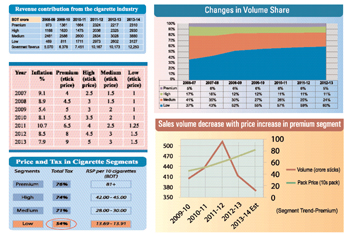
When we talk over the contribution of tobacco industry, more than 95% of its revenue comes from the cigarette industry. In the fiscal year 2013-2014, this industry contributed around 29.71 %( estimated) to the national internal revenue. In UK the total share of government revenue from this sector is around 3% and for our neighbouring country Nepal it is around 5.4%. On the contrary in Bangladesh it has been more than 25% of the total internal revenue for the most part of the last decade. Unfortunately, the growth of the revenue share from this sector is almost stagnant given the immense untapped potential it has. So, the in light of the recent 'ambitious' budget for fiscal year 2013-2014, tapping into the potential of the cigarette industry to raise additional revenues should be a major concern for the government.
Cigarette taxation trends: The cigarette tax structure in Bangladesh is complex, with a tiered structure which imposes different ad valorem taxes based on retail price slabs. Low brands are taxed at much lower rate (at 54%) than higher brands (up to 76%) where the real retail prices of the low brands are not considered.
Back in 2007, cigarettes in low segment were available at 1 taka per stick whereas now the low segment's products are sold at 1.5 per stick. On the other hand, the prices have considerably increased in premium and high segment. In premium segment it has gone up from taka 4 to taka 9 and in high segment it has increased from 2.5 taka to 5 per stick. The price of premium segment is almost 6 times as much as the price of low segment.
This gives fuel to the down trading of the consumers and huge revenue loss for government. The value share from premium segment is 20% though their volume share is only 5%. Same scenario can be noticed in high segment where value share is twice as much as the volume share. But in low segment the volume is almost 60% but excise revenue contribution is intensely low .The value share of the low segment is about 28%.This has been caused by massive down trading of consumers to lower brands over years. Surprisingly during the years of 2007 to 2010 there was no price increase in low segment so the real price has fallen due to inflation of these four years. On the other hand, prices in all other segments have increased more than the inflation of that year.
Cigarette taxation of Bangladesh fails to meet global standard and address health issues: An estimated 57 000 number of people die each year from tobacco use and this number is going to rise due to the availability of cheap brands in our country. The solution to the health hazards is also embedded in the proper taxation of cigarettes. It is a proven fact that, price increase in the low segment significantly reduces the consumption amount. But in our country we have been focusing on increasing the price and tax of upper segments which is ineffective to reduce cigarette consumption.
"It is the retail price of cigarettes that affects the consumption decision of smokers, not the share of tax in the retail prices"- Source: Tobacco Policies on Tobacco Products in Thailand: the Way Forward (2011)
To address this particular issue couple of days back the "Sommilito Tamak Birodhi Jot" organized a press briefing where they urged the government to increase price and tax in low segment. It is matter of concern that where nothing is affordable by 1.5 taka in our country but only cigarettes are available for the same or even less rate than that. In recent years price of all food products and necessities of livelihood have increased except the cigarette products in low segments. WHO( World Health Organization) advised a total tax of 70% in every segment which is properly maintained in medium, high and premium segments for our cigarette industry except in the low segment. In low segment the total tax is only 54% and the price is only 1.5 taka per stick which is appalling given that almost every year the prices of premium and high brands are increased ignoring the retail price of low brand cigarettes.
Current price indexing gap leads to down-trading and impedes sustainable revenue inflow: There are two very evident anomalies in the industry. One is the price indexing gap and the other is corresponding contribution from each segments. The volume leader which is the low segment is failing the government every year in terms of value share. Also the widening price indexing gap is causing rapid down trading in the market as the major concern. Eventually, the cigarette industry will not be able to give us any significant return. As it's always easier to move to a cheaper brand in the market than to quit smoking the consumers take that path. When consumers trade down to lower segments they pay lesser taxes to the govt. upon consumption. In Bangladesh the market share of low segments has been increasing due to the increases of excise duty and price per stick in upper tiers.
With these one sided price increases, the premium segment has been marginalized and showing the signs of decline. The prices of premium brand cigarettes are so high that if it continues this segment will not generate any further revenue growth in near future. It is matter of fact that, back in 2006-07 the cigarettes of different brands were available at 1.5 taka per stick and even in our present year in 2014 we can get the cigarettes at the same price in the market. Irrational price indexing gap has already decresed the government revenue. The government needs to create avenues to milk the low segmet which is 60% percent of the industry by assigning appropriate pricing and exicse measurers.
On the other hand if the price indexing gap of the year 2007 continued upto 2013 then low segment's volume share would have been around 37% . Their value share in the industry would be around 27%. This way even medium segment would have been able to contribute more revenue. The value share for the medium segment would have changed to 38% from the current 28%. All of the upper segments would have grown in both value and volume share of the market if the prices of all segments grew just like the price of premium did. Most importantly, from the existing cigarette industry government would have earned an extra amount of around 5000-6000 crore taka every year.
If government had increased the price and tax of low segment every year then the smokers would have shifted to better quality of cigarette products. Then the manufacturers would have spent more on the quality of the cigarettes in low segments. It would have eventually benefited the consumers. Also overall smoking incidence would have declined .The developed countries such as New Zealand have taken stern policy measures to encourage up trading of the consumers by increasing retail prices of cheaper cigarettes.
Modification of cigarette tax policies and prices for sustainable revenue inflow for the government: The current tax structure that applies different ad-valorem taxes to cigarettes result in very low prices for some cigarette brands and very large differences in prices between high and low priced brands. Government should eliminate the differential taxation of cigarettes based on price slabs and apply a uniform tax rate to all cigarettes. The uniform tax rate that would be the most effective in earning more revenue as well as reduce health hazard is 70% which is also proposed by WHO. This would reduce the price indexing gap and stop the massive down trading of the consumers. The current structure and slabs of cigarette is very complex and create more complications for the administrators. Most of the developed countries have adopted fewer slabs for the cigarette taxation structure to avoid complexity and bring more simplification to the system. Moreover, those countries and even some of the developing countries now have adopted progressive taxation policy for their non-desirable products. Similarly in Bangladesh, we should adopt this approach for the most popular non-desirable products in the market, which is the low segment cigarette brands.
Studies show that with every 1 taka increase in 10's pack price for the LOW segment cigarettes (even at the current 54% tax), government can potentially earn an additional BDT 3.0 billion.
If we increase stick price of LOW segment cigarettes to taka 2.00 from current price of taka 1.5 (33% increase in stick price) the minimum price of 10's pack would be BDT 18.00. This 31% increase in pack price will increase govt. revenue to a minimum of BDT 1,600 crore from this segment only.
Government should also consider putting a base price on cigarettes below which no cigarette should be available. Such solutions will reduce the economic burden caused by smoking in Bangladesh while increasing government revenue. In addition to those, a structural change of moving towards same specific tax in tobacco taxation also brings sustainable revenue inflow. Countries such as Philippines and Indonesia have also changed their tax structure to specific tax and they have earned 28% and 38% more respectively than their base years before change. Those countries are maximizing the potential from their industry with the sustainable inflow in government revenue. It's time our government takes proper measures in changing the taxation in cigarette industry in this fiscal year for our own economic and social benefits.
...............................................................
email: hishamuddinkhan@gmail.com