
Emerging US-BD trade deal ramifications
US buyers begin recalibrating apparel sourcing strategies
Textile, apparel-specific provisions in special consideration, attuned to tariff, geopolitical tensions
MONIRA MUNNI | Sunday, 19 April 2026
American buyers are carefully monitoring the newly negotiated US trade agreement with Bangladesh, especially its textile -and apparel-specific provisions, to recalibrate their apparel- sourcing strategies amid tariff and geopolitical tensions, a new study reveals.
The Agreement on Reciprocal Tariff between Bangladesh and the United States, signed on February 09, reduces the reciprocal tariffs imposed on Bangladeshi products on the US market from 20 per cent to 19 per cent.
It also introduces duty-free facilities for using American inputs. Garment produced from cotton and man-made fibres imported from the United States will not be subject to any reciprocal tariff whatsoever.
According to the study findings, US fashion companies identified shifting consumer demand, macroeconomic volatility, tariff hikes, and ongoing policy uncertainty as their main business concerns.
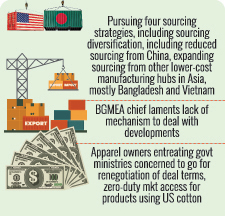
It also reveals that they are following four sourcing strategies-continuing sourcing diversification, including reducing sourcing from China, expanding sourcing from other lower-cost manufacturing hubs in Asia, mostly Bangladesh and Vietnam, and exploring near-shoring opportunities in Mexico and Central America and taking advantage of lower-tariff benefits.
One of the four sourcing strategies that stand out is "Carefully monitor newly negotiated trade agreements with the US, especially those with textile and apparel-specific provisions, such as the one with Bangladesh."
Meanwhile, many companies note that full sourcing realignment takes 12-18 months or more, according to the report conducted by Sheng Lu, professor, Department of Fashion and Apparel Studies, the University of Delaware.
This study examines US fashion companies' evolving apparel sourcing and business practices in response to a shifting business environment, including ongoing rising tariffs and geopolitical tensions. The study has been conducted on available data, transcripts of the latest earnings calls held between February and April 2026 from about 30 leading publicly traded US fashion companies.
As an example of sourcing strategies, it has cited Kontoor Brands as saying: "Of particular interest to us is the trade agreement with Bangladesh, which we highlighted. That trade agreement reflected a potential reciprocal tariff ranging from zero to 19 per cent, depending on the US-grown cotton content of products sourced from Bangladesh."
It says more than 80 per cent of the products Kontoor Brands source from Bangladesh does include US-grown cotton, adding that "Bangladesh is our largest country of origin from a sourcing perspective, so by nature, it's also our largest source of tariff pressure.
It quoted Gildan as saying "We are pleased to announce that we are moving forward with phase two of our Bangladesh complex. Over the next 18 months, we will begin construction of our second large-scale textile facility, with initial production expected to come online in the later part of 2027. Expanding our Bangladesh footprint is central to reinforcing our cost leadership in ring spin and innerwear"
The buyer also says they are increasing their internal capacity in Bangladesh and in Central America, "obviously in anticipation to support the Hanes integration."
Quoting Land's end, the study says, "Our teams just got back from a sourcing trip in India with one of our major airline partners, and they couldn't be happier about the breadth that we're able to offer, and the opportunity that we're creating for their employees."
As their broader mitigating actions take shape, country of origin shifts. "You'll start to see those all come into play as we move through fiscal 2027," says Ralph Lauren.
Asked about the latest developments concerning the country's largest export sector, Bangladesh Garment Manufacturers and Exporters Association (BGMEA) president Mahmud Hasan Khan said a mechanism must be developed to determine the use of US cotton in garment produced here in Bangladesh and exported to the US.
"But no such mechanism we have received yet from the concerned authority," he rues.
Talking to the FE, Shovon Islam, managing director of Sparrow Group, said buyers are looking into the issue their own way though the speed was much higher before the Middle East war, US high court verdict on tariff imposition while US launched new investigation.
"The situation becomes uncertain due to all of those factors," he notes, adding that both buyers and suppliers are working together.
He, however, says they (local manufacturers) are pushing government authorities, including commerce and foreign ministries, to renegotiate for zero-rated duty-no reciprocal and existing duty-on garment produced using US cotton.
Munni_fe@yahoo.com