
Unforeseen worries on trade front
US imposes restrictions on ACU payment
FE REPORT | Tuesday, 26 September 2023
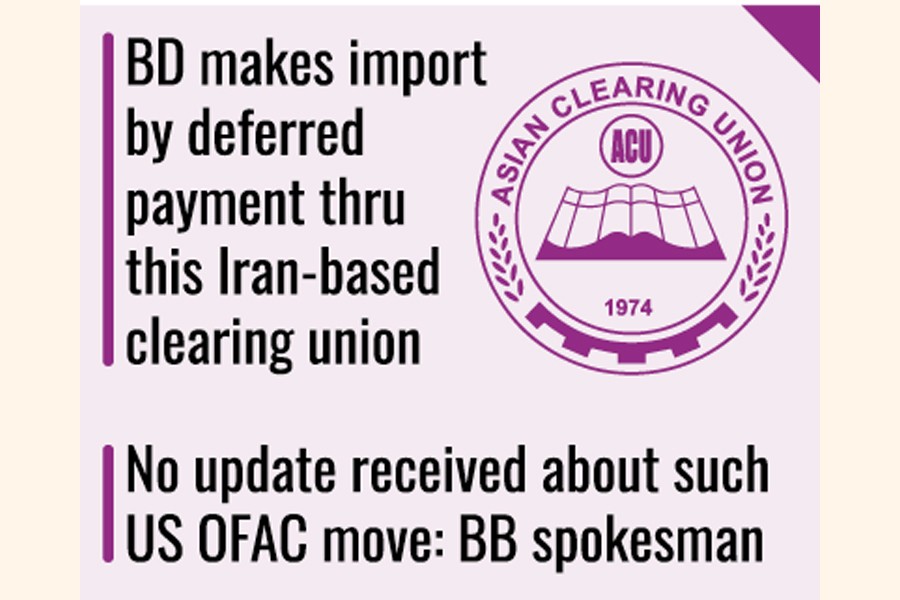
An oncoming problem on trade front is feared from a reported US restrictions on processing payments linked to the Asian Clearing Union (ACU) through which Bangladesh also settles deferred import payments.
According to Indian media report, the US Office of Foreign Assets Control (OFAC) under the US Department of The Treasury asked banks there to refrain from processing payments linked to the ACU mechanism.
Following the OFAC directive, Indian banks have reached out to the Indian central bank-Reserve Bank of India (RBI)--for its guidance as it instructs banks in the United States to cease processing payments associated with the ACU arrangement, says The Economic Times (ET) report.
The ACU is a trade-related payment mechanism established in 1974 to enable regional cooperation, economise on foreign-exchange reserves, and promote trade among its members.
Its member-countries are India, Bangladesh, Bhutan, Iran, the Maldives, Myanmar, Nepal, Pakistan and Sri Lanka.
The report says the advisory from the US Financial Intelligence Agency could have "significant implications for India's trade settlements with ACU-member countries, particularly Bangladesh and Iran".
The report also states that India controls nearly 93 per cent of ACU's credit positions.
Earlier this month, Indian lenders sought RBI intervention as regards clarity and solutions for payment processing without an alternative mechanism for settling trade with ACU members.
Under the current ACU arrangement, the participants are authorised to settle transactions either in US dollar or European Union's euro.
Bangladesh Bank, the country's central bank, clears US$1.0 billion- plus ACU liabilities every two months.
When contacted about the matter, BB spokesperson Md Mezbaul Haque said they had not received any update about such OFAC move yet. "Once we receive, we will be able to make comment regarding the matter," he added.
"If it (the OFAC embargo) is true, it will cause additional problem under the current macroeconomic situation," says another BB official, who prefers not to be quoted by name.
Talking to the FE on the riddle, former lead economist at World Bank's Dhaka office Dr Zahid Hussain said the development, if true, would be a major headache to India, which controls major share of trade through ACU system.
The economist thinks it will not create any major pains for the economy as Bangladesh now pays ACU liabilities involving US$ 1.0 billion-plus each two months and that it can be paid in euro from BB's non-US overseas accounts receivables.
"If the BB does not have enough stock of euro, it can instruct the Federal Reserve (of US) to transfer required dollars into its accounts held with central banks in European countries through which the payments can be settled," Dr Hussain says about the byways.
But executive director of the Policy Research Institute of Bangladesh (PRI) Dr Ahsan H. Mansur says different. He says the US move possibly comes against ACU which is headquartered in Iran, a sanctioned US rival.
"As Bangladesh has been using the ACU platform quite a bit, it will certainly cause extra burden to the economy in the form of creating fresh complexities in its trade-payment procedure," he says about the possible fallout from the taboo.
About the possible option for settling ACU liabilities through non-US accounts, the eminent economist mentions that countries in the European Union generally follow the actions taken by the United States when it comes to the issue of sanctions.
The news of trade-payment sanctions comes close on the heels of concerns over the US visa restrictions on Bangladesh individuals, and institutions and select media outlets overt the issue of elections in Bangladesh.
jubairfe1980@gmail.com