
US misses an opportunity to ease tensions with China
David Gordon writing for Reuters | Sunday, 13 July 2014
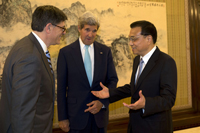
The US Secretary of State John Kerry and Treasury Secretary Jacob Lew travelled to Beijing last week (July 09-10, 2014) and for the annual Strategic and Economic Dialogue (S&ED), at a time when U.S.-China tensions are running higher than at any point in the past decade. Though each country's bureaucrats were able to put on a good face and paper over significant disagreements, they were unable to make progress on any major security or economic issue.
Unfortunately, the U.S. administration passed up a chance to advance and elevate the U.S.-China Bilateral Investment Treaty (BIT), an agreement that sets the rules of the road for cross-border investment. Doing so could have yielded major economic benefits and had positive spillover effects on the strategic issues vexing both countries. But now, with little for the two sides to hang their hats on, the relationship is ripe for more tension.
A year ago, when President Barack Obama met with new Chinese President Xi Jinping at the Sunnylands Ranch in California, the two laid out an ambitious agenda, agreeing to discuss contentious cyber issues, the need to increase pressure on North Korea, and more broadly chart a positive course for the world's most important bilateral relationship.
Since the earlier summit, however, a number of issues have set back relations. Increased Japan-China acrimony in the East China Sea, an aggressive Chinese move to set up oil rigs in disputed waters off Vietnam, and the Edward Snowden espionage revelations have set teeth on edge in Washington and Beijing.
On the economic side, U.S. indictments of Chinese military hackers, a series of ongoing trade disputes, the recent weakening of China's currency and continued restrictions on foreign investors have each threatened to undermine the countries' $500-billion-a-year commercial relationship. While the United States continues to describe relations with China as a delicate balance between cooperation and competition, China looks at the United States through a darker lens, convinced that America is determined to "contain" its rise.
At this year's dialogue, the Obama administration passed up a big opportunity to make progress on the BIT. At the opening ceremony, Xi publicly expressed interest in "speeding up" talks on the treaty, but from the final communique it is clear that the U.S. side did not take up his offer.
So, why is the treaty important? Each country would have to treat most foreign business ventures as if they came from home. China could no longer subject U.S. companies to technology-transfer mandates that force them to hand over trade secrets as a price of doing business in the country. Chinese state-owned enterprises would be restricted in their ability to use the government to boost their competitiveness. U.S. firms would be allowed to invest more in sectors like insurance, telecom and banking, which were previously highly restricted to foreigners. They could for the first time seek legal recourse through independent international arbitration. The Chinese economy would benefit from the BIT - both by making U.S. investors more confident in their Chinese exposure, and by allowing more Chinese investment in the United States.
Treaty talks remain in the early stages because the Obama administration, it appears, does not want to seem too eager to either engage China or reward the Chinese for bad behaviour. But slow-rolling the BIT will reinforce the view of many in China that the only real U.S. economic priority in Asia is the Trans-Pacific Partnership, a deal that China has not been asked to join and which it sees as part of a U.S. containment strategy.
At the S&ED, the administration should have pushed to conclude the BIT before President Obama leaves the White House. Such a commitment would have sent a strong signal that Obama remains serious about his statement at Sunnylands that - despite the tension surrounding regional maritime claims, currency manipulation and corporate espionage - the U.S. has a real stake in China's success.
Progress on the BIT will not make regional tensions disappear. Security issues will remain strained as the United States continues to stand strong on maritime issues, a matter of critical importance to America's treaty-bound allies Japan, South Korea, the Philippines and Australia. By demonstrating resolve in the face of Chinese maritime aggression, U.S. security commitments decrease the odds of conflict. This stance, though, will inevitably strain U.S.-China relations.
Still, the BIT could take at least some of the bite out of a growing list of security challenges. It would be the first major agreement between the United States and China on any issue since the negotiations for China to gain World Trade Organisation (WTO) membership ended in 2001. During the Cold War, the United States and Soviet Union came to major agreements on a variety of strategic and economic issues, providing an important safety valve for the relationship. Passage of the BIT would help the USA and China create a habit of dealing with difficult issues in a workmanlike way. A major economic breakthrough is more likely to soften Beijing's territorial assertiveness than holding back on an agreement that would benefit both countries.
David Gordon is Chairman and Head of Research at Eurasia Group and former Director of Policy Planning at the U.S. State Department.