
US report sees human rights situation in BD 'stable'
FE REPORT | Thursday, 14 August 2025
After years of grim assessments, the United States' annual human-rights review has described as ‘stable’ the human-rights situation in Bangladesh following the fall of the previous government, though it noted isolated incidents in August 2024 and lingering concerns. 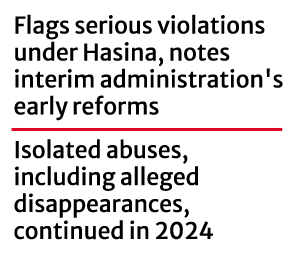 The 2024 'Country Report on Human Rights Practices' credited the interim government, led by Prof Muhammad Yunus, with taking steps to address entrenched abuses, but catalogued a litany of violations under former Prime Minister Sheikh Hasina's rule until her flight from the country on August 5.
Between January and August 2024, the report found, authorities engaged in arbitrary killings, enforced disappearances, torture, transnational repression, and severe curbs on free expression and press freedom.
Other abuses during Hasina's tenure included degrading treatment, arbitrary detention, threats or violence against journalists, censorship, restrictions on union activity, attacks on labour organisers, and the persistence of the worst forms of child labour.
The document noted that the previous administration "granted widespread impunity" to security forces, with minimal efforts to identify or punish perpetrators.
Under the current administration, however, "many individuals accused of human rights violations during the former regime have been taken into custody," the report said.
It commended the government for working with the United Nations to prosecute offenders through both Bangladesh's judiciary and the International Crimes Tribunal.
The report also highlighted documented abuses by the Chhatra League in July and August 2024, based on "credible" findings from rights groups and media outlets.
The 2023 report had found "no significant changes" in Bangladesh's rights record, listing political prisoners, transnational repression, arbitrary interference with privacy, and collective punishment of relatives among ongoing issues.
This year's edition welcomed the interim government's move to withdraw over 1,000 cases filed under the Cyber Security Act 2023 and its defunct predecessor, the Digital Security Act 2018.
The Yunus administration also reopened many of the 191 news websites shut down in 2023 and oversaw a marked improvement in media freedom, despite revoking accreditation for 167 journalists linked to the former ruling party, a move that restricted their access to ministries.
Four prominent journalists seen as sympathetic to Hasina -- Farzana Rupa, Shakil Ahmed, Mozammel Babu, and Shyamal Dutta -- were arrested in August and September last, alongside more than two dozen others accused of crimes against humanity and genocide during mass protests.
While one alleged enforced disappearance was reported under the interim government, the US acknowledged progress in curbing extrajudicial killings and in opening space for public dissent, though several cases of violence against labour activists and investigations into protest-related charges remain unresolved.
smunima@yahoo.com