
VAT on superstore sales: Why it doesn\\\'t make sense
Sunday, 23 February 2014
The National Board of Revenue (NBR) has recently reduced VAT on superstore sales from 4.0 per cent to 2.0 per cent. But the businessmen are not satisfied and they demand package VAT arrangement on superstores. While the general perception is that whatever measures the government may take, it fails in most of the cases to satisfy the demands of businessmen, our concern is why government should impose such VAT on superstore sales. Why doesn't the government waive such VAT on superstores? We argue that the government should rescind the 2.0 per cent VAT on superstore sales and give as much assistance to businessmen so that this sector flourishes in the country.
Many may, however, argue that imposition of 2.0 per cent tax is justified given the composition of buyers who shop in the superstores. Such an argument supports taxing the wealthy people who go to superstores to shop as a welfare-oriented policy. Such taxing-based symmetric argument that may apply in other cases may not apply to superstore sales, especially in our country. In this article we will show why cancelling even 2.0 per cent VAT would be justified and why it would benefit the
country.
SUPERSTORE SALES AND FORMALIN PROBLEM: Formalin problem is a time-bound demand problem. In other words, it springs from time-bound demand pattern. When demand follows the time-bound demand pattern, the conventional atomistic perfectly competitive market structure can't survive and market must make the transition; otherwise, it will definitely malfunction. The best example of such malfunctioning market is the widespread use of formalin.
In fact, contradictorily, we can justify the use of formalin in our country taking into consideration the time-bound demand pattern. A very erroneous belief is that formalin problem is a result of dishonest practice of businessmen. One may be tempted to describe such widespread use of formalin as a total dishonest practice of businessmen. But why wasn't the use of formalin in our country so widespread 15 to 20 years ago? Why are all the products that are sold by a small and tiny vendor in our country are also sold in developed countries, for example, in the USA, in superstores such as Walmart, King Shoopers, etc.?
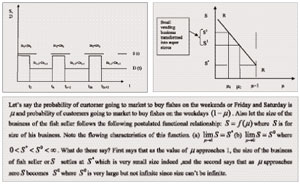
To make the argument clear and lucid, we will draw upon how size of business grows over time due to time-bound demand pattern and why small vendor-based sales of products in our economy can't sustain in the market. Let's assume that one person sells fish in small vending carts in Dhaka city and meets most of his customers on the weekends such as Friday and Saturday. Now we depict this argument in graphical term in the following way:
In the above figure, Supply (S) and Demand (D) are measured on the vertical axis and time on the horizontal axis which is weekly basis. Time (t2) measures the day in which the seller meets his desired number of customers so that his supply is equal to demand in market, and in the rest of the days he has less than desired number of customers. This depiction shows that supply is fixed but the demand fluctuates around it. The interval of time in which demand falls much below the supply denoted by (Stn-2>Dtn-2) is the vulnerable region that encourages the use of formalin in fishes. Such fluctuating demand pattern is the core reason of the widespread use of formalin.
Given such fluctuating demand pattern, we can formulate a rough estimate of probability of the fish seller's meeting customer in the market. The illustration is given the following box:
If we draw a graphical view of the above functional relationship between size and µ, we find the following picture:
In the above figure, µ is measured off in the horizontal axis and size(S) on the vertical axis. The negatively slop inclined drawn curve RR shows that as the value of µ increases, the size of the business of fish seller decreases and as it decreases, size increases. In above graph, when µ is one, S is equal to S0. As µ reduces and becomes µ1 and µ2 respectively, S becomes S1 and S2. The interesting feature is that when µ reduces to µ1 and µ2 respectively, the small vending business is transformed into superstore or department store. But what will happen if S doesn't increase in size as µ reduces to µ1 and µ2 and S remains fixed at S0? The result is malfunctioning of market and as a consequence formalin problem will crop up.
Now, the question arises what is the lesson of such analysis? The critical insight we get from such analysis is that market must transform over the time to superstore-based sales of those products that are now sold in small vending shops. If our market fails to achieve such transition over the time, a lot of troubles will emerge and we are already experiencing one such problem - the formalin problem.
Coming to the issue of VAT, imposing any VAT on superstore-based selling of products at such initial stage is apparently counterproductive. What we need is that we just help the economy to make the proper transition to superstores so that over the time such superstore-based selling of products can reach to even small income groups. Such a scheme is not unrealistic. Businessmen will find their target customers given their own discretion and target market analysis, and government just needs to offer them support - by not imposing VAT on them so that prices of products become comparable to the prices offered in small vending shops. Indeed, one can see the fallacy of the comparable prices here also. Because, if one includes all the indirect costs such as health hazards, then superstores' prices are worthy to avail. Those who will advance argument advocating that all upper class people shop in superstores and taxing such wealthy people is justified, they should also try to give a comparable picture of the welfare effect of taxing wealthy people and the welfare effect of giving the market a room to make proper transition over the time. Without going into formal analysis, it can at least be argued that in any terms the welfare benefits achieved from the latter will outweigh the welfare benefits achieved by taxing wealthy shoppers in superstores. In other words, taking care of all these calculations, VAT can't be justified at this initial stage of transition in market structure.
JUST PRICE AND SUPERSTORES: Recently we have seen many reports in the newspapers on slump in potato prices, and some also have put forward suggestions on how to overcome such problems in the future. Even given such horrible market situation in which farmers, who toiled the most to bring potatoes in market, do not get the just price, the action of the NBR seems totally ridiculous.
One of the cures for such slump in potato prices can be the widespread development of superstores. Superstores would strengthen the supply chain management in terms of structured procurement and market delivery. It will ensure more efficient and effective operation of market economy. For example, superstores over the time will locate their target suppliers and will customise their demand imposing specific requirements on productions. This will strengthen the comparative bargaining power of farmers, and this will encourage large-scale operations increasing the size of farming scale. Moreover, such superstores will operate in a monopolistically competitive market environment in which each will seek its own target customers and target suppliers according to its differentiated preferences. Such heterogeneous preferences will replace the current homogeneous preferences and will create diverse markets and niches for each superstore owner with distinct set of suppliers and distinct set of customers with distinct preferences. From such perspective also, the imposition of VAT on superstores doesn't seem to be justified. Rather, the removal of such VAT would help to broaden the base of the development of this new market structure and the customer base with proper market segmentations.
CONCLUSION: The essence of the above analysis is that NBR should rescind even the current 2.0 per cent VAT on superstore sales and government should try to give as much incentives as possible to this sector so that it can flourish and create a broad customer base in the country. Today or tomorrow our economy has to make the transition to department store- or superstore-based selling of products and such transition is inevitable. Moreover, current economic structure is such that we badly need such transition to correct the existing malfunctioning market. So, the removal of VAT on superstores would not only give incentive to entrepreneurs to undertake such initiatives broadening the base of their customers and devising proper market strategy and segmentations, but also create a diversified market giving rise to differentiated preferences and pricing policies which will ultimately strengthen the comparative bargaining power of our farmers.
Md Jamal Hossain writes from the University of Denver, USA.
jheco.du@gmail.com