
Vision Chittagong: A master plan for rebuilding the port city
Pankaj Dastider | Sunday, 30 November 2014
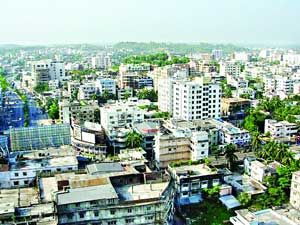
Remove the Shishu Park (children's park) from in front of the Chittagong Circuit House and you find a thin portion of open green space. Keep the outer stadium as it is. Around the outer stadium there will be a city hall, library, and a museum where history, tradition, popular proverbs will be preserved. Life sketches of great people along with photographs will also be there.
And there will be an IT (Information Technology) Centre and relevant other structures.
There will be provisions for conjoining MA Aziz Stadium, CJKS (Chittagong Jila Krira Sangstha) auditorium, Railway CRB (Central Railway Building) Hills and Chittagong Club.
In all, there will be an area of 13 acres of land, without needing to acquire any land from private ownerships.
This city centre can grow up as a unique symbol of a new-look Chittagong. From the structures at the same place foreign tourists and our new generation can learn a lot and will be familiar with the history and tradition of thousand years of Chittagong.
This vast open space can also be a meeting ground of political and socio-cultural workers who will fight for actual development of Chittagong.
This is no fancy. This is how Adnan Morshed, a famous architect and city planner of Chittagong origin, now residing in the USA, narrated his vision about a beautiful Chittagong at a workshop in the port city in 2011.
A group of researchers, city planners and architects staying in America prepared such a vision of Chittagong. For this, in 2009, they designed a plan, styled Chittagong 2020, in the highest seat of education, The Catholic University of America in Washington, DC. The main initiator of the visionary project was Associate Professor of that University Adnan Morshed.
A group of 55 students and teachers of that University worked at a stretch for five months on the project. In 13 groups they collected data, documents of historic, economic and political importance from different areas of Chittagong for the first three months. For the rest two, they worked for designing a development plan for the port city.
Architect Adnan Morshed told the workshop of professionals, including journalists, three years back that they had held a Chittagong Fair with this research work on Chittagong in Washington in May 2009. Famous town planners and architects and also some investors were present at the fair. "The investors were ready to invest in the project as they realised that the returns on the investment will be huge," he said.
Every city of international standards has a symbol of its own through which people know it. Somewhere it is a fascinating historic structure, somewhere it is an open courtyard. Washington is known for its National Mall open courtyard. New York has Statue of Liberty, Italy has Colosseum, Delhi has India Gate and Kolkata has Victoria Park.
We need such a symbol for Chittagong. It can be a symbol of knowledge and learning. Either the government can provide funds for the scheme or it can be constructed on the PPP (public-private partnership) basis.
Chittagong has grown up from a small town of 4.50 square miles to a mega-city of 60 square miles in a span of 150 years. Chittagong City Corporation has already announced that it will be expanded to 120 square miles shortly. The process has also started, City Mayor M Manjur Alam said in his last budget speech.
A galaxy of 32 mayors, chairmen and administrators turned the city into its present status by degrees. It is called port city and commercial city. For the prime seaport they call it gateway to the east, Bangladesh's regional hub. The city will be broadened to 120 square miles incorporating Anwara and Patiya upazilas on the southwest and Hathazari upazila on the northeast.
With the population of the small town at 19, 000 in the beginning and growing of area and density its current population is about 6.00 million while it has expanded its service-oriented network. Among the thirty-two city fathers who have pioneered in shaping the city through ages is Mr JD Ward in 1863.
The city of 6 million people is administered by a body of 55 directly elected ward councillors -- women and men -- and elected mayor to steer the whole gamut of things.
Problems that bedevil this gateway are manifold, and multi-dimensional. The major problem is that it cannot provide even half of the services its citizens deserve because it is running in financial constraints. Its income is very limited but the responsibility to provide services to its people is much greater.
The CCC looks forward to the government not only for the money it needs to implement its projects but also for getting the projects approved by the government, be it funded by the government or the CCC itself.
City Mayor M Manjur Alam has undertaken short-, medium- and long-term plans for addressing water logging, traffic congestion, power generation, coal-based power generation, construction and repairing of roads and drains, bypass roads and footpath construction, education and health.
Water logging, the main problem of the city, remains unchanged and every year the people of the low-lying areas -- almost half of the total area -- suffer a lot during the rainy season.
Engineers and city planners opine that CCC has failed to address problems of the residents due to its faulty schemes. Failing absolutely to address the water-logging problem over the last two decades is a glaring example of how the city mayors have neglected one of the major woes of the city-dwellers. The CCC could solve the problem by digging a planned new canal from Bahaddarhat to the Karnaphuli River and checking indiscriminate hill cutting by influential persons.
Education is however an important sector of the CCC that is being successfully run as thousands of students come out successful from CCC's academic institutions ranging from primary schools to the highest seat of education -- University.