
Volatility, dollar crunch, inflation remain main cracks in economy
Says Dr Zahid Hossain, noting net reserves now below $18.6 billion
FE REPORT | Thursday, 5 October 2023
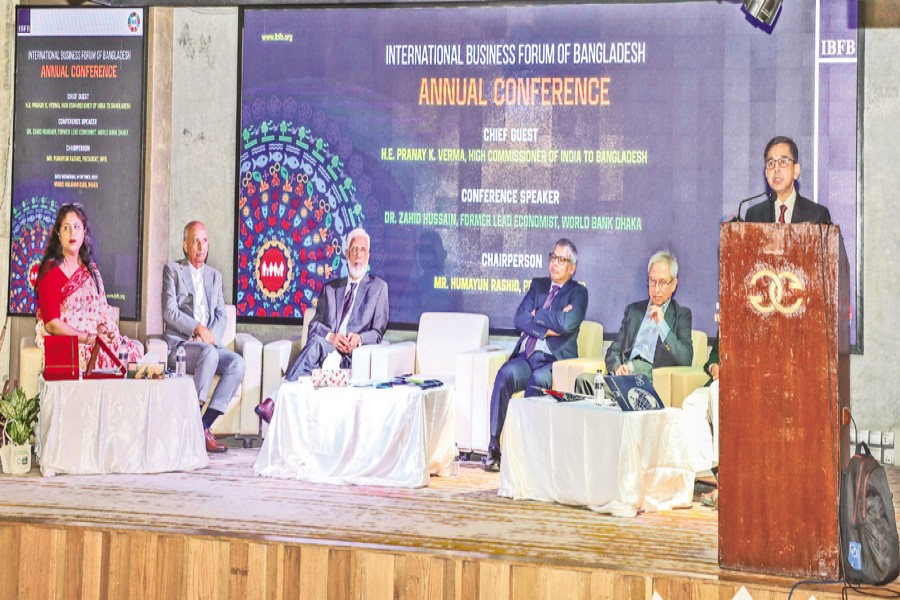
Growth volatility, dollar shortage, non-performing loans and inflation are the main cracks in the country's economy, said noted economist Dr Zahid Hossain, suggesting tightening monetary policy, implementing a market-based disciplined forex regime and practising prudent public spending to mend these faults.
Dr Zahid said the recent reserve drawdown had outweighed reserve accumulation and the net international reserve is now below $18.6 billion as per BPM 6.0 definition.
"During the pandemic, there was a big fall, followed by a very strong recovery of the growth rate and subsequently, there was another decline," said Dr Zahid Hossain, while delivering his keynote speech at the annual conference of the International Business Forum of Bangladesh (IBFB) on Wednesday.
Indian High Commissioner in Dhaka Pranay K Verma was present at the programme as the chief guest.
"Subsequently, average growth has declined and the volatility has increased. The difference between actual and average has widened. So, that's why I'm saying that recently, one crack in macro-financial stability is the volatility in growth," he argued.
"The second crack in macro stability is inflation, which is higher and more variable. Between July 2019 and June 2021, the average inflation rate was 5.6 per cent. The volatility was only 0.3. So, inflation was very stable, but subsequently, the average inflation has increased, and so has the variability of inflation. Therefore, inflation has also become volatile," he explained.
Terming the dollar shortage another crack in the economy, he said the country experienced a rapid accumulation of reserves immediately after Covid, but subsequently, the reserves have been declining at a steady rate.
He pointed out that the rise in non-performing loans poses a serious threat to macroeconomic stability. The total distressed assets in the banking system were about 22.8 per cent in June 2022.
Explaining global shocks that affect the country's economy, he said prices of the dollar, international commodity prices and interest rates hurt the economy badly.
"So the question now is, how did this get transmitted into Bangladesh? One major transmission mechanism was the balance of payments. We had a surplus, which turned into a deficit."
"And there is a third item in the balance of payment which is called errors and omissions, and this additional information is actually the difference between foreign exchange inflows and foreign exchange outflows that is not explained by the changes in the foreign exchange reserves of the country," he said.
Though these errors and omissions are sometimes positive and sometimes negative on balance, in the case of Bangladesh recently, this has always been negative, he said, adding that some outflows are happening, which are not captured in the official records.
About the policy shifts in monetary policy, he said the country recently saw a very unique monetary and financial policy, which is very hard to describe because it has an expansionary component, which is the growth of credit to the private sector.
"But there is also another part of monetary policy which is the internal tightening and this internal tightening as excess liquidity in the banking system that has been declining. So that's why I'm saying there is a mixture of expansion and contraction. And that's why the only term I found that can best describe this policy is that it is unique," he added.
"You cannot say it was purely expansionary. You can't say it was the worst contraction. It was a bit of both."
He pointed out that the deficit proposed in the budget has always been lower than the actual, as the country failed to meet both the expenditure target and the revenue target.
He said Bangladesh has followed a very unorthodox response to the global shock in the last year and a half, resulting in about $1 billion of official reserve loss per month.
He noted that there is a strong association between consistently tight monetary policy and disinflation. "So you will not get lower inflation through a short-term tightening of monetary policy. You'll have to stay with it for a while."
High Commissioner Pranay Verma observed that the stronger bilateral ties between the two countries are crucial to attaining the desired growth for both countries.
He narrated the projects undertaken in the last decade to enhance multimodal connectivity and trade between the two countries and urged Bangladeshi entrepreneurs to capitalise on these facilities.
"India and Bangladesh are poised to play an important role in regional strategy, making our economic engagement with each other a priority for both of us," he said.
"In the last decade, we have made unprecedented progress in advancing relations between our two countries. One of the key manifestations of that transformation has been the growth in our trade and economic engagement, as well as our connectivity links. As India and Bangladesh continue to take strides to become economically stronger, the simulation aspiring to become high income country driven by knowledge economy by 2041. And with India poised to join the ranks of the world's developed economies by 2047".
"Today, Bangladesh is our largest trade partner in South Asia and the fifth largest in the world. In the last five years, our bilateral trade has grown from $7 billion to more than $14 billion. Contrary to the impression that the trade relationship is structurally imbalanced, India has provided duty-free, quota-free access to Bangladesh for almost every good for a decade now."
He also pointed out that the majority of India's exports to Bangladesh constitute inputs upon which considerable value is added, contributing remarkably to Bangladesh's export income.
"I must also add that Bangladesh is our largest development partner in the world, with concessional financing of nearly $10 billion committed by the government of India to Bangladesh for various infrastructure projects under our lines of credit and other programmes. Many of these projects are geared towards building better connectivity and improving our cross-border trade infrastructure," he said.
He said as a close friend and partner, India initiated some steps, including commencing India-Bangladesh trading through the Indian rupee in July of this year.
"This mechanism is a modest beginning, to say the least, and is a response to a long-standing demand of local businesses. In my view, it has tremendous potential to further enhance our bilateral trade in the longer term," he noted.
Another positive development has been the very recent signing of an MoU between Bangladesh Bank and the National Payments Corporation of India for network connectivity to link the digital payment infrastructure of both countries, he added.
"At the same time, we are also exploring other innovative ways for ease of doing business. One of these is to achieve better harmonisation of standards between our two countries, which can facilitate the smoother movement of goods and services. Improving the infrastructure at our land customs stations and integrated check posts is another key priority for us," Mr Verma said.
He said that important steps have been taken in the last five years to improve cross-border trade and integration infrastructure, which would facilitate the easier flow of goods and the development of new infrastructure.
IBFB President Humayun Rashid chaired the programme and its founder president Mahmudul Islam Chowdhury made the closing remarks.
mirmostafiz@yahoo.com