
Vulnerability of financial sector a sore point
Faruq Ahmad Siddiqi | Sunday, 30 November 2014
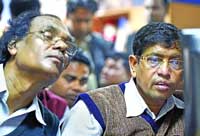
Market crash of 2010-2011 affected a large number of investors. Many of the three million investors became paupers overnight. Behaviour of the institutional investors in those days was not very different from that of retail investors. Many of them were investing for quick profit without proper financial analysis and on short term basis. Greed overtook their judgments. As a result they also could not escape the ill-effect of the market collapse. Many institutional investors like mutual funds, banks, financial institutions, insurance companies, merchant banks and other companies suffered substantial loss after the crash. Default margin loans crippled the merchant banks and some broker houses.
All these took place at a time when government started adopting a firm monetary policy to reduce inflationary pressure on the economy. Central bank also took steps to reduce exposure of the banks to stock market in the interest of the depositors. These factors affected the stock market and shook confidence of the investors. It was only to be expected that the effect of the shock would continue for some time and it could take a few years to stabilize the market. However, it was also expected that the market would take far less time to revive compared to the time taken after the 1996 crash due to the presence of a larger number of investors and market players and the reforms made after 1996.
Three years after the collapse, the market is now clearly showing signs of recovery and relative stability. At the moment, the DSEX is hovering around 5000 points. It needs to be noted that the buoyant banking and financial sectors that constitute a large part of market capitalization are now in a extremely vulnerable state. Secondary market price of some bank shares is close to their face value. This has distorted the overall market index. Had not the prices of bank shares plunged so low, the current market index could have been nearly 6000 points. This means that that current market price of other sectors is more favourable than the index would suggest. In my judgment, current market price of some shares is, in fact, overvalued. However, this is an investable market where well-judged long-term investment can be extremely profitable. Certain factors are now contributing to the growth of the market. Political stability- notwithstanding its uncertainty- may have contributed to improve confidence of the investors. Regaining confidence has always been the key issue. Low interest rate on bank deposits is likely to divert some funds to the capital market where a higher level of profit can be expected from sensible investments. Such fund flow can be anticipated both from small investors and institutional investors. A healthy index level suggests that such fund flow may have started already.
Bangladesh stock market is dominated by retailers. That is a basic problem. These retail traders are interested in short term investment and expect quick profit. Most of them do not have the financial capacity to hold shares for a longer period of time. Many of them are inexperienced and do not have the minimum understanding regarding quality of shares. They are easily influenced by rumours spread by vested quarters. Many of them sell their shares out of panic in a falling market and rush for investing in a rising market. Therefore, they are often the easy victims of the market manipulators. We do not have a large number of institutional investors who take long term investment decisions after careful financial analysis of the strength of the companies. Their role is limited. That explains frequent irrational market behaviour on a short term basis. Manipulation is much easier in a market lacking depth and institutional investors. In a situation like this, it becomes a nightmare for the regulators to protect investors from various forms of manipulations like insider trading, rumours, circular trading, pump and dump strategy and so on. We need a balance of short-term traders and long-term investors for a stable, vibrant and knowledge-based market. Unfortunately, that is not likely to happen any time soon.
So inexperienced retail traders are mainly victims of periodic market fluctuations and manipulations. In our country most of the retail traders and investors are taking investment decisions themselves. That makes them vulnerable in an uncertain market. In most developed countries, this segment of investors invests their funds through mutual funds where investments are made on the basis of professional expertise and long years of experience. Investment through mutual funds helps reduce market risks. That is not the case in Bangladesh and there are reasons for that. Here investors' perception of a mutual fund is different. They consider mutual funds like other companies where investments are mostly made for capital gains and dividends including stock dividends. They hardly consider mutual funds as medium of managing their funds prudently in a risky market. Inexperience and lack of adequate knowledge are mainly responsible for this. But we have also partly created this impression by allowing the close end funds to declare stock dividends.
But there are more cogent reasons for investors to avoid investments through mutual funds. Many of these funds, numbering 41 now, were mostly established hurriedly during 2009-10 in expectation of quick profit from that unregulated and distorted market. So from the beginning, their focus was on quick profit rather than professional management of their funds. Many of these funds do not have professional expertise and they failed to protect their unit holders from market risks and offer decent cash dividends. In fact, in many cases, face value and NAV came down below the level when these funds were issued. It is only reasonable that investors would lose confidence in the poorly managed funds.
In the recent past, we have seen approval of IPOs on regular intervals. This is an encouraging development. We have very limited number of listed companies and the market needs more depth. Bangladesh stock markets are equity-centric. Practically there is no bond or derivative product in the market. Only product is equity- that too of a very limited number of companies. Listing more companies will contribute to depth of the market. It is also encouraging that investors are enthusiastic about IPOs and they are being oversubscribed by big margins. However, investors seem to have some grievances on the issue. Very few reputed companies with good track record seem to be interested in listing. Mostly lesser known companies are being listed. So there is a risk factor as far as the future of these companies is concerned and investors need to be cautious. Secondly, it is becoming almost a common experience that price of the shares are increasing rapidly for a few weeks after commencement of trading only to decline sharply after that. In the process, inexperienced investors are losing money. It appears that regulators need to address the issue adequately. Investors will also have to accept the responsibility of investing their money in shares of newly listed companies at an abnormally high price. Thirdly, there have been newspaper reports pointing out irregularities of some new IPOs. Some allegations are of serious nature. If IPOs with gross irregularities are approved, the issuer companies, auditors, issue managers and regulators will have to accept responsibilities. It seems that there is scope for lot of improvements in this area.
Some of these irregularities could possibly be due to inadequate financial disclosures and unsatisfactory auditing. This brings us to the core of the problem that is affecting discipline of the entire financial sector. The quality of substantial number of financial disclosures and auditing is not satisfactory. This is a very important issue that is not being addressed for a long time. The problem starts with financial reporting by the management of a company. If management report is not transparent or misleading, it creates problems for the auditors. There are allegations that in some cases, the chief financial officers (CFOs) are not allowed to act independently and have to follow instruction of the board in preparing financial reports. There may be cases where auditors also lack ethical standard. There is no immediate solution to the problem. Improvements in this vital area may not be adequate without improved corporate governance practice which is shockingly poor in most cases. The Bangladesh Securities and Exchange Commission (BSEC) has introduced new corporate governance guideline which is a reasonably good document. But the regulator perhaps does not have necessary in-house capacity to ensure proper compliance with the guidelines. It is highly probable that, in absence of proper supervision, the corporate governance reporting by the companies may result in mere box ticking.
That brings us to the issue of audit quality which is so vital for proper functioning of the stock market. Audit quality is also a matter of concern to the National Board of Revenue (NBR), the central bank, Register of Joint Stock Companies and Firms, the credit rating companies and many others. While there are some well reputed audit firms in the country, overall audit quality requires professional and ethical development. We cannot expect this to happen overnight. But steps should be taken urgently. There is a general perception that present structure of self-regulation of the audit profession is not working. Therefore, ICAB should consider reforming and strengthening its self regulation capability. The other option is the formation of a financial reporting council, effectively equipped and managed by the professionals to take over the regulatory function. Government should take decision on the issue quickly after adequate consultation with the stakeholders.
To complete this write-up, some observation on current status of demutualization is necessary. Demutualization of exchanges is an important step that was completed on mutual understanding between all the stakeholders. This is to be appreciated. After enactment of the legislation, necessary steps were taken within a reasonable time and boards of the exchanges were formed with a majority of independent directors as provided in the act of the parliament. In my opinion the new boards may have made some marginal improvements by reducing the influence of former members. Radical improvement was not expected and that has not happened. However, formation of boards with majority of independent members does not mean that the exchanges have been demutualized. Most important condition is separation of the owners (share holders) from the traders (TREC holders). No visible progress has been made in this area. Existing share holders (former members) continue to remain the only owners of broker houses. This is against the basic concept of demutualization. The exchange authorities will do well to take steps to offload the 60% blocked shares as early as possible to make demutualization meaningful.
..............................................................
The writer, a former secretary to the
government of Bangladesh, was chairman of the Bangladesh Securities and Exchange Commission. He can be reached at: faruqasiddiqi@yahoo.com