
WB recommends massive trade reforms
Says deep trade deals with EU, India could boost BD growth
FE REPORT | Friday, 30 September 2022
Comprehensive bilateral trade deals with the European Union and India at the next door could boost Bangladesh's GDP by 0.4 per cent and 0.5 per cent respectively, says the World Bank as it recommends massive reforms.
The country's export to both the destinations could also swell by 1.4 per cent and 3.9 per cent respectively for the comprehensive trade agreements, the Bank says in its "Country Economic Memorandum - Change of Fabric" report launched in Dhaka Thursday.
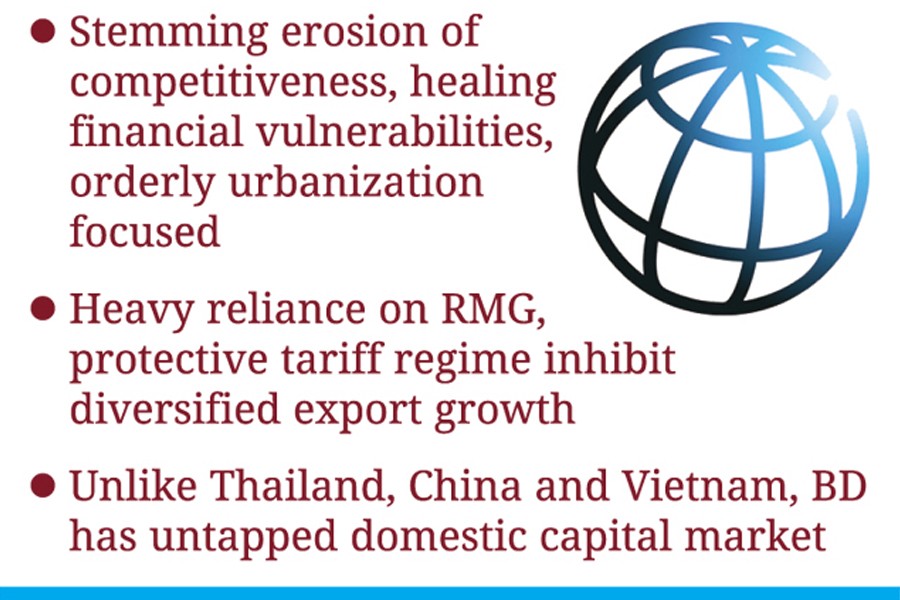
It says heavy reliance on readymade garments (RMG) and Bangladesh's protective tariff regime inhibit diversified export growth.
South Asian Network on Economic Modeling (SANEM) Executive Director Prof Selim Raihan at the launching programme said it's a big question on the absence of necessary trade reforms over the decades despite a lot of discussions on export diversification.
"See the next potential sector-the leader-has also failed to play a role in export diversification due to the massive tariff protection," he said, citing the example.
Prof Raihan said export diversification is not taking place because there are deep political and institutional factors involved here.
With the presence of Planning Minister MA Mannan, former Lead Economist of the WB Dr Zahid Hussain and Senior Economist of the WB Ms Nora Dihel made a presentation on the report.
The WB finds strong policy reforms in three areas critical to sustaining growth in Bangladesh, such as, stemming the erosion of trade competitiveness, addressing vulnerabilities in the financial sector, and ensuring orderly urbanization process.
The WB has strongly suggested reforms in the financial sector to enhance Bangladesh's capacity in the post-LDC era.
It says Bangladesh will face a big challenge after the LDC graduation in 2026 as it will fall into competition with other competitor nations on the global market.
"Average tariffs in Bangladesh are higher than in its comparator countries. The average tariff rate on intermediate goods in Bangladesh is 18.8 per cent, which is about twice the rate as in China, Thailand, and Vietnam."
Overall trade costs and inefficient border processes are termed major impediments to trade.
"Scaling up of private-sector financing is essential for sustaining economic growth. Actions to improve asset quality, increase the capitalization of banks, and address increasing non-performing loans are urgently needed to maintain financial stability and accelerate credit growth," the WB suggests.
Unlike Thailand, China and Vietnam, Bangladesh has an untapped domestic capital market, which is required for raising long-term finance, particularly for infrastructure-and climate- adaptation projects, the report says.
Unlocking private-sector financing for green investments and climate-risk financing will become increasingly important.
The WB report says the country also needs to focus on expanding access to finance in underserved segments, such as women and MSMEs.
"Bangladesh also needs to source external resources proactively, including through international capital markets, by promoting local-currency financing, easing external-borrowing constraints, and attracting foreign direct investment," it adds on the dos ahead.
Dr Zahid Hussain said if Bangladesh goes for strong reforms, its GDP will grow at 7.5 per cent in 2041. But if the country goes for a moderate reform, the GDP will expand at 5.9 per cent while in the existing scenario its economic growth could slow down to 5.0 per cent in 2041.
Dandan Chen, World Bank Acting Country Director for Bangladesh and Bhutan, said: "Over the past decade, Bangladesh has been among the top 10 fastest-growing economies.
"But there is no room for complacency. New and emerging challenges-including advances in technology and climate change-demand new policy and institutional innovations to cater to the changing needs of a growing economy. To achieve its vision of upper-middle-income country by 2031, Bangladesh will need strong and transformative policy actions."
About reforms, Dr Selim Raihan said Bangladesh's five-year plans and vision paper correctly indentified the required reforms for the country. "But the questions are whether the political will of the government is enough or whether the implementing agencies are performing correctly."
Planning Minister MA Mannan said, "I had understood that we must conduct strong reform for attaining the goal of developed nation by 2041.
"But there are some problems on political economic fronts which we have to consider. And that may sometimes hamper the reform space. But we have taken off. If we even fail to run fast, we will walk a bit faster than the previous motion."
Assessing a "dark political climate" in the future days Mr Mannan urged the opposition to come forward for discussion rather than creating any instability or violence, for the betterment of the economy.
The WB report envisages export diversification to reduce the risk of export volatility, create new sources of growth, and increase foreign-exchange earnings in the long term.
kabirhumayan10@gmail.com