
We are loath to remembrance: Assaults of oblivion
Shihab Sarkar | Friday, 20 March 2015
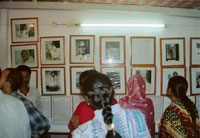
A museum comprising the personal souvenirs of Poet Jasimuddin has been in operation at Ambikapur in Faridpur district since 2011. It was set up with financial back-up from the National Museum of Bangladesh. Befitting the poet's creative temperament, it is located at his village residence.
Jasimuddin is considered the foremost Bengalee poet, who has marvellously blended our pastoral and rural essence with modernism. In the earlier days, many readers, critics as well, ignorantly linked him with Bengal's folk tradition. But Jasimuddin was not a folk poet. He belongs to the 'modernists' using a narrative, folk diction.
Many of our celebrities in literature, painting, music and different branches of the liberal arts are not as fortunate as Jasimuddin. It's because despite being an enlightened poet strongly based on modern academic feats that took him up to the university level, the poet quintessentially had his roots in the village. He has enjoyed large readership with equal shares in the urban and rural areas. The poet passed his youth and the elderly stage of life in Dhaka. But he never severed his ties with the village, the leitmotif of his massive corpus. Thanks to this unalloyed focus on the village, and the ever-growing rural bond, Jasimuddin has been able to leave behind scores of mementoes for the new-generation admirers. The residence of the poet in Dhaka metropolis could have well been turned into a house-museum.
The poet spent decades in this city. His residence on Kabi Jasimuddin Road in the city's Kamalapur was once a popular literary salon of sorts for writers and musicians. In consideration of memorabilia, the place carries enormous significance. Yet the poet's ancestral home at Govindapur village under Ambikapur union in Faridpur district is replete with the poet's very self and his basic identity, coupled with the intimate landscape, natural and figurative, which he had kept discovering as he grew up in his early days.
Like the poet, Shilpacharya Zainul Abedin (1914-1976), the great painter, is quite fortunate to have a small gallery-cum-museum solely dedicated to him in Mymensingh town. It was set up in 1975, one year before the artist's death. He was born in Mymensingh district. This museum contains a number of major works done by the painter.
Many highly reputable artists of Bangladesh have yet to have exclusive and permanent galleries dedicated to them. Qamrul Hasan or Kibria does not have any. Nor do Aminul Islam, Rahid Chowdhury or Debdas Chakraborty. Qayyum Chowdhury has just left us. He deserves one. We look forward to a museum-cum-gallery that will preserve the major works of the artist.
In this list of legendary painters, SM Sultan (1923-1994) occupies a distinctive place. He had been apart from the other artists in the country during his lifetime. Sultan was different altogether. In the posthumous phase also, he is unique with his admirers embarking on various projects to remember him. He passed the last two to three decades of his life at a village in Narail district in the country, and remained engrossed in spreading the music of the land's soul through his art-related works. The artist established the Sultan complex at his ancestral village, built a fantasy-laced large boat to teach children how to begin painting and love it. Sultan's memorial museum, though begun by him, finally saw scores of his admirers in the country participating in it as a venture. After all, SM Sultan is an outstanding artist of the country born of colossal creative genius.
Few in Bangladesh and the sub-continent can parallel his uniqueness when it comes to the subject of his works. He began his career picking Bangladesh villages, its muscular men and elegant women busy working in crop fields and courtyards of thatched huts -- and presented the eternal rural Bengal. Zainul Abedin and Qamrul Hasan (1921-1988) have also nurtured an affinity with the village, but they also tried to delve into the realities of the other areas of life in the land as well. Sultan was inextricably linked to the country's rural entity. He remained engrossed in it with an enviable emotional charge till his last days. That a memorial museum centring on the artist will be set up in a typical Bangladesh village, like that of Poet Jasimuddin, is quite natural.
Keeping the rural scenario in view vis-à-vis our broader cultural landscape, we may pay attention to our iconic figures in the music sector. A prominent figure in this area is Abbas Uddin Ahmed (1901-1959). In order to assess the legendary folk singer, we need to turn to the past. During the times prior to the 1947 partition of the sub-continent, the general people in the eastern part of Bengal discovered in the songs of the popular vocalist an embodiment of their aspirations and dreams. Abbas Uddin, originally from Kochbihar in northern West Bengal, moved to Dhaka from Kolkata after Partition.
In the then East Pakistan, later Bangladesh, the singer reached the zenith of popularity in no time. His residence at Purana Paltan in the city soon became a popular hangout for Bengalee writers, artists, and, of course, young and senior singers. In those days, there were few similar Addas in the city. In the later days, this residence produced two talented singers of the country: Ferdousi Rahman and Mostafa Zaman Abbasi. The two were offspring of Abbas Uddin Ahmed.
The celebrated singer breathed his last in Dhaka in 1959. Over five decades have elapsed. People close to Abbas Uddin Ahmed have moved to new areas of the city. The worn-out, one-storey house still stands at Purana Paltan. None perhaps has paused for a while to think of turning the famous place into a house-museum dedicated to the legendary singer. The cultural ministry could have come up to set up a small museum there. Initiatives could also have been taken for such a venture by individuals or private organisations. To our apprehension, hundreds of objects related to this great singer now remain exposed to the risk being passed into oblivion.
Instances like this are many in Bangladesh. Celebrated singer and composer Sachin Dev Burman (1906-1975) was born in Comilla and his residence still stands in the district town. Despite it, no serious attempt has yet been made to establish a memorial museum on him at the historic house. The residence was encroached on by some influential quarters, and it had been under their control for a long time. Of late, the district administration freed the house from occupation. But it lies literally vacant. Local cultural organisations under the banner of a united body could take initiatives to set up a museum there. Perhaps things could get easier if the government agencies concerned stand by private efforts.
The assaults of oblivion have long been in the making targeting many great persons in this country. Apart from the arts, they also belong to varieties of fields including politics, social activities, philosophy and science.
People in this country will never forget the colossal contributions of Bangabandhu Sheikh Mujibur Rahman (1920-1975) to the creation of Bangladesh. Due to this, we did not have to wait for long to see the setting-up of a virtually institutionalised museum at the great leader's residence in Dhaka. The grand mausoleum on the grave of Bangabandhu at his ancestral village can claim a place in the record books of South Asian architectural marvels. Yet despite their immense contributions to the struggles for the people's improved lot, many of our leaders did not get what they deserved. They include Sher-e-Bangla AK Fazlul Haque, Maulana Bhasani and Huseyn Shaheed Suhrawardy. Decades after their passing-away, no political parties, social organisations or individuals could keep for the posterity the mementoes or relics representative of much of their lives and careers. However, thanks to popular love and respect for Bhasani, a number of memorial institutions after his name have been set up over the decades --- especially in Tangail, the leader's place of birth.
Considering the whole gamut of memorial tributes, we find, to our expectation, that it is Rabindranath Tagore (1861-1941) who occupies the most revered place in this respect. Both Paschimbanga and Bangladesh are littered with countless memorabilia linked to the great Bengalee poet. However, in Tagore's case it is Shantiniketan and the state government of Paschimbanga which have played catalytic roles in preserving the memorial bits of Tagore the man and the poet. The government of Bangladesh, too, has put in the best of its efforts to preserve the places that the poet resided in while travelling the then East Bengal. In fact, after Shantiniketan, and Jorasako in Kolkata, it was Shilaidaha, Patisar and Sajadpur in Bangladesh which stood witness to many creative moments in Tagore's life. Had not the post-Liberation War government of Bangabandhu Sheikh Mujibur Rahman been successful in bringing Nazrul to Bangladesh, he would have eventually ended up being a disease-battered and financially crippled 'major rebel poet' in Kolkata. It was owing to the birth of independent Bangladesh in 1971, that we were able to pay the due respects to Kazi Nazrul Islam (1899-1976). He was made the National Poet of the country, with an institute-cum-archives dedicated to his memory. His grave in Dhaka enjoys the solemn grandeur of a mausoleum.
Jibanananda Das (1899-1954) was born in Barisal district in Bangladesh. He stayed in the country until he had finished his college education and gone to Kolkata. The poet's emotional attachment with rural Bangladesh, with twists of modernism though, has earned him immense popularity among poetry lovers. He has long been recognised as the greatest poet in the post-Tagore-Nazrul era. To our utter failure, we have not been able to even preserve the poet's ancestral homestead in Barisal city, leave alone setting up a house-museum there. The Dhansiri river, immortalised by the poet in his poems, has long been in a dying phase. There are a lot of literary-cultural organisations in Barisal region. They could have launched a campaign to save this river. Jibanananda, however, is fully alive within his ever-increasing readers.
Home-based museums on illustrious people are a part of modern times. In the West and the developed countries in Asia and Africa, there are many such archives. Ranging from George Washington and Einstein to Beethoven, from Karl Marx to John Keats, many luminaries still come alive as their memorabilia keeps attracting curious people. Apart from arousing inquisitiveness, the house-museums serve as an inspiring force for the youths. Despite being enriched with contributions made by many persons, we are loath to remember their attainments. Maybe, it has a lot to do with our ethnicity.
shihabskr@ymail.com