
RAJSHAHI, C'NAWABGANJ, NAOGAON
Weather woes deal a heavy blow to mango production
OUR CORRESPONDENT | Friday, 1 May 2026
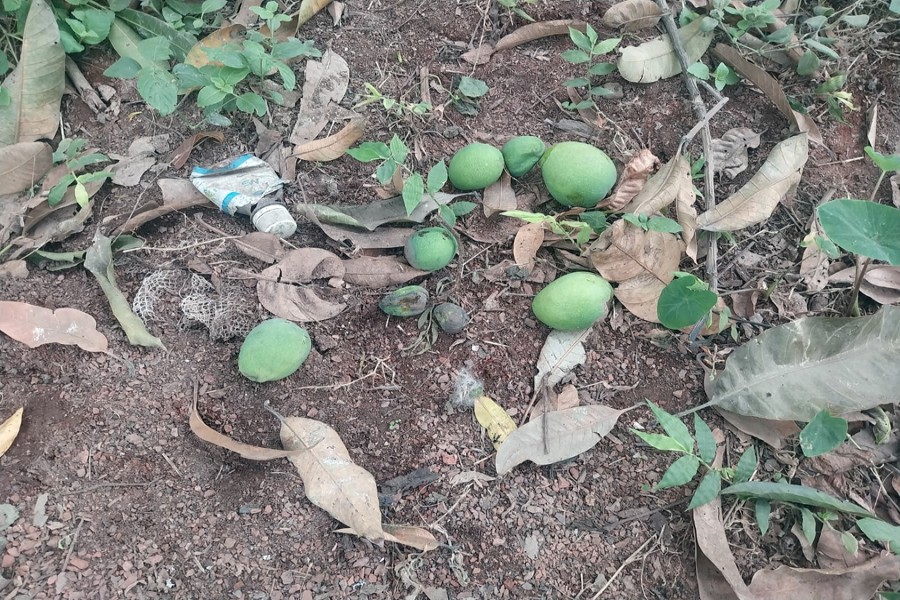
RAJSHAHI, Apr 30: The country's prime mango-producing districts-Rajshahi, Chapainawabganj and Naogaon-are facing a severe setback this season as persistent heat wave, drought and repeated nor'westers have disrupted orchard conditions, triggering widespread fruit drop, pest attacks and other weather-related damage.
Growers and officials say the combined impact of extreme heat, moisture stress and sudden storms has created uncertainty over what is normally a multi-thousand-crore mango industry.
While farmers report significant losses at the early fruiting stage, the Department of Agricultural Extension (DAE) maintains that the situation is still manageable if proper orchard management is ensured.
In Rajshahi, temperatures have consistently hovered between 38°C and 40°C throughout April, with almost no meaningful rainfall since late March.
According to the local weather office, only 1.4 mm of rainfall was recorded on April 7 and 9.2 mm on March 28, after which dry conditions persisted.
The prolonged dry spell has severely reduced soil moisture, affecting mango trees during the critical fruit-setting stage.
"As water movement inside the trees is being disrupted due to drought, the trees are failing to retain developing fruits. If the situation continues, nearly half of the crop may be lost," said orchard owner Anwarul Haque in Rajshahi city's Terakhadiya area.
Farmers in Puthia and Paba echoed similar concerns, citing rising irrigation costs and fuel price pressures as key barriers to saving orchards.
"Even though flowering and fruit set were initially good, the situation changed drastically with the heat wave," said grower Asif Iqbal. "We are unable to irrigate regularly due to high diesel costs, and nearly 30 per cent of fruits have already dropped," he added.
Another farmer, Shahriar Hossain of Paba, said water scarcity has further worsened the situation. "We had around 300 mango trees with good potential this year, but the sudden heat has triggered fruit drop. Irrigation has become difficult due to fuel constraints," he said.
However, not all orchards are equally affected. Grower Hanif Mondal of Charghat said his orchard has suffered comparatively less damage due to regular irrigation. "Where irrigation was possible, the trees are still in relatively stable condition," he said.
According to the DAE, Rajshahi, mango cultivation covers around 19,062 hectares this year with a production target of 244,000 tonnes. Officials say the final output will depend widely on weather conditions in the coming weeks.
Dr Shafiqul Islam, chief scientific officer at the Fruit Research Centre, said fruit drop is partly a natural process but has intensified this year due to moisture stress. "Trees naturally shed excess fruit, but drought conditions have significantly increased the rate of drop due to nutrient and water deficiency," he explained.
In Chapainawabganj, often referred to as the country's mango capital, growers are facing a dual challenge of heat stress and pest infestation. "The combination of extreme heat and increased pest attacks has made orchard management extremely difficult," said grower Sadarul Khan.
Farmer Bipul reported that two rounds of storms had already caused substantial damage. "After the storm damage, the heat wave started again. We are trying to protect the orchards with spraying, but weather conditions remain highly unfavourable," he said.
Agricultural officials said that nor'westers and hailstorms in April have damaged crops in several areas, particularly in Shibganj upazila, where about 10,451 hectares of mango orchards have reportedly been affected.
Chapainawabganj DAE Deputy Director DrYasin Ali said the overall situation remains under observation. "There is no major concern at the moment. Some localised damage has occurred, but with proper irrigation and water spraying, the situation can still be managed," he said. The district has set a production target of around 500,000 tonnes of mangoes from 37,500 hectares of orchards this season.
In Naogaon, which has around 33,000 hectares under mango cultivation, farmers are also worried about yield losses due to drought and storm damage.
Growers estimate that 5-7 per cent of fruitlets have already dropped due to drought, with additional losses caused by recent storms.
"Since the beginning of Baisakh, drought has weakened the trees. Later storms caused further fruit drop," said farmer Faridul Islam of Sapahar.
However, Naogaon DAE Deputy Director HomayraMondal said the overall impact on production is expected to remain limited. "Fruit drop is a natural phenomenon. Although some damage has occurred, we expect a good yield if rainfall occurs on time," she said.
anaetru@gmail.com