
West to be Dhaka\\\'s top export destination to 2030 : HSBC
FE Desk Report | Wednesday, 17 September 2014
Ready-made garments make up around 80 per cent of total merchandise exports from Bangladesh with the value of exports in this sub-sector being greater than exports from India, the HSBC has said.
In its latest trade forecast, the bank said textiles and garments are Bangladesh's most important export sector. In 2013, half of Bangladesh's exports of garments and textiles went to Europe and a quarter went to the US.
"Amongst the 25 economies in the HSBC Trade Forecast, we expect Bangladesh's share of textiles and garment exports to rise from 2.8 per cent in 2010 to 3.8 per cent in 2020", the HSBC report said.
The authorities have introduced new safety laws for textile factories to strengthen standards, which has helped to reinforce established relationships with international buyers and in turn should help the industry to expand production.
The 77 per cent increase in minimum wage for garment workers implemented in December 2013 will add to firm's costs, but the industry is expected to remain competitive in global markets.
To improve longer-term growth prospects, Bangladesh will need to raise labour productivity and move into higher value-added textile sectors, the reports said.
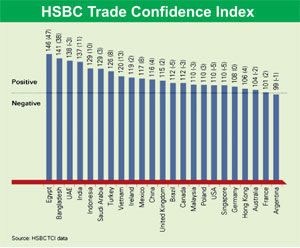
The trade confidence index rose sharply from 103 in H2 2013 to 141 in H1 2014 - the second highest in the sample of 23 countries - underpinned by strong demand from the West for Bangladeshi garments and textiles. The authorities are introducing more safety regulations to the garments sector and this appears to have provided an additional boost to confidence, the HSBC report mentioned.
It finds that 40 per cent of survey respondents said that Europe offers the best opportunity for business growth over the next six months. One-third of respondents said Asia and 17 per cent said North America.
"The US$ is the currency of choice for more than 85 per cent of survey respondents. Nearly 80 per cent see currency movements having a positive impact on trade over the next six months while more than two thirds see trade agreements as favourable for international business", the report said.
"But around a quarter of survey respondents cited high costs of logistics, shipping and storage would potentially as potential constraints on business growth", it added.
New safety laws for textile factories introduced after a series of disasters could boost investor confidence. Meanwhile, the country has the fourth largest population in Asia and the working age population is growing. Investment should be increasingly aimed at services and consumer products to take advantage of this trend.
The Eurozone, Bangladesh's biggest trading partner, is now growing steadily again, although very modestly, and global demand is expected to continue to pick up. Within Asia, trade flows improved modestly in Q2 and recent data on PMIs and Hong Kong container shipments suggest this improvement is likely to continue.
Nonetheless, the US, Germany and the UK are Bangladesh's top export partners and this will be unchanged out to 2030 thanks to strong demand from the West for textiles and garments.
Amongst the 25 economies in the Trade Forecast, Bangladesh gets around 20 per cent of its imports from China and by 2020 this share will have risen to closer to 30 per cent. Other emerging market economies in Asia will also gain market share in Bangladesh at the expense of developed economies.