
Western Marine Shipyard shines in ship building industry
Pankaj Dastider | Sunday, 7 December 2014
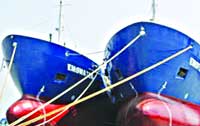
Bangladesh has emerged as a modern and high tech shipbuilding nation making a place in the shipbuilding globe. The industry has made very a positive image of the country in western world by building ships for European and African buyers. Western Marine Shipyard, leading shipbuilder of the country, stands over 16 hectares (42 areas) of land and has modernised itself into a world class shipyard through investment of over 50 million US Dollars.
The shipyard is capable of constructing up to 12,000 DWT (dead weight tonnage) ocean-going vessels and is fully equipped with all sorts of hi-tech machineries and comprised of all requirements for quality shipbuilding. To initiate the tasks it has 3500 manpower including 300 highly qualified marine, mechanical and electrical engineers, naval architects and technologists.
The shipyard's major completed projects include eight 5200 DWT multipurpose container (MPC) vessels for Germany, one double-ended car ferry for Denmark, one floating reception vessel for Finland, two passenger vessels for Pakistan and one 60-ton BP tugboat for Chittagong Port Authority.
Apart from these, it has built coastal ships for domestic use of Bangladesh Government and private owners which include cargo ships, tankers, car ferries, passenger ships, tugs, cutter suction dredgers and many more.
Currently, they are building the following ships at the yard: a) one off-shore patrol vessel for Kenyan Ministry of Fisheries, b) one 60-pax international SOLAS (Safety of Life at Sea) passenger ship for New Zealand, c) one 30-pax aluminum catamaran passenger ship for Tanzania, d) one 750-pax passenger ship for Bangladesh Government, e) one 60-M RoRo ferry for Bangladesh Government, f) one 1000-ton fresh water supply vessel (for port use) for Bangladesh Government, g) 12 number of 176-TEUs capacity coastal container ships for Bangladeshi owners and h) nine 250-ton deep sea fishing trawlers for Bangladeshi owners.
Recently, the WMShL went into joint ventures with the Japanese organisation Greenheart Project for building sustainable ships which will carry low volume cargo within the coastal regions in different parts of the world.
The ship will run by renewable energy (prototype solar and wind-powered). The purpose of this joint venture is to build the metal structure in Bangladesh which is most cost-effective compared to other Asian shipyards.
Western Marine has a joint venture with the Netherlands based shipbuilder IHC Merwede, focusing on dredgers. There is currently high demand for dredgers in Bangladesh, for developing new ports and deepening river channels for better navigation of bigger ships. In the venture IHC Merwede supplies the dredging machinery and Western Marine completes the steel structure for the dredgers. In 2012, the yard delivered a cutter suction dredger to Mongla Port Authority.
There are several reasons why ship owners from all over the world are getting more and more interested to invest in Bangladesh. The main strength for Bangladesh's shipbuilding industry is the country's vast and cost-effective labour force.
Shipbuilding is an industry both labour-intensive and technology-based. The pools of workers are readily available in Bangladesh. Standard of living is less expensive in the country compared to other shipbuilding nations like Japan and Korea. This gives a huge cost-advantage while quality and time is managed in the most efficient manner. Bangladesh offers 15% cost-saving in shipbuilding than the ship builders in other nations. Energy prices, utility prices and land prices are much lower than major shipbuilding countries.
Major shipyards are not interested in building small scale ships. This creates a scope for our country. Bangladesh can now build ships up to 12,000 DWT. Local players plan to take this capacity to 25,000 DWT in future. Again traditional market leaders of world ship building industry are overbooked mainly for construction of large ships. So the buyers are in search of suitable and reliable markets in Vietnam, Bangladesh, India, Brazil, Netherlands etc.
Slump in demand for export of ships from the key market such as EU countries has affected the industry recently. Global recession in the recent past all over the world has caused a steady decline of foreign orders. However, a highly potential market for new building of ships has been observed over the last few years.
The demand for marine vessels is increasing. Building Padma Bridge will require 150 to 200 barges. Bangladesh needs a lot of dredgers to keep up the navigability of its rivers. Local ship builders can build such dredgers and barges. Increasing trade activities will also require more ships. Fishing ship is also another growth area.
The local shipbuilders rely on imported raw materials. The main raw materials required for shipbuilding are steel plates and propulsion machinery. The industry is relying on imports from abroad as they are yet to establish these industries in the country. The management of the Western Marine Shipyard is confident that the country would start manufacturing Marine equipments and marine grade steel plates in the years to come.
Bangladesh has good opportunities to secure a share of the global shipbuilding market. This is because price wise Bangladeshi yards are competitive and have already marked a good position in the global shipbuilding arena through quality ship building practice. It must be stressed that support from the government is essential as the governments of other ship building nations like China, India and Vietnam have done.
The writer can be reached at: pankajdastider@gmail.com