
Beyond deals and discounts
What DITF offers to the buyers and sellers
MIZANUR RAHMAN RAFI | Wednesday, 14 January 2026
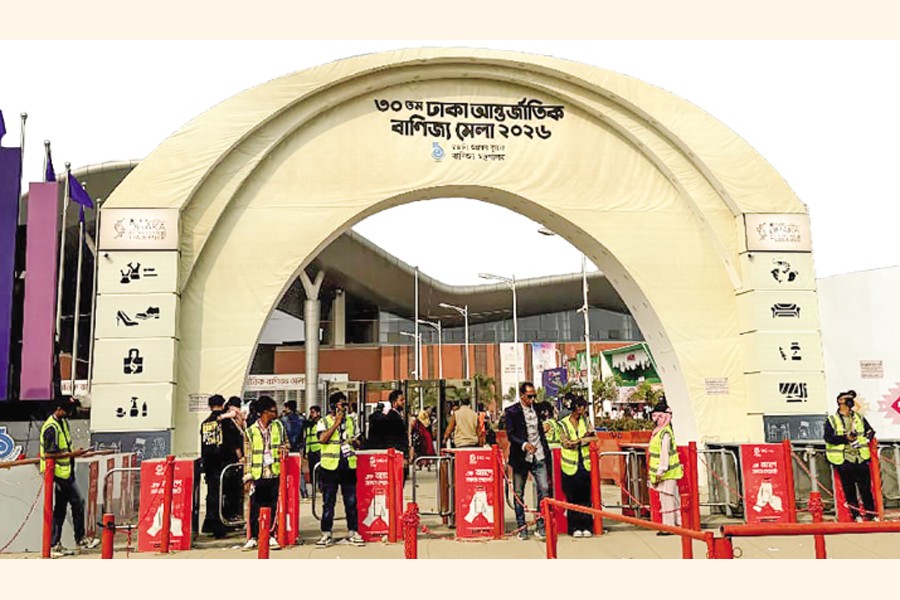
Mr Sanjoy, 26, claims to be Indian and works as a shoe seller at a shop named 'Indian Footwear' at the Dhaka International Trade Fair (DITF). Although his shop offers various types of shoes, the first thing buyers notice is his persistent attempt to speak Hindi, from bargaining to every small detail. His performance is merely an attempt to prove the authenticity of his 'Indian' origin and his products.
Fifty metres away from the shop, we found the Haji Biriyani stall. Naturally, they claimed to be the country's 'original and authentic' Haji Biriyani.
Beyond this 'Indian language drama' or claims of authenticity, what does the DITF actually offer buyers?
With over 300 shops and sellers from seven countries, including India, Pakistan, and Turkey, the DITF features stalls for clothing, kitchenware, home decor, furniture, pickles, snacks, various rides, and health and hygiene products. Beyond tangible goods, some companies are offering flat-rate purchases or property-sharing options. Different shops are offering discounts ranging from 10 per cent to 50 per cent on their products.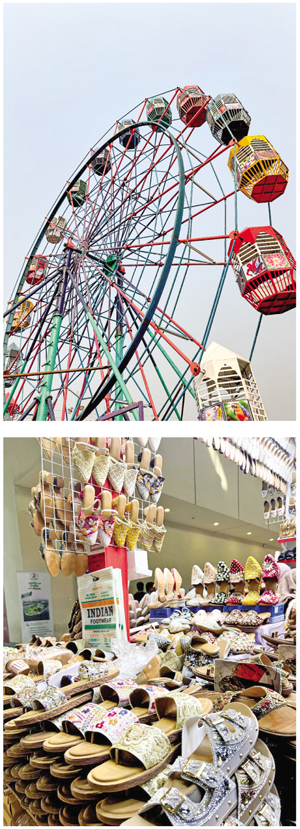 Clothing and Footwear
The fair hosts a significant number of clothing and footwear stalls. Most clothing shops focus on women's apparel, ranging from sarees to three-piece sets and Western outfits.
Men have fewer options, with only a handful of suit-and-blazer shops available. However, these blazer shops offer substantial discounts; buyers can purchase a blazer for as little as 1,500 BDT. Conversely, women's clothing stores are offering even greater discounts, with some exclusive shops providing up to 50 per cent off.
The footwear section is dominated by 'foreign' shop owners rather than local brands. While two familiar local brands have set up stalls, they are not offering much product variety.
On the other hand, a wide range of shoes was available in shops run by foreign sellers. Market observation reveals that while local brands are offering discounts, foreign shoe shops are not providing significant price reductions. Buyers have to spend at least 1,200 BDT for a pair of shoes.
Kitchenware and Home decor
The market for kitchenware and home decor is the most vibrant section of the fair. There is an abundance of stalls selling vegetable cutters, plates, bowls, and utensils. Additionally, everything from decorative home lighting to imported Turkish mattresses is available.
The highest discounts are found on plates, bowls, and utensils. Some items are being sold at fixed rates, such as 'Any item for 120 BDT.'
'Well-known' domestic brands are offering discounts of 15 per cent to 40 per cent on their products, including stoves, buckets, baskets, water bottles, flasks, and rice cookers. Although there aren't many significant discounts on home decor products, a wide array of colourful items that can attract buyers is on display.
Pickles, Snacks, and Foods
A Bangladeshi fair is incomplete without pickles. Pickles made from almost every possible fruit-mango, olive, jujube-are available at the fair. However, sellers are unwilling to offer significant discounts, and due to high demand, pickles are mostly sold at fixed prices.
Domestic snack brands, however, are bringing good news for buyers. Customers can purchase almost all products-such as biscuits, noodles, ramen, cakes, and juices-at discounts of 5-20%. They are also offering significant discounts on various package deals.
For heavier meals, in addition to a large cafeteria-cum-food court, there are stalls for the 'Original and Authentic' Haji Biriyani and another domestic brand. Food prices are high; one has to pay at least 200 BDT for Morog Polao.
Handicrafts, Healthcare, and Hygiene
Various government agencies and some private initiatives have set up handicraft stalls at the fair. These shops offer neither special discounts nor attract a significant number of buyers.
Several domestic brands have set up stalls to promote health and hygiene, placing considerable importance on women's reproductive health. Discounts are available on products such as sanitary napkins, hand wash, and body lotions.
Various rides
For children, the fair offers typical rides, games, and a ghost house. However, it is not just children; adults were also seen enjoying these rides. Depending on the type of ride or game, visitors have to pay between 50 and 200 BDT. A spot check revealed there wasn't much of a crowd for the rides.
Beyond these products, stalls from local and well-known furniture brands were also spotted. Additionally, various real estate companies are present, offering flats and resort shares.
The fair management body remembers the July uprising. A dedicated corner displays moments from the July uprising, including photos of Abu Sayeed, Mir Mugdho, and Sharif Osman Hadi; pictures from the 1952 language movement to the 1971 liberation war are also displayed. 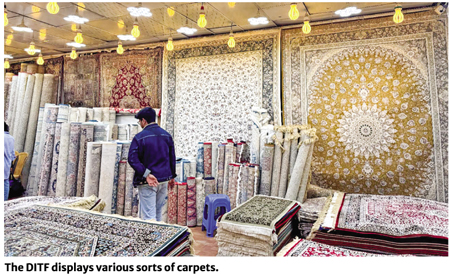 Are visitors and sellers satisfied?
Mixed reactions to the fair's satisfaction were observed among sellers, depending on their shop type. The previously mentioned Sanjoy said, "We are not getting the response we expected. The fair has just started; perhaps the number of buyers will increase over time. We have a variety of shoes. I believe we can attract buyers."
Ride providers, as well, feel the same way. They firmly believe that visitor numbers will accelerate, and consequently, so will their business. They noted that visitor numbers are currently low because the fair has
just begun, but hope for an increase in the coming days.
On the other hand, sellers of plastic products, kitchenware, pickles, and snacks are happy with the buyers' response.
Visitors gave mixed reactions. Most were happy with the environment but criticised the lack of stall diversity.
Swasreeya Roy, a 24-year-old university student, shared her experience: "It was good, but it could have been better. All the stalls were of the same type. I expected there would be some traditional food items. I didn't even find any Bengali food during this winter season; it was all just fast food and biryani. Overall, it was okay."
Swasreeya, including a few other visitors, mentioned that they are satisfied with the management.
Another visitor, Saba, agreed with Swasreeya. She said, "It was decent but not very unique. Most of the stalls felt quite similar, making the experience somewhat repetitive." She also mentioned that while she was happy with the shopping experience, she missed the 'expected' cultural diversity.
DITF brings nations to exhibit their products and do business; however, the fair is limited to a few countries. Beyond the discounts, the fair is still part of excitements among the families who came to visit the place from the far side of the city. It has both the pleasure of hanging out with family and great deals, and the frustration of a long journey, followed by long, tiring
walks in the dust.
mizanur2351@gmail.com