
Whitening black money does not help investment
Syed Mahbubur Rashid | Wednesday, 14 May 2014
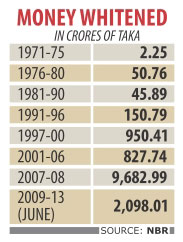
Not long ago, black money was newly baptised as 'undisclosed income'. But does it materially differ? Why will there be no disclosure of any income if there is no kleptocracy? When Finance Minister A M A Muhith in his first budget speech of the past Grand Alliance government offered some facilities for investment of undisclosed income, it was widely appreciated, particularly by the mandarins of the stock exchange as they were protagonists of patronising investment of undisclosed money. They strongly believed that the share market would be overflowed with undisclosed money. Their observations did not come true. In the valedictory budget speech in 2013-2014 fiscal year, Muhith said: "In the past, we extended a number of facilities for investment of undisclosed income which did not yield any tangible outcome." Since the Finance Minister has doubt about the so-called benefit of investment of undisclosed income, he has come forward with a decision of not allowing it any more indulgence.
Previously on a number of occasions, clearance was given for conversion of black money into white one despite the fact that the result was the same as expressed by the present Finance Minister.
A section of wise men were advocating for the continuation of this illegal act. They tried to place some misleading information to confuse the Finance Minister. They said the garment industry got a big boost when in 1989 black money was allowed to be converted into white one and pumped into the sector. An analysis of the development of the garment industry leads us to believe it. In the 1980s when the garment industry started flourishing, entrepreneurs rushed to the scene and the industry made rapid strides. Moreover, the garment industry is not a capital-intensive one.
Meanwhile, it has been further stated that lack of opportunities for investment of undisclosed income has been the cause for flight of capital from Bangladesh. It has been further argued that countries like Singapore, Canada and Malaysia have allowed such income to be invested. The issue has not been discussed in proper perspective. In those countries the corruption situation is not as gargantuan as in Bangladesh. Actually, there can't be any comparison between Bangladesh and these countries. In Bangladesh, professional businessmen and entrepreneurs had invested in the apparel industry, banks, insurance and non-banking financial institutions whenever the opportunity came. There has been remarkable achievement in the pharmaceutical sector.
All IPOs (initial public offerings) have always been over-subscribed. In the agriculture sector, availing the logistics provided by the government, the farmers have been doing an excellent job. All these led to the growth of the GDP (gross domestic product) by six plus per cent and it prevailed for almost a decade. This year the growth is likely to fall just below 6.0 per cent because of unprecedented political violence.
In Bangladesh, black money holders are not businessmen in the real sense of the term. They are marauders. Their income has thrived on crimes (like extortion, smuggling, land grabbing, etc). These shenanigans have garnered both political and muscle power in amassing huge fortune. Their story of earning wealth shadows the fanciful story of Aladdin lamp.
Bribery is also a major source of earning illegal money. A meter reader of electric or gas company has become a billionaire within a decade. Tender works in government offices, including the autonomous bodies and corporation, are in the grip of muscle-flexing student activists. This has led to murders and kidnappings. In a word, the country seems to be facing a hydra-headed monster called corruption. The civil society has launched a crusade against some of the corrupt. Of late, the Anti Corruption Commission (ACC) has been very vigilant and doggedly pursuing some sensational cases of financial corruption. Of course, the ACC has gained momentum after the Prime Minister assured the nation of zero tolerance towards corruption when she met the press after being elected for the third time.
The shenanigans are neither entrepreneurs nor businessmen. They are simply marauders. They have earned their fortune in the dark world and will continue to do so. It is wrong to believe that they will come out in the broad daylight and invest in an open project. Moreover, we cannot encourage such dreadful acts. Continuation of welcoming the black money would have meant encouraging more corruption officially.
In this connection, it may be mentioned that inadequate infrastructure facilities discourages investment. The government has a major role to play for the development of infrastructure facilities both on its own and in collaboration with the private sector.
rezaulparvaz@live.com