
Why BB's cash dividend requirement may not yield expected outcome
MOHAMMAD MUFAZZAL | Monday, 1 June 2026
Investors are feared to withdraw investments from listed banks following Bangladesh Bank's restriction on the distribution of cash dividends, according to market operators.
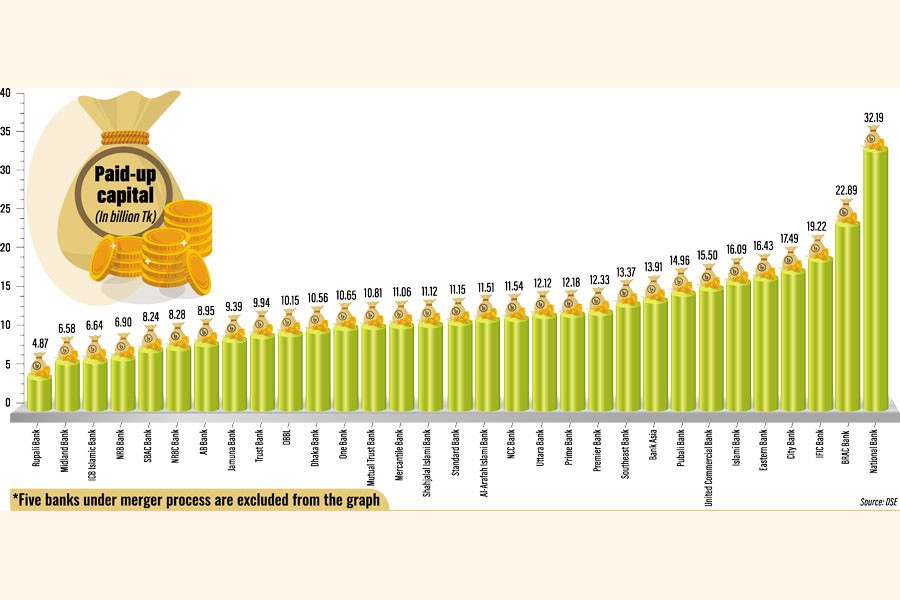
Through a directive issued on May 24, the central bank imposed a condition that no bank with a paid-up capital of less than Tk 20 billion will be allowed to pay dividends to shareholders. The restriction has been put in place so that lenders can strengthen their financial capacity to absorb future shocks by retaining profits.
Experts and industry insiders, however, say that without improving banks' asset quality through the enforcement of accounting standards, boosting paid-up capital would not benefit the industry.
National Bank Ltd. (NBL) is a case in point, with a paid-up capital of Tk 32.19 billion. It has been unable to declare any dividend over the past five years due to a staggering volume of non-performing loans and hefty losses. Among the 36 listed banks, only BRAC Bank and NBL meet the newly set criterion for cash dividends.
Two other banks - City Bank and Eastern Bank Ltd. (EBL) - are close to meeting the condition, with paid-up capital of Tk 17.49 billion and Tk 16.43 billion respectively. Market operators say these two banks might become eligible to pay cash dividends after a year of issuing stock dividends.
The remaining lenders will have to issue stock dividends for at least the next three to four years before becoming eligible to pay cash dividends.
Speaking to The FE, stockbrokers and fund managers say the portfolios of general and institutional investors include stocks of many banks because of their consistency in cash dividend payouts.
"The P/E (price earnings) ratios of banks are at a lucrative level. That's why investors, especially institutional ones such as asset management companies (AMCs), hold the stocks of banks," said Md. Ashequr Rahman, managing director of Midway Securities.
If banks cannot distribute cash dividends for a prolonged period, many investors who hold such stocks as part of a long-term investment strategy may withdraw their investments, Mr Rahman added. The impact, however, may not be visible immediately.
Apart from general and institutional investors, banks' sponsor-directors mostly prefer cash dividends and are therefore likely to be unhappy with the central bank's decision.
On the possible reactions from sponsor-directors, Md. Khalid Mahmood Khan, managing director of Southeast Bank, said, "Sponsor-directors usually want cash dividends. The bank's sponsors may discuss the issue at a meeting of the Bangladesh Association of Banks (BAB), [the association of the bank owners]." He, however, noted that the BB's directive could help improve the financial conditions of cash-trapped banks.
Ali Imam, chief executive officer (CEO) of EDGE Asset Management, said the central bank's decision to tie cash dividend eligibility to paid-up capital requirements was irrational.
Referring to NBL, he said the bank's large paid-up capital did not indicate its financial strength or weakness. As a regulator, the central bank could instead facilitate an improvement in banks' asset quality through strict enforcement of existing mechanisms such as IFRS 9.
NBL posted a loss of Tk 24.32 billion in 2025 alone, extending its losing streak to four consecutive years as a surge in classified loans continued to erode its financial health. The bank's cumulative losses over the past four years reached Tk 89 billion, while its non-performing loans exceeded 70 per cent by the end of 2025.
Mr Imam said that without ensuring accurate financial reporting by banks, any enhancement of paid-up capital would bring no real benefit.
For instance, if a bank has a paid-up capital of Tk 20 billion and incurs a loss of Tk 5 billion, its effective paid-up capital stands at only Tk 15 billion.
"The provision for distributing cash dividends by banks can be tied to their ROA (return on assets)," Mr Imam said.
The ROA measures how efficiently a company converts its physical and financial resources into profits.
It is a critical indicator of management's operational efficiency and an organisation's overall financial health.
Mr Imam also warned that the central bank's decision could prompt many investors to withdraw from listed banks. Such a withdrawal, if it materialises, would cause significant erosion of the equity market, as the banking sector alone accounts for more than 20 per cent of the market capitalisation of the Dhaka Stock Exchange (DSE).
mufazzal.fe@gmail.com