
Why debt ceiling is so important?
M Kabir Hassan and José Antonio Pérez Amuedo | Thursday, 1 June 2023
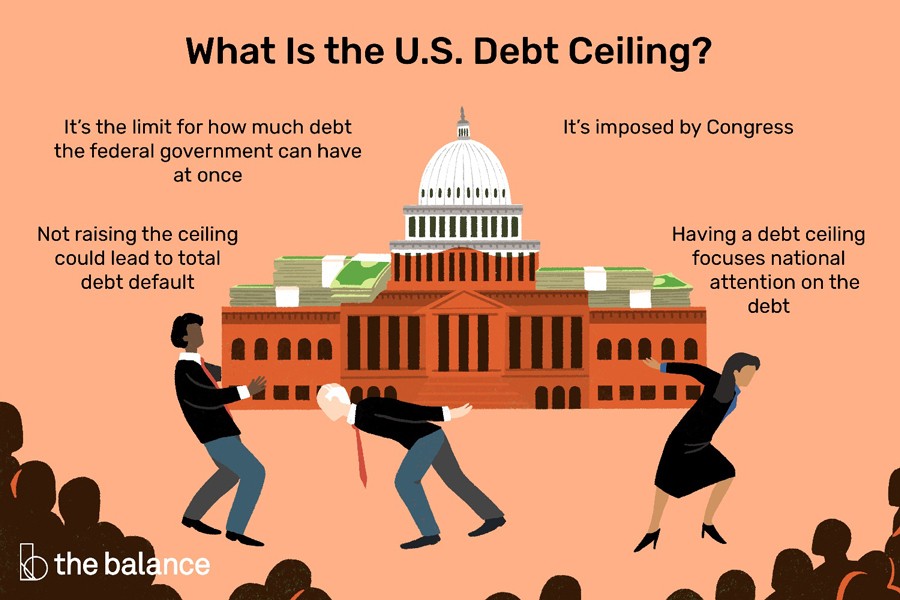
Regardless of the financial newspaper you may have perused recently, there is a prevalent term that likely caught your attention: debt ceiling. Esteemed figures such as Janet Yellen, the Secretary of the US Treasury, Jerome Powell, the Chair of the Federal Reserve, and even President Joe Biden have voiced their concerns regarding this unresolved issue. So, what exactly does the term "debt ceiling" signify, and why is it of utmost significance?
As commonly understood, the utilisation of debt as a means of financing is prevalent among most nations worldwide, including the United States. In the case of the US, they rely on the issuance of bonds, which are essentially debt obligations that enjoy the full backing and faith of the US government. These bonds come in various durations, encompassing short-term (e.g., 2 years), medium-term (e.g., 10 years), and long-term (e.g., 30 years) options. Given the US's strong credit- worthiness, characterised by a low probability of default, these bonds typically offer comparatively lower yields in relation to other bonds available in the market. Importantly, these bonds are accessible to a diverse range of investors, including individuals, corporations, and even other nations.
However, the issuance of debt by a country is not without limits. The debt ceiling represents the maximum allowable level of debt that a government can accumulate. Initially established in 1917 at $11.5 billion, this threshold has undergone a series of modifications since 1944, with 104 adjustments in total, including 94 increases and 10 decreases. Notably, the national debt of the United States has consistently risen under every president since President Herbert Hoover's term (1929-1933). As of May 2023, the current debt ceiling in the US stands at a staggering $31.4 trillion. Among the presidents who have contributed to raising this limit, President Barack Obama holds the distinction of overseeing the most significant increase. Under his leadership, the debt ceiling was augmented by approximately $9.3 trillion.
In recent years, the United States has experienced a significant surge in debt issuance, primarily due to the ongoing impact of the pandemic. Additional factors contributing to the escalating deficit include measures such as tax cuts and investments in foreign nations. Furthermore, the persistent demand for US treasuries has resulted in low-interest rates. Collectively, these circumstances have led to a mounting national debt, as the revenue generated falls short of compensating for the high level of indebtedness. Consequently, in January this year, the US reached its debt ceiling, triggering the need for the Treasury Department to implement what it terms "extraordinary measures" or workarounds to ensure timely payment of government obligations. However, it is crucial to acknowledge that this temporary solution cannot be sustained indefinitely, and a crucial decision must be made before the nation's financial resources are depleted.
The most widely anticipated and commonly sought-after solution to address the impending financial crisis is the raising of the debt ceiling, a measure that has been implemented on over 100 occasions in the past. By doing so, the United States would maintain its ability to borrow funds and fulfill its financial obligations each month. However, a significant obstacle lies in the path to achieving this resolution: the debt ceiling can only be raised through a vote in the House of Representatives, which currently holds a Republican majority. In situations where the ruling party does not have control over the House, as is presently the case with the current administration, there is no guarantee of reaching a mutually agreeable consensus. The Republicans know this, and they are using this in their favour; they are leveraging this impending deadline as a means to exert pressure on President Joe Biden to concede to spending cuts. On April 26, the House approved a bill to raise the debt limit by $1.5 trillion, albeit with the condition that spending be reduced to 2022 levels and subsequently capped at an annual growth rate of 1 per cent. However, it is widely anticipated that this bill will face significant challenges in the Senate, where the Democrats hold a majority.
With the United States spending funds at a faster rate than its revenue collection, and the nation's debt ceiling already reached, the pressing concern now centers around the impending exhaustion of financial resources and the potential consequences. According to Treasury Secretary Janet Yellen, the US is projected to exhaust its available funds as early as June 5, 2023. This critical juncture would signify a significant challenge, as the country would be constrained to allocate resources solely based on tax receipts, unable to meet its obligations fully. This predicament encompasses not only debt repayments but also extends to public sector salaries and other essential expenditures.
The distribution of US debt reveals an intriguing landscape, with the majority (69%) of the debt being held domestically within the United States. Among the domestic holders, the Federal Reserve accounts for 21.2% of the debt, while pensions or mutual funds possess 12%, and US households possess 6.7 per cent. On the international front, approximately 31 per cent of the US debt is in the hands of foreign entities. Japan emerges as the largest foreign holder, boasting around $1.1 trillion worth of US Treasury securities. Following closely behind, China and the UK hold significant amounts, with $867 billion and $654 billion respectively. This complex web of debt ownership highlights the intricate interplay between domestic and international financial stakeholders in the United States.
Theoretically speaking, the US would default in case of not finding a solution for this problem. That would affect the value of the US debt. US government debt is widely regarded as the safest asset within the financial system, and its influence extends far and wide. The value of numerous other financial assets is intertwined with the price of US government debt, given its significant presence in the market. In the unfortunate event of a US default, the consequences would be farreaching. Borrowing costs in America would experience a sharp and substantial increase, subsequently triggering a ripple effect of elevated borrowing costs worldwide. This sudden shift in the perception of safety would undermine the trust and stability associated with previously secure assets.
A US default would cast a shadow of uncertainty across wider financial markets. If the US government's ability to fulfill its financial obligations is jeopardised, the ramifications would reverberate throughout the global economy, creating a state of unpredictability. The Organisation for Economic Cooperation and Development (OECD) echoes these concerns, cautioning that a failure to reach any agreement would exacerbate macroeconomic disruptions. Given the current magnitude of the Federal budget deficit and the urgent actions required to address it, the potential ramifications of inaction would lead to severe economic upheaval.
Amid ongoing negotiations on the debt ceiling, President Joe Biden remains hopeful, expressing optimism regarding the progress being made alongside House Speaker Kevin McCarthy. Acknowledging the severity of the situation, both parties have emphasised that default is not an acceptable outcome, and that there is the need for bipartisan collaboration to reach a resolution.
Despite facing criticism from fellow Democrats for not being more directly involved in the debt-ceiling discussions, President Biden departed from the White House for a weekend trip to Camp David and Delaware. While some have raised concerns about his level of engagement, the president's team continues to work diligently on the issue, aiming to find common ground and avert any potential disruptions.
The recurring issue of the debt ceiling evokes concerns and uncertainties, yet historical patterns suggest that the turmoil surrounding it is typically short-lived, as the ceiling is ultimately raised. A default by the United States, the foremost global financial power, would yield few beneficiaries, making it highly unlikely. The responsibility for resolving this issue lies within the hands of the US government, bolstering confidence in a positive outcome.
However, continuously raising the debt ceiling and accumulating high levels of debt do raise legitimate concerns for any country. Such circumstances signify inefficiency in the nation's operations, resembling a company that consistently spends more than it earns and faces the risk of bankruptcy. The distinction here lies in the fact that we are discussing the most influential nation on the global stage, making its potential bankruptcy an implausible scenario unless an extraordinary event unfolds. A default by the US would have far-reaching consequences for the international community.
It is essential to note that US debt is universally regarded as the safest among all nations. Thus, if the US were to default, it would cast doubt on the perceived safety of other countries' debt. This, in turn, would complicate and escalate the cost of issuing debt for other nations, posing significant challenges and financial burdens. It should be a matter of time that people involved reach an agreement. And the good news is that both President Biden and the Speaker of the House has reached an agreement as of May 27.
M. Kabir Hassan is Professor of Finance at the University of New Orleans, USA. KabirHassan63@gmail.com
José Antonio Pérez Amuedo is a Ph.D. Student at the University of New Orleans, USA