
Why one WC trophy cannot define Ronaldo
His record, leadership and impact on Portuguese football cement an enduring legacy
Wednesday, 8 July 2026
Cristiano Ronaldo's sixth and final FIFA World Cup ended not with the fairytale finish he had dreamed of, but with tears, heartbreak and a painful reminder that even football's greatest careers can have one unfulfilled chapter, report agencies.
Yet if the World Cup remained beyond his reach, it did little to diminish a legacy that transformed Portugal into one of international football's most successful nations and redefined longevity and excellence in the modern game.
Portugal's campaign came to an end in the Round of 16 when Mikel Merino scored a stoppage-time winner to hand Spain a dramatic 1-0 victory. Having confirmed only a day earlier that this would be his final World Cup, Ronaldo's pursuit of football's biggest prize ended in heartbreaking fashion.
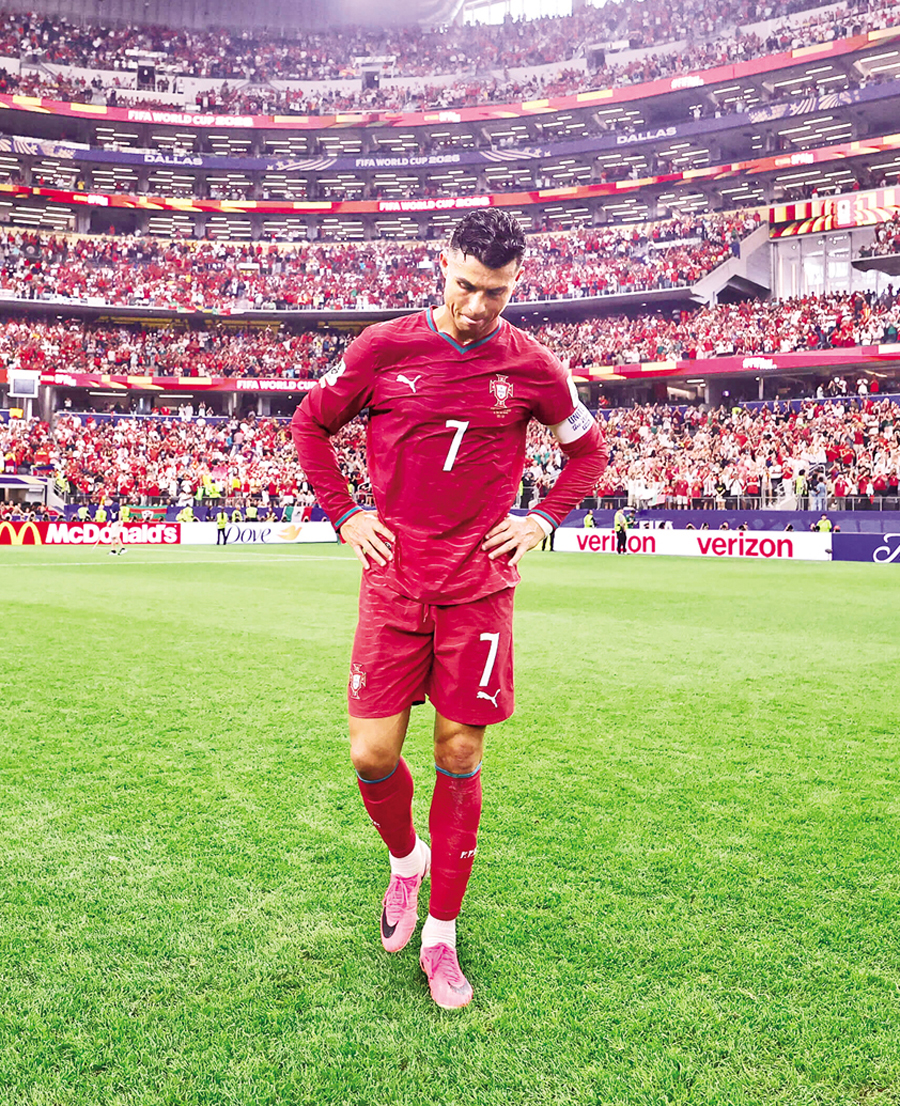
Portugal's Cristiano Ronaldo looks dejected after the end of the FIFA World Cup 2026 round of 16 match against Spain in Arlington, Texas, near Dallas, on Tuesday (as per BST). — AP
As the 41-year-old walked off the field for the final time at a World Cup, tears in his eyes, the moment instantly became one of the tournament's defining images. While such an ending might define many careers, for Ronaldo it simply marked the closing chapter of one of football's greatest journeys.
Few players have dominated the sport as completely as Cristiano Ronaldo. He has won league titles in England, Spain and Italy, lifted five UEFA Champions League trophies, claimed five Ballon d'Or awards and become men's international football's all-time leading goalscorer. Yet the World Cup remained the one prize that consistently eluded him.
Across six World Cups spanning two decades, Ronaldo carried the hopes of Portugal, often entering tournaments as the nation's greatest hope. His determination never faded, even as age gradually reduced the explosive pace that once made him one of football's most feared forwards.
Perhaps Ronaldo's greatest achievement cannot be measured by trophies alone.
When he made his senior debut in 2003, Portugal were respected but inconsistent. Their best World Cup finish remained third place in 1966, while their closest brush with European Championship glory before his arrival was a semi-final appearance at Euro 2000.
Everything changed during the Ronaldo era.
Portugal reached the Euro 2004 final before suffering a heartbreaking defeat to Greece. Rather than signalling a missed opportunity, that tournament marked the beginning of the most successful period in Portuguese football history. Portugal reached the semi-finals of the 2006 World Cup before finally winning their first major international trophy at UEFA Euro 2016, defeating hosts France. They later lifted the inaugural UEFA Nations League title in 2019 and won it again in 2025, firmly establishing themselves among world football's elite.
Ronaldo was not solely responsible for that transformation, but he became its defining symbol and its greatest ambassador.
His statistics underline his extraordinary influence. Ronaldo leaves international football with a record 233 appearances and 146 goals for Portugal, making him both the most-capped player and the highest goalscorer in men's international football history.
His dominance extended to the UEFA European Championship, where he holds the records for the most appearances, most goals and the most tournaments played. He also became the first men's footballer to score in six different FIFA World Cups.
His World Cup record stands at 27 appearances and 11 goals. Ironically, his only knockout-stage goal came in his final tournament, helping Portugal eliminate Croatia and briefly keeping alive the dream that had followed him since his World Cup debut in Germany in 2006.
Questions surrounded Ronaldo before this tournament as Portugal's new generation emerged and debate intensified over whether the veteran should remain an automatic starter.
He responded by scoring against Croatia and continuing to lead from the front. Against Spain, however, time finally caught up with him. Playing the full 90 minutes, Ronaldo managed three attempts on goal but could not produce the decisive moment that had defined so many nights throughout his remarkable career.
Spain's disciplined defence denied him one final piece of World Cup magic.