
Why the kitchen shouldn’t be a ‘Women-Only’ zone this Ramadan
Maliha Tasnim | Wednesday, 4 March 2026
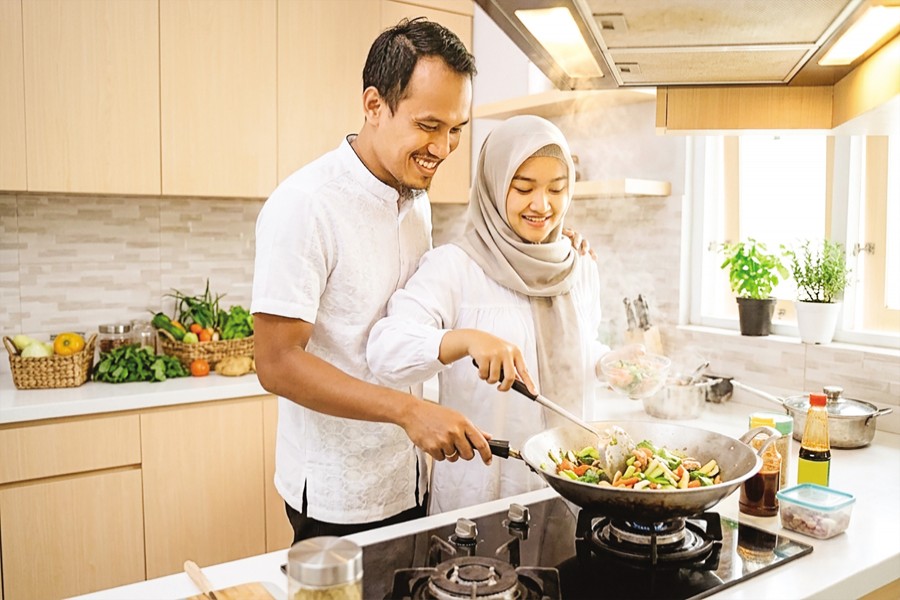
At the time of Maghrib’s call to prayer, many households move quickly toward the iftar table. In numerous homes, however, one familiar scene unfolds, while the family gathers, one person remains in the kitchen, finishing dishes, pouring drinks, or clearing space on the counter. By the time she joins the table, the meal may already have begun. The same rhythm often repeats before dawn at suhoor.
For many families, this arrangement feels normal. It is rarely announced or formally assigned. Yet over time, expectations take shape. In some households, mothers, wives, or daughters assume primary responsibility for preparing, serving, and cleaning up meals during Ramadan, even as they observe the fast themselves. The pattern is so common in certain cultures that it is often taken for granted.
The question, however, is whether such arrangements reflect Islamic teaching or longstanding social custom.
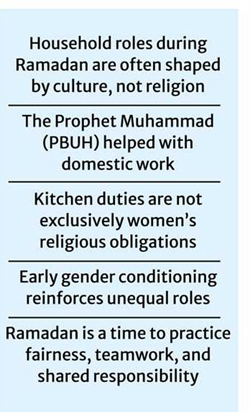
The life of Prophet Muhammad (PBUH) gives us a clear answer. According to Sahih al-Bukhari, Aisha (RA) narrated that the Prophet (PBUH) used to stay busy serving his family and mending his own clothes, leaving for prayer only when the call was made. He did not treat household work as a task beneath him. He was part of the home. He did not sit aside as food appeared before him. If the Prophet of Islam helped in his home, then how did the kitchen become a ‘women-only’ zone?
Ramadan, as a month of fasting and spiritual reflection, intensifies daily routines. Preparing suhoor before dawn and iftaar at sunset requires planning and effort. In larger households, cooking for extended family members can become physically demanding, particularly while fasting. Heat from the stove, time pressure before prayer, and post-meal cleaning can add to fatigue.
At the same time, Ramadanis a month associated with increased worship. Many men attend nightly Taraweeh prayers at the mosque and devote additional time to reciting the Qur’an. Women also pray, read the Qur’an, and seek spiritual growth during this period, whether at home or in communal settings. The demands of worship, therefore, are not limited to one gender.
Islamic teachings on marriage and family life emphasise mutual care and cooperation. While cultural practices vary widely across regions and communities, classical Islamic jurisprudence does not uniformly define cooking and cleaning as religious obligations assigned exclusively to women. In many interpretations, household responsibilities are understood within the broader framework of kindness, agreement, and shared understanding between spouses.
In several cultures, children internalise domestic roles from an early age. Girls may be encouraged to assist in the kitchen, while boys are directed elsewhere. Over time, such patterns can solidify into assumptions about what is ‘normal.’ In adulthood, these assumptions shape expectations within marriage and family life.
There is also another layer to this story. Sometimes mothers themselves stop their sons from helping. A son enters the kitchen and offers to cut vegetables. The mother says, “Leave it. You can’t do it. You are just a boy.” The daughter stands beside her and continues working. The son walks away. Not because he is lazy. But because he has been told that this space is not his.
Years pass. He does not know how to cook rice. He does not know how to wash dishes. He has never been taught. Then people say, “Men do not know these things.” But how will they know if they were never allowed to learn? By stopping boys from helping, we do not protect them. We limit them. We prevent them from learning basic life skills. We also place a silent weight on girls. They learn early that service is their role.
Some families, however, adopt different models. There are households where fathers prepare suhoor, sons wash dishes after iftaar, and responsibilities are rotated among family members.
The broader discussion is not about assigning blame to one group or about singling out all households. Practices differ widely across socio-economic backgrounds, cultures, and individual families.
Many men contribute actively to domestic work, and many women prefer to manage the kitchen as an expression of care and hospitality. The key issue raised is whether roles are chosen freely and shared fairly, or whether they are assumed without reflection.
Ramadan offers a context in which these questions naturally arise. The month encourages self-examination, not only in personal habits, but also in interpersonal conduct.
Acts of service within the home, such as setting the table, assisting with cooking, or cleaning after meals, can be understood as forms of kindness and solidarity with those who are fasting.
There is also a practical dimension. Teaching all children basic cooking and cleaning skills equips them for independence later in life. Regardless of gender, the ability to prepare simple meals, maintain a household, and contribute to shared tasks is widely regarded as an essential life skill. When domestic work is framed as a collective responsibility, it may reduce stress and foster a sense of teamwork.
At the same time, any discussion of household roles must account for context. Work schedules, health conditions, and individual capacities vary. In some families, one spouse may assume a greater share of domestic duties because of flexible hours or personal preference. In others, responsibilities may shift depending on circumstances. The emphasis in Islamic teaching is on fairness, compassion, and mutual agreement.
Small changes can alter the atmosphere of a household. A family member who offers to set the table, refill glasses, or manage cleanup may ease the burden on others. Rotating responsibilities for suhoor and iftaar can create a greater sense of shared experience. Even brief gestures of assistance can signal appreciation for the effort required to prepare meals while fasting.
Ultimately, the kitchen during Ramadan can reflect broader values. It can be a space where one person works while others wait, or it can become a space for cooperation and mutual support. The distinction often lies not in formal rules, but in attitudes shaped by faith, culture, and habit.
The kitchen should not be a space where women serve, and men wait. It should be a space for teamwork. A space where fasting is understood as a shared struggle. A space where worship includes helping hands.
Ramadan is for mothers. For wives. For daughters. For fathers. For sons. It is for every believer. And in this month of mercy, one of the most sincere acts of worship is simple: to stand up, walk into the kitchen, and help.
malihatasnim02215@gmail.com