
Why was the Turkey-Syria quake deadliest?
Wednesday, 8 February 2023
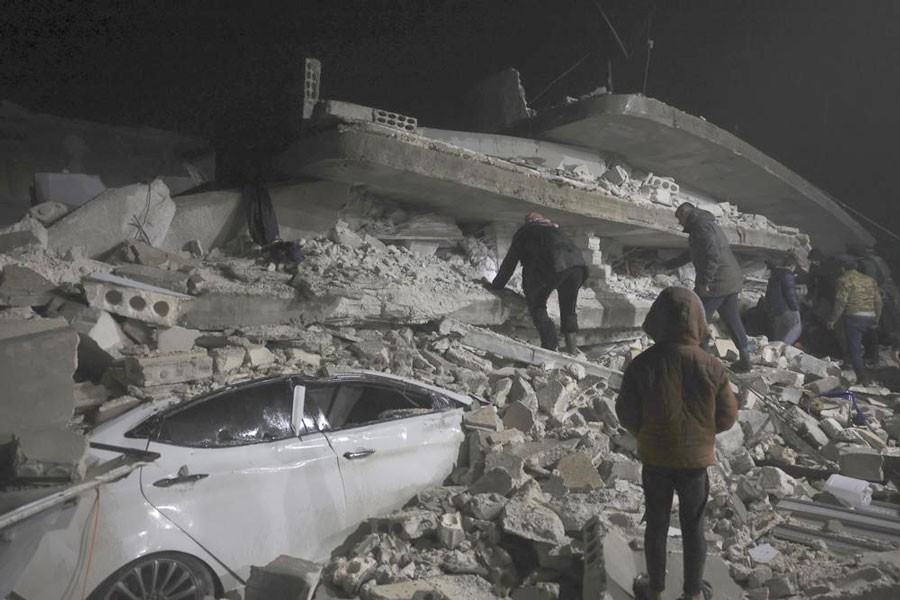
ANKARA, Feb 07 (Reuters/BBC): The magnitude 7.8 earthquake that struck Turkey and Syria on Monday is likely to be one of the deadliest this decade, seismologists said, with a more than 100 km (62 miles) rupture between the Anatolian and Arabian plates.
Here is what scientists said happened beneath the earth's surface and what to expect in the aftermath: The epicentre was about 26 km east of the Turkish city of Nurdagi at a depth of about 18 km on the East Anatolian Fault. The quake radiated towards the northeast, bringing devastation to central Turkey and Syria.
During the 20th century, the East Anatolian Fault yielded little major seismic activity. "If we were going simply by (major) earthquakes that were recorded by seismometers, it would look more or less blank," said Roger Musson, an honorary research associate at the British Geological Survey.
Only three earthquakes have registered above 6.0 on the Richter Scale since 1970 in the area, according to the US Geological Survey. But in 1822, a 7.0 quake hit the region, killing an estimated 20,000 people. On average, there are fewer than 20 quakes over 7.0 magnitude in any year, making Monday's event severe.
Compared with the 6.2 earthquake that hit central Italy in 2016 and killed some 300 people, the Turkey-Syria earthquake released 250 times as much energy, according to Joanna Faure Walker, head of the University College London Institute for Risk and Disaster Reduction.
Only two of the deadliest earthquakes from 2013 to 2022 were of the same magnitude as Monday's quake. The East Anatolian Fault is a strike-slip fault.
Survivors in streets as
rain hampers rescue
Rescuers are battling heavy rain and snow as they race against the clock to find survivors of a devastating earthquake in south-east Turkey. More than 5,000 people were killed and 15,000 injured in Turkey and over the border in Syria when the quake struck in the early hours of Monday.
The World Health Organization has warned the toll may rise dramatically as rescuers find more victims. Rescue teams have being stepping up their search for survivors.
Heavy machinery worked through the night in the city of Adana, with lights illuminating the collapsed buildings and huge slabs of concrete, in scenes repeated across southern Turkey. Occasionally the work stopped and a call of "Allahu Akbar" rose up when a survivor was found, or when the dead were recovered.
War-torn Aleppo
worst-hit in Syria
Syria's war-torn city of Aleppo is one of the places to have borne the brunt of the deadly earthquake, which also devastated parts of southern Turkey. More than 1,600 people have been reported dead so far in northern Syria following the quake.
Emergency rescue teams said many buildings were damaged or destroyed and that people were trapped under the rubble. The region is home to millions of refugees displaced by the civil war.
Control of northern Syria is divided between the government, Kurdish-led forces and other rebel groups. They remain embroiled in conflict.
Even before the earthquake the situation in much of the region was critical, with freezing weather, crumbling infrastructure and a cholera outbreak causing misery for many of those who live there.