
With his death Aylan moves world conscience
writes Abdur Rahman Chowdhury from Virginia, USA | Wednesday, 9 September 2015
A catastrophic famine hit the east African countries in 1984. Ethiopia and Sudan were worst affected. Drought had destroyed the crops in successive years, livestock gradually extinguished and people began migrating to urban and semi-urban areas. The international community was responding to the crisis but not at the magnitude warranted by the situation. While a two-year-old highly malnourished boy was crawling to the nearest gruel kitchen, a vulture had positioned a few yards away waiting for the baby to die so that it could eat the corpse. Cavin Carter, a British journalist, captured the scene and posted in the media. The picture, once published, shook the entire world. The people, intelligentsia and politicians urged their governments to come forward and save the people dying out of starvation in Ethiopia and Sudan. Nobody knew what happened to the journalist. A few months later he was found dead in his lonely apartment in the U K.
Now 31 years later, three-year-old Aylan has captured the headlines in the media. His body was found lying on a beach in Turkey. Abdullah Kurdi, father of Aylan, was a resident of Syrian city Koban. He moved to Turkey in order to escape the scourge of civil war. He heard about altruistic civil society in Scandinavia and decided to migrate with his family. His first attempt failed and on the second attempt an agent arranged a boat for 12 passengers, including Abdullah and his family. Sadly the boat capsized and Abdullah floated to the coast but did not find his wife and two children. He went back to the agreed meeting point near the refugee camp but his worst fear came true. He received the tragic news that his wife and children were dead. His dream of seeking a better life in north Europe turned into greatest tragedy.
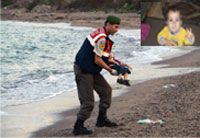
Aylan's body was washed up to the beach. Nilufer Demir from Dogan News Agency, Turkey captured the image of dead Aylan dressed in red T-shirt, blue shorts and sneakers and posted in the media. Many international news channels showed the footage which created opprobrium all over the globe. Many invoked it as a tragic symbol of indifference of the international community in the midst of a humanitarian catastrophe.
Syria, though not blessed with natural resources, gradually developed its infrastructure and tourism. Its 22 million population achieved a higher living standard with per capita income exceeding $1800. People are well educated and remained ardently committed to Arab nationalism. The country was under autocratic rule for ages. Hafiz al-Assad ruled the country ruthlessly for over 25 years. His son Basher al-Assad succeeded him. Given his education abroad and international exposure it was expected that Basher al-Assad would open up the society and gradually shift towards pluralism. Unfortunately, this did not happen; he followed his father's footsteps and pursued totalitarianism. The Arab Spring installed pluralism in Tunisia, dislodged 30 years of Hosni Mubarak's despotic reign in Egypt and culminated in the assassination of Gaddafi in Libya.
The Arab Spring caused uprising against Assad's dictatorial rule but could not bring about "regime Change" in Syria. All major cities and habitations witnessed civil strife with colossal damage of life and property. The army loyal to Assad confronted insurgency with heavy hand and reportedly used "deadly gas" against its own population. People, especially women and children, were caught in between. More than half of the refugees fleeing Syria are younger than 18 years. During the past four years over 250,000 people have been killed, four million took refuge in neighbouring countries and another four million became internally displaced. In the meantime, the civil war took a new turn with the emergence of the Islamic State (IS) in mid 2014 which swiftly brought a huge territory adjoining the central region of Iraq and south-eastern Syria under its control. Horrendous brutality unleashed by IS resulted in new waves of displacement of population - thousands sought shelter in Turkey.
The international community responded to the crisis with great generosity. The refugees were provided food, shelter and medication in the refugee camps built in Turkey, Jordan and Lebanon. But generosity has also its ups and downs. Twice in recent months World Food Programme, the food aid agency of the United Nations, reduced food rations and then suspended delivery of food rations due to fund deficit. The funding situation still remains precarious.
Refugee camps, regardless of how well-managed, cannot be the substitute of homes. Nonetheless, refugees have to put up with the "camp life." The hardships inflicted by harsh winter, hot summer, restrictions of movement, inadequate health care and pains of leaving behind lifelong earnings make people desperate for trying anything different. This is why, refugees in thousands decide to brave the extremely dangerous journeys in quest of unknown destinations.
The heart breaking footage of Aylan shook the conscience of the world but could not soften the attitude of Hungarian Prime Minister Viktor Orban. He authorised the army to install razor fences along the border to prevent the refugees from crossing into Hungary for onward journey to Germany, Austria and to Scandinavia. Viktor Orban apprehended that Muslim refugees would endanger the continent's Christian identity. He is not alone in rejecting Muslim refugees. Slovakia's government announced it would only accept Christians for settlement. The rest of the European leaders, however, viewed the crisis differently. Chancellor Angela Merkel urged the EU to seek a solution of the crisis and pledged to accept 800,000 refugees in Germany. She asked other countries to take due share of the burden. EU Council President Donald Tusk refuted Viktor Orban and said, "For a Christian, it shouldn't matter what race, religion and nationality the person in need represents," and proposed resettlement of at least 100,000 refugees across Europe. Austria, Finland, France and Sweden have agreed to accept the refugees fleeing from war zone.
The first batch of asylum-seekers reached Germany on Sunday. About 200,000 have arrived in Greece during this year and relief agencies estimate that another 200,000 are on the move. Pope Francis has made an appeal to the Christians to extend helping hands to the refugees. Washington and Ottawa's indolence in this regard, to say the least, is highly deplorable.
Nobody can expect Europe would accept four million Syrian refugees now camped in Jordan, Lebanon and Turkey. Granting asylum to a selected number of refugees cannot be the antidote either. The remedy lies in diplomatic offensive to stop the devastating war. But nobody knows how to bring the war to an end.
The US-Iran nuclear deal would remove one of the major irritants in the US-Iran bilateral relations. It would pave the way for enhanced dialogue between Tehran and Washington. Russia is at odds with the US over the sanction US-led coalition had imposed on Moscow. Nonetheless Russia would not be opposed to a diplomatic solution of the four-year long war. Under this changed circumstances, the US and EU countries would be well placed to work out a formula, in concert with Iran and Russia, to end the Syrian crisis.
Aylan's motionless body with face down the sands moved the conscience of the European leaders but this cannot be attributed to the leaders in the Muslim world. The Gulf States, oil-rich Arab countries and wealthy individuals could have come forward with resources to avoid disruption of humanitarian assistance to the Syrian refugees. But their priorities are different. Saudi King's recent extended holiday in France with an entourage comprising hundred guests lodged in luxury hotels takes precedence over the humanitarian crisis next door. The Organisation of Islamic Conferences (OIC) has utterly failed to broker peace deals amongst the warring factions in Syria, Libya and Egypt. It is time for the OIC to prove its relevance or dissolve itself and save tax payers hard earned money.
The writer is a former official of the United Nation.
darahman.chowdhury@hotmail.com