
Women economic empowerment: Gender and local economic development
Fahmida Akter | Sunday, 15 March 2015
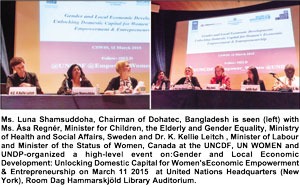
A high-level event on 'Gender and Local Economic Development: Unlocking Domestic Capital for Women's Economic Empowerment & Entrepreneurship' was held at the United Nations Headquarters in New York on March 11. It was organised by UNCDF, UN Women and UNDP. The event merits a particular attention in the context of the fifty-ninth session of the Commission on the Status of Women (CSW).
Ms. Asa Regnér, Minister for Children, the Elderly and Gender Equality, Ministry of Health and Social Affairs, Sweden gave the keynote at the event. Dr. K. Kellie Leitch, Minister of Labour and Minister of the Status of Women, Canada and Ms. Luna Shamsuddoha, Chairman of Dohatec, as entrepreneur from Bangladesh, also spoke on the occasion. It was moderated by Ms. Meg Jones, Chief of the Economic Empowerment Section, UN Women. Ms. Judith Karl, UNCDF Executive Secretary and Ms. Randi Davis, Director, UNDP BPPS Gender Team, participated on behalf of their respective organisations, among others.
"When women succeed, our country succeeds, and also we're contributing to the world succeeding," Dr. K. Kellie Leitch said. Luna Shamsuddoha was tweeted: "Luna is such an amazing inspiration and role model!" Luna talked at the event about works of women and bringing them into the global supply chain. She discussed the situation involving the Bangladesh women and girls and also about different initiatives in the digital space for gender empowered and entrepreneurship. The Bangladesh project for making 3000 girls entrepreneurs, Luna mentioned, is a joint initiative of BWIT, A21 Prime Minister's Office (PMO), Small and Medium Enterprise (SME) Foundation and Ministry of Women Affairs. This was a novel and innovative creation and collaboration that started to be appreciated right from the beginning. Luna also pointed to the seminal change in the outlook amongst women and girls in Bangladesh.
In response to domestic and global initiatives, Luna Shamsuddoha said, "the feeling of failure should fly away from women - take these opportunities." To be in the workplace, women, she noted, need friendly environment and role models. She was asked to explain some of her projects at home and abroad, in particular the public procurement and the favourable opportunities that lie therein. "We cannot have empowered women entrepreneurs without access to finance", she emphasised.
Some of related constraints and innovative and transformative solutions to unlock domestic capital for women's economic empowerment and entrepreneurship at the local level in the least developed countries (LDCs) were elaborated at the event. It featured the Transformative Impact Financing (TIF) approach, currently being developed.
Leveraging domestic resources is important for gender-sensitive local economic investments that have measurable and transformative impacts on the livelihoods of local communities, such as increasing women's employment and productive capacities as well as expanding business and market development.
These can help secure the positive spillovers that such investments can generate. The conversation at the event emphasized the need for an enabling environment that supports businesses development that is inclusive of all women and men, especially youth.
Speakers there showcased the potential of global online communities, to connect local entrepreneurs with regional and global markets and policy advocacy as well as to strengthen sharing of experiences and learning opportunities.
PRINCIPLES INTO PRACTICE: MARKETPLACE AND VALUE CHAIN: Luna Shamsuddoha was also a panelist on "Principles into Practice: Marketplace and Value Chain" event, organised by UN Women as a part 2015 Women's Empowerment Principles in New York. This session was devoted to drawing in women entrepreneurs in the global supply system and also to focusing on the impediments that remain in the way. Market opportunities, change, efficiencies, logistics, public procurement opportunities, infrastructure and security were discussed at the event.
The discussions in the session included, among others, an overview of the market system and high-potential women entrepreneurs and women's collectives.
Concrete examples of engaging women in the value chain were also featured. Innovative ways of engaging women entrepreneurs, workers and farmers within the value chain, including women generally excluded from the global marketplace, were presented.
The benefits that accrue to the SMEs and also to women were brought out during the discussions. The contribution that a focus on high-potential women entrepreneurs can help create employment for women was highlighted in the discussions. The role of women's collectives like cooperatives, associations, networks etc., that play in the whole process were discussed with real life examples from the distinguished panel. The contribution of the Bangladesh Women in Technology in the country's efforts to coalesce multiple organisations to scale up the engagement in creating and supporting entrepreneurs was highlighted.
The interactive event was moderated by Meg Jones, Chief, Economic Empowerment Section, UN Women, the speakers/panel participants were Nedra Dickson, Global Supplier Inclusion and Sustainability Lead, Accenture for market systems from corporate perspective, Dana Smith, Trestle Group for support to high-potential women entrepreneurs, Luna Shamsuddoha, Chairman of Dohatec, Bangladesh for ICT value chain/pipeline, Patricia Morris, CEO, Women Thrive International for women's collectives, Mpume Mqwebu, Head Chef, Africa Meets Europe Cuisine Ltd, South Africa for including women farmers in the culinary value chain and Anna Falth, EmpowerWomen Manager, UN Women.
It is to be noted that one of the women's empowerment principles calls for companies to make inclusive sourcing a key pillar in their business strategy. There are clearly opportunities for rapid growth of women in business in developing countries and for Bangladesh in particular, Luna pointed out.
The exceptional position of Bangladesh being already in the global supply chain, she noted, provided an opportunity for international corporations to bring Bangladesh women entrepreneurs into their inclusive sourcing programmes.
The participation of Bangladesh was more to bring a success story of women in entrepreneurship and IT in particular.
The writer is a senior software engineer and Chief Technical Officer of an IT company.
faktergm@gmail.com