
Women seed entrepreneurs at community level
M. G. Neogi | Sunday, 11 January 2015
Seeds are the most important input to increase crop production. They enhance food security and alleviate poverty in the agro-based developing countries. It is believed that good seeds alone can increase 20-25 per cent yield. If the seed is capable of ensuring higher yield, then the use of other inputs like fertilisers, irrigation, pesticides, etc. becomes fruitful. Otherwise, these become futile. Therefore, the best techniques need to be followed to produce and preserve good quality seeds.
In Bangladesh, a large number of farmers throughout the country use their self-produced and preserved seeds to cultivate rice. The seeds comprise more than 50 per cent of the total rice seed requirement of the country. Eighty-five per cent of self-preserved seeds are used by the poor farm households.
Almost hundred per cent of the seeds are processed at farm household-level by women, and they are solely involved in drying, cleaning and storing these seeds. A 2011 survey report indicates that from 1999 to 2006, participation by men in the agricultural labour force is declining, while female agricultural labourers are increasing in the crop fields. The said report notes that as men move from farming to the service industry and other non-agricultural sectors, women are gaining more acceptance as paid farm workers and post-harvest processors. Women are now working in crop fields along with men, a rare scene in the past. They prepare seedbeds, transplant seedlings, engage in activities like weeding, harvesting, and threshing of crops. Most importantly, almost hundred per cent women farm households are solely involved in cleaning, sun-drying and storing the crops and their seeds at their houses.
But most of the women farm households are not capable enough to produce quality seeds and they have very shallow knowledge on how to produce and process quality rice seeds. Normally, farm households are cultivating rice for their consumption and sale, and they save a portion of it as seed, which is never maintained properly as seed. These seeds are usually inferior in quality with mixtures of other varieties, and thus the farmers incur a huge loss, because of poor yield-capability.
The awareness and knowledge of women of farm households about quality seeds, their importance and seed processing, as well as preservation techniques, are very limited. They are not able to maintain quality storage facilities at household level due to their poor housing condition. Although women are directly involved with seed processing and preservation at their households, there is no institutional linkages in order to improve their awareness and skills. A huge number of women households in rural areas are involved with micro-credit programmes, but they have very limited access to 'know-how' on quality seeds. Effective storage equipment is also one of the most important components to keep the seeds at quality level, as most of the women farm households store their rice seeds in traditional containers, like jute bags, soil-made containers, tin boxes, gunny bags, etc. which are not found to be satisfactory in storing rice seeds and maintaining their quality.
With the available production technologies, it is possible to produce around six tonnes of crop on one hectare of land, but the average production is less than three tonnes per hectare. Among the many constraints, awareness and knowledge at women farm household level, quality seeds, post-harvest drying and storage facilities are considered the major barriers to improved rice production technologies. Therefore, there is the need for making the farmers aware and train them, especially the women farm households, for quality seed production, processing and preservation by using simple and affordable technologies.
It is proved that the traditional methods of seed storage cause lower germination and infestation of seeds by pests and diseases, which ultimately leads to lower production. As the requirement of quality seed production and preservation is a serious constraint for improved rice production, the International Rice Research Institute (IRRI) strongly feels about an immediate need to equip grassroots farmers with training through local seed producing associations for quality seed promotion in rural areas. Through using quality seeds, yields can be increased between 15 to 30 per cent. Farmers will get more food and have more income for their families, if they use quality seeds.
Under USAID and BMGF (Bill & Melinda Gates Foundation) support, IRRI works with rural poor farm households, where NGOs, private local seed producers and the government agricultural extension department (DAE) are the partners of this project. The three major areas like roughing, drying and storing proved the most important factors to improve seed quality. A polyethylene bag which has been developed by IRRI named as IRRI Super Bag has also been proved to be unique and affordable equipment for the farm households of rural areas to store rice seeds at household level maintaining its quality. The IRRI has provided 25,000 IRRI Super Bags to 8,500 households (mainly women), through the partner organisations like the government extension agencies such as DAE, local NGOs and local seed producers.
Seeds preserved in the IRRI Super Bag as storage equipment maintain higher germination, viability and vigour as well as disease-free plants, and thus yield is comparatively much higher than from the seeds available from other sources. Hence the seed production technology as well as seed processing and preservation technology under this component is treated as a complete package programme. The seeds production and preservation technology has been provided to the poor community households enabling them to produce quality seeds at community level. In the same way, seed processing and preservation training can be provided to women of farm households to keep the seeds on right track as post-harvest technology. Based on practical learning, women are now more aware of moisture percentage in seeds and are interested to store them in storage equipment (IRRI Super Bag) for airtight preservation.
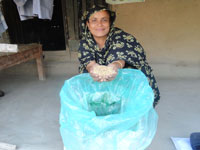
A trained woman of a farm household, Rexonara Khatun, speaks about the usefulness of this storage equipment. Rexonara and her husband Arafat Hossain live in Aila-affected saline-prone village named Treefol Kathi of Ishwaripur union under Shyamnagar upazila of Satkhira district. They have 60 decimals of land. Before Aila, they cultivated rice and received a very good harvest. But due to Aila, their land was affected by saline water and they failed to have any reasonable harvests after the Aila storm. Through a group meeting with Nakshikantha - a NGO, in 2012, she came to know that a newly-developed salt-tolerant rice variety can grow in salt-affected land. She showed her interest about the rice variety and received Binadhan-8 rice seeds as salt-tolerant rice variety from Nakshikantha and cultivated that in their land and got a good yield of around 3.8 tonne/ha. This was the first time after the Aila, when they cultivated crop and harvested such an amount of rice. Rexonara also received training on how to produce and process as well as store the rice seeds. She got IRRI Super Bag during a training programme. She stored dry and cleaned quality Binadhan-8 rice seeds in IRRI Super Bags in airtight condition.
Inspired by the achievement of Rexonara, her neighbouring farm households are demanding seeds of this variety. Rexonara decided to keep seeds in her IRRI Super Bags to maintain their quality and sell them to her neighbours in the next season.
Hundreds of trained women of farm households are now producing quality seeds at household level and are getting higher yields. They also supply their surplus seeds to their neighbours, relatives and other farmers.
A number of trained women of farm households have become seed entrepreneurs at community level getting benefits and enjoying better livelihood.
As the quality seed production and preservation is a serious challenge for improved rice production, IRRI strongly feels the immediate need for equipping grassroots farmers with training through local seed producing associations. It also feels the urgency for quality seed promotion in rural areas.
The article is adapted from a paper Dr. M. G. Neogi, a consultant with the International Rice Research Institute (IRRI), presented at the International Rice Congress held at
Bangkok in 2014.
mgneogi@gmail.com