
Work for peace, prosperity shunning path of war, PM tells UNGA
Sunday, 24 September 2023
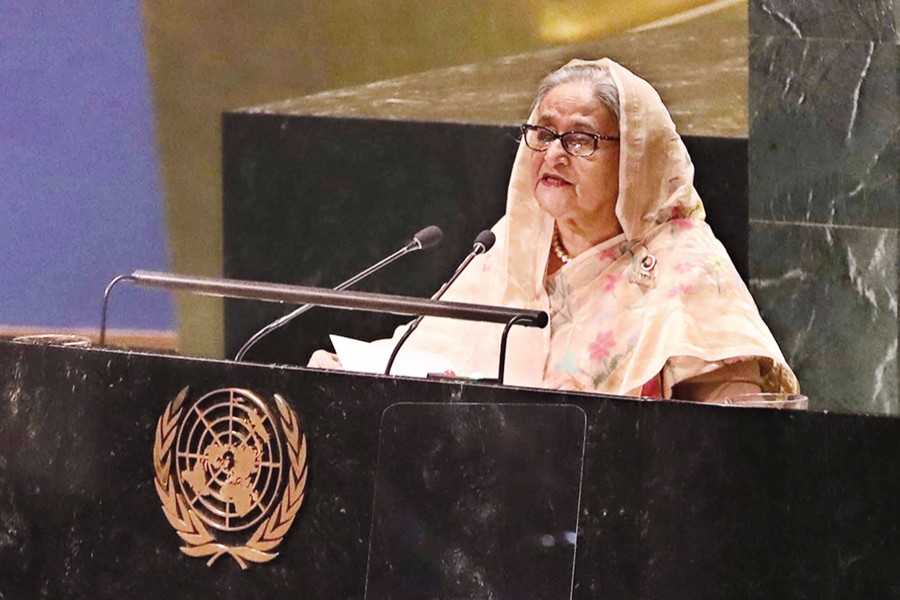
NEW YORK, Sept 23 (BSS): Prime Minister Sheikh Hasina has called upon the global leaders to work in unison for peace, welfare of mankind and prosperity by shunning the path of war and confrontation.
"My appeal today is to all of you - to the leaders of the world, to shun the path of war and confrontation, and to work collectively for enduring peace, welfare for humankind and economic prosperity for our people and future generations," she said.
The prime minister was addressing the General Debate of the 78th session of the United Nations General Assembly (UNGA) at the General Assembly Hall here on Friday.
She said the overall progress towards a peaceful and prosperous common future is faced with threats due to the impacts of the pandemic, the effects of an existential climate crisis, and the wide ramifications of the war in Ukraine affecting global food, financial, and energy securities have greatly impeded the achievement of SDGs in developing countries.
The premier said Bangladesh always supports the Secretary-General, Antonio Guterres, for his strong commitment to strengthening multilateralism and for his efforts, bold statements, and his far-sighted and pragmatic steps toward making the UN deliver its mandates and stand up to the challenges of the current world.
In her address delivered to the UNGA session, she highlighted the Rohingya crisis, climate change, food crisis, human rights, women empowerment, healthcare, sustainable development goals (SDGs), terrorism and the government's inclusive economic development and other global and regional issues.
Like the previous years, Sheikh Hasina addressed the session of the UNGA in Bangla for the 19th time following the footsteps of the Father of the Nation Bangabandhu Sheikh Mujibur Rahman who delivered his address in Bangla in the UNGA on September 25 in 1974.
This year's UNGA theme is: "Rebuilding trust and reigniting global solidarity: Accelerating action on the 2030 Agenda and its Sustainable Development Goals towards peace, prosperity, progress and sustainability for all".
She referred to assassination of 18 members of her family that included her father, then President of Bangladesh, Father of the Nation Bangabandhu Sheikh Mujubur Rahman, her mother and three brothers, three sisters-in-law and paternal uncles on August 15 in 1975.
The premier said she and her only sister survived the brutality as they were abroad at that time.
"Before that, in 1971, three million of our countrymen were killed during our great War of Liberation while two hundred thousand women were heinously tortured and abused," she said.
"As a victim of and witness to brutalities of war and assassination. I can feel the pain and agony that people endure due to the horrors of wars, killings, coup d'‚tats and conflicts," she said.
Let's give Rohingyas a brighter future.
In her address, Sheikh Hasina has sought global leaders' attention to the forcibly displaced Rohingya people from Myanmar as their mass displacement has witnessed six years.
Mentioning that the displaced Rohingyas want to return to their own country, Myanmar, and live a peaceful life there, she said: "Let's bring those destitute people hope of a brighter future in their own land and thereby foster safety and stability in the region".
"Out of humanitarian concern, we have given shelter to those who fled their homes for safety. However, the situation has really turned unbearable for us now. The prolonged presence of the Rohingyas in Bangladesh has caused serious ramifications on the economy, environment, security, and socio-political stability in Bangladesh," she said.
Sheikh Hasina opined that uncertainty over repatriation has led to widespread frustration and this situation can potentially fuel radicalization.
"If the problem persists further, it may affect the security and stability of the entire region, and beyond," she said.
Rich countries must fulfill their $100 climate commitments, she said and called upon the developed countries to walk on their promises.
"We call upon the major emitters to submit and implement ambitious NDCs. The developed economies must fulfill their 100-billion dollars commitments," she said.
The development needs of the climate-vulnerable countries must be considered, she said, adding that they demanded an urgent operationalization of loss and damage funds as agreed in COP27.
"We call for a stronger global solidarity in sharing the burden of climate migrants induced by sea-level rise, salinity increase, river erosion, floods, and droughts," she said.
Despite contributing less than 0.47% of global emissions, Bangladesh is one of the most climatically-vulnerable countries in the world, she said.
Sheikh Hasina went on saying that the adverse effects of climate pose serious threats to the security and economic prosperity of our present and future generations while urgent, bold and ambitious collective actions are needed to address these threats.
"Bangladesh is committed to protecting and preserving the environment and biodiversity and pursuing a climate-resilient sustainable development path," she said.
The premier said Bangladesh established the "Bangladesh Climate Change Trust Fund" back in 2009 to finance climate adaptation and allocated 480 million US dollars to this fund so far from our own resources.
Sea dykes, cyclone shelters are constructed; greenbelt and tree plantation initiatives are undertaken for climate adaptation and mitigation purposes, she said.
"We are implementing the world's biggest housing project for people displaced by the impacts of climate change in Cox's Bazar by constructing 139 multi-storied buildings with all necessary amenities to shelter 4,409 climate change-affected families," she added.
The premier said they are implementing the "Bangladesh Delta Plan 2100" with an objective to achieve a safe, climate-resilient and prosperous delta through coordinated delta management process.
She said her government has undertaken the "Mujib Climate Prosperity Plan". "We are working to ensure our gradual transition from climate vulnerability to climate resilience," she said.
"More than six million people are using solar home systems. We are also working for a more sustainable energy mix. We hope to have 40% of our energy from renewable sources by 2040," she added.
Sheikh Hasina called for establishing regional "food banks" for emergency situation against the spiral of prices of essentials.
"For the countries like ours, uninterrupted access to fertilizers must be ensured. Furthermore, we need global investment in cold chains to preserve the food we produce. I have proposed initiating the regional 'food banks' for emergency situations. We must collaborate in research and development of climate-resilient crops," she said.
The premier said the interlinked crises of the past few years have pushed up prices of food, energy and commodities globally, weakening our efforts to recover from the pandemic.
"As an energy-and food-importing country, Bangladesh's import bills have shot up significantly, having a negative impact on our foreign currency reserves. Despite these challenges, we have ensured food for everyone," she said.
The government, she said, is providing 10 million people in the low income bracket with rice and other commodities at affordable prices and has taken different initiatives to keep inflation under control.
"I have called upon our people to grow their own food and leave no cultivable land uncultivated. Our scientists have now developed climate-resilient varieties including drought-and flood- and salinity-tolerant varieties of crops," she said.
She said they are deeply concerned that the Black Sea Grain Initiative has become defunct and call upon all parties concerned for its early restoration.
Sheikh Hasina said a political declaration will accelerate implementation of the 2030 agenda.
"We believe, despite some limitations, the Political Declaration will accelerate the implementation of the 2030 Agenda," she said.
"Therefore, we welcome the successful holding of the SDG Summit this year and the adoption of its Political Declaration," she continued.
The premier said for a timely achievement of SDGs, financing is one of the most critical factors adding that unfortunately, however, the international financial infrastructure is barely aligned with the SDGs, nor can it respond to the financial needs of developing countries especially during crises.
"Today, we urgently need an international financial architecture that will help developing countries receive concessional, low-cost, low-interest-rate funds, with minimum conditionalities," she said.
Besides, developing countries must also have equitable access to IMF's SDR funds during emergencies and disasters and s special 'disaster clause' should be included in all lending instruments, she opined.
"We must make all efforts to collectively address the common challenges of humanity to secure a peaceful, prosperous, and sustainable future for all. And, for that, we must choose unity, solidarity, and multilateralism over fragmentation, insularity and isolation," she said.
Since assuming office in 2009, the premier said they have invested heavily to build a human-centric, inclusive, modern democracy as envisioned by our Father of the Nation Bangabandhu Sheikh Mujibur Rahman.
Following his pathway, she said their tireless efforts, pragmatic policy interventions and forward-looking investments have transformed Bangladesh from a lower-middle income country to a middle-income country.
"We have reduced the poverty rate from 41.5 percent in 2006 to 18.7 percent in 2022 and the extreme poverty rate from 25.1 percent to 5.6 percent," she said.
Sheikh Hasina said, "Building on our success in achieving MDGs, we have made sustained progress in achieving the SDGs, she said, adding that like other countries in the world, Bangladesh also faced serious challenges. COVID 19 pandemic, various man-made crises and natural disasters have intensified those challenges manifold.
"We thank the Secretary-General for proposing a 500 billion dollar SDGs stimulus package and demand its early operationalization," she said.
In Bangladesh, she said they have taken a set of tough fiscal and policy choices to ensure macroeconomic stability and to control inflation during and post pandemic period.
"On the other hand, we have increased our investment in social safety net programs and provided targeted support for agriculture, Small and Medium Enterprises (SMEs), and other vulnerable sectors. We have expanded the social safety net coverage to ensure social and financial security of destitute women, widows, the elderly, persons with disabilities, persons of third gender and other marginalized segments of the society," she said.
In the current fiscal year, a total of 12 billion US dollar has been allocated for the social safety net programmes, she said, adding that this year, they have introduced the Universal Pension Scheme through which any citizen aged between 18 and 50 years of age can avail of old age benefits.
The premier arrived in New York on September 17 to attend the 78th UNGA session and other high-level side events.