
RESTORING DHAKA'S RIVERS TO LIFE
World Bank to back $8.5b 'Blue Network' megaproject
Pledges $600m for first phase of flagship programme
JAHIDUL ISLAM | Monday, 6 October 2025
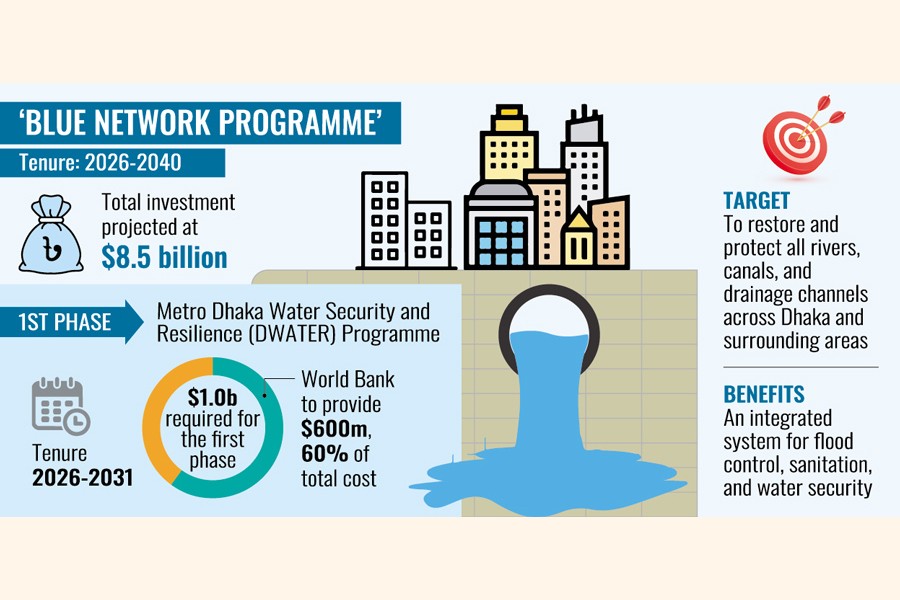
The World Bank has agreed to lend US$600 million in the first go to support the interim government's flagship 'Blue Network Programme' that seeks to restore to life and protect all rivers, canals and drainage channels in and around Dhaka.
Officials say the initiative aims to create an integrated ecological system for flood control, sanitation, and water security - marking one of Bangladesh's most ambitious urban-resilience projects to date.
The funding will cover around 60 per cent of the $1.0 billion required for financing the programme's first phase, to be implemented between 2026 and 2031.
The wider initiative is expected to continue until 2040, with an aggregate investment projected at $8.5 billion, officials at the Economic Relations Division (ERD) have said.
The World Bank's involvement signals renewed international confidence in Bangladesh's efforts to transform Dhaka's water infrastructure.
The city's river system, once a lifeline for trade and transport, has become choked by pollution, encroachment, and poor drainage, leaving millions vulnerable to urban flooding and waterborne diseases.
A senior official at the Economic Relations Division (ERD) says the government has also proposed the Metro Dhaka Water Security and Resilience (DWATER) Programme, seeking a $550-million investment component along with $50 million in technical assistance to support institutional reforms, policy frameworks, and preparatory activities.
"To expedite the scheme's approval, the World Bank has already issued a Concept Programme Information Document (PID), a draft Environmental and Social Systems Assessment (ESSA), and other preliminary papers," the official adds.
According to the ERD, the World Bank may provide $350 million from its concessional lending arm, the International Development Association (IDA), while the remaining funds for the first phase have yet to be explored.
Officials say the DWATER project will focus on universal access to safe water supply and sanitation (WSS), flood-and drought-risk reduction, and sustainable water-resource management.
Priority areas include drinking-water supply, sewerage-and sanitation services, and stormwater drainage, along with supporting measures such as solid waste management, industrial-effluent control, and canal rehabilitation.
The World Bank's concept paper paints a stark picture of Dhaka's water crisis. Urban and industrial zones in and around the capital discharge untreated sewage and toxic effluents into rivers and canals, causing pollution and siltation besides encroachment that block natural drainage.
And the sprawling megacity's vulnerability to climate change is growing, with flooding risks amplified by declining waterway capacity and inadequate drainage.
The document highlights that the Buriganga, Turag, and Shitalakhya rivers receive an estimated 1,500 million litres of untreated sewage, 2,400 million litres of industrial effluents, and 10,000 tonnes of solid waste daily-- a situation that has turned once-vibrant rivers into open sewers.
The Washington-based global lender also has found wide disparities in water and sanitation services.
While Dhaka city has around 70-percent piped-water coverage, neighbouring cities manage less than 25 per cent. "Heavy reliance on contaminated groundwater, coupled with limited treatment facilities, poses severe health risks."
Sewerage coverage in Dhaka remains at only 20 per cent, and just 2.0 per cent of households benefit from proper faecal-sludge management.
Access to safe sanitation is even lower in surrounding cities. The World Bank warns that weak sanitation worsens water pollution, while pollution and flooding in turn undermine the sustainability of WSS services.
The Blue Network Programme will be led by the Local Government Division (LGD) in coordination with the Ministry of Water Resources (MoWR).
Implementation will involve Narayanganj City Corporation, Gazipur City Corporation, Dhaka South City Corporation, Dhaka North City Corporation, and Dhaka Water Supply and Sewerage Authority (Wasa).
The initiative was first unveiled last year by Syeda Rizwana Hasan, Adviser for Environment, Forest and Climate Change of the interim government.
The 15-year programme, aligned with Rajdhani Unnayan Kartripakkha's (Rajuk) Detailed Area Plan (DAP) 2022-2035, aims to reconnect Dhaka's waterways and reduce flood risks by restoring natural drainage and improving water quality across the metropolitan region.
If and when fully implemented, the Blue Network Programme could mark a turning point in urban water management, transforming Dhaka's rivers from polluted backwaters into arteries of resilience, sustainability, and economic vitality.
jaid.rn@gmail.com