
‘Nepal firmly believes in the relevance of SAARC’
Asjadul Kibria | Sunday, 12 February 2017
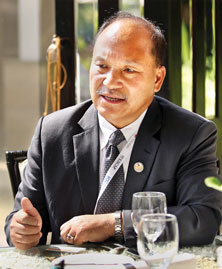
Despite a lot of tension over the future of the South Asian Association for Regional Cooperation (SAARC), the relevance of the regional grouping still exists and it will continue to do so.
Commerce minister of Nepal Mr Romi Gauchan Thakali expressed the view while talking to the Financial Express Thursday last on the sidelines of the two-day Asia-Pacific Business Forum in Dhaka.
"SAARC is an established institution and Nepal firmly believes in the relevance of SAARC," he said, expressing satisfaction over the SAARC's moving forward during the last three decades, despite lot of impediments and tensions. "Now, we have to work more to advance the regional cooperation arrangement."
He termed the South Asian Free Trade Area (SAFTA) a vital tool for extending the regional cooperation.
Regarding the strength of South Asia, he pointed out the demographic dividend of the region. "Our population is our greatest resource and strength."
Mr Thakali said that besides SAARC, Nepal was also taking greater interest in BIMSTEC (Bay of Bengal Initiative for Multi-Sectoral Technical and Economic Cooperation).
"Being a land-locked country, Nepal's interest in BIMSTEC is mainly to establish wider links with East and South-East Asia," he explained. "BIMSTEC can be a gateway to ASEAN (Association of Southeast Asian Nations)."
Nepal is likely to host the fourth BIMSTEC summit at the end of this year.
Bangladesh, Bhutan, India, Nepal and Sri Lanka are the common members of both the SAARC and BIMESTEC. While Afghanistan, the Maldives and Pakistan are SAARC members only and Myanmar and Thailand are in BIMSTEC grouping only.
Mr Thakali said establishing the regional connectivity was a key to further progression of both the SAARC and BIMSTEC groupings.
"For effective connectivity, we need huge investment in infrastructure," he said. "Besides road network, we need to invest in rail network too to facilitate carrying bulk cargoes across the region."
The Nepalese trade minister also mentioned that his country had not been able to tap the benefit of the low cost access to the sea ports of Bangladesh mainly due to lack of adequate infrastructure and connectivity.
"We thanked the Bangladesh government as they allowed us to use the sea ports at 50 per cent lower charge," he said. "But, the poor road condition impede us to use the opportunity."
"Nepal wants to see that both Bangladesh and India are doing more to ensure better connectivity," he added. "Bangladesh is now a vibrant country."
He also emphasised the successful implementation of Bangladesh-Bhutan-India-Nepal (BBIN) Motor Vehicle Agreement (MVA) to enhance road connectivity in the sub-region.
The trade minister of the Himalayan country also believed in wider connectivity as he mentioned energy cooperation among the regional countries.
"Nepal wants to export power in future," he said. "Our annual power demand up to 2050 would be 10,000MW and we are able to generate as high as 80,000MW. So we can export it to India and Bangladesh."
Theoretically, Nepal has hydropower potential of over 80,000 MW while the country's economically feasible potential is 43,000 MW.
But, its current capacity is around 1,000MW. To meet the present shortage, the country is importing power from India.
Mr Thakali also mentioned that initiatives to set up cross-border transmission and distribution lines already started.
He also pointed out that the low-level of intra-regional trade in both SAARC and BIMSTEC regions undermine the prospects of both the regions as well as regional countries.
According to statistics available with Geneva-based International Trade Centre (ITC), intra-regional BIMSTEC trade stood at $74.53 billion in 2015 against $25.16 billion in 2005. Intra-regional trade stood at 6.2 per cent of the total global trade of the grouping.
On the other hand, intra-regional trade in SAARC stood at $ 46.51 billion in 2015 which was $16.64 billion in 2005. The ratio of SAARC intra-regional trade stood at 5.61 per cent of global trade.
Mr Thakali stressed the need fort trade and transport facilitation measures to enhance the intra-regional trade.
Asked whether the implementation of the Trade Facilitation Agreement (TFA) of the World Trade Organisation (WTO) would bring any positive outcome for the SAARC and BIMSTEC in this regard, he expressed optimism.
"The TFA will be very important for all the countries in South Asia," he said. "The success of TFA depends on implementation of the agreements, its rules and regulations."
The TFA will oblige all the member countries of the WTO to simplify and harmonise the export, import and transit procedures with electronic documentation. Only two ratifications are needed to make the agreement come into force.
Mr Thakali was of the view that TFA would be instrumental to dealing with the non-tariff measures (NTMs) as well as non-tariff barriers (NTBs). He also stressed facilitating the regional value chain.
asjadulk@gmail.com