
WAR DISRUPTION TO GULF TRADE ROUTES
Agro, vegetable exporters hit hard, seek market diversification
Freight charges on risky routes more than double
JASIM UDDIN | Thursday, 26 March 2026
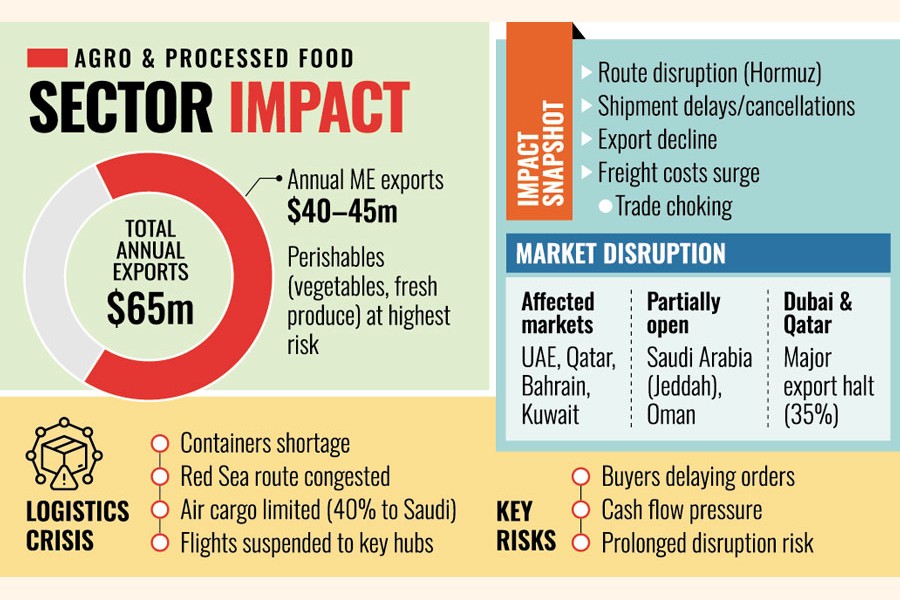
Bangladesh's agro-processed food and vegetable exporters lament irreparable business losses as the ongoing Middle East war chokes key Gulf trade routes, halts shipments and drives up freight costs.
Industry insiders say exports to major destinations in the Arab world such as the UAE, Qatar, Bahrain and Kuwait have plummeted, following shipment delays and cancellations.
Facing mounting uncertainty, some leading agro-based food companies have begun restructuring operations to contain losses and maintain liquidity.
One such exporter has suspended product supply to the domestic market, too, amid fuel shortages and fears of power outages, while advising all business units to revise pricing and prioritise high-margin essential products.
Production of non-essential items is being scaled back, with a stronger focus on preserving raw materials and avoiding wastage during the ongoing logistical crisis.
The company has also instructed its units to accelerate the recovery of outstanding payments and rely on existing inventories to keep markets supplied until the situation stabilises.
Seeking anonymity, a senior official has said business-unit heads have been asked to reassess available raw materials and determine production priorities in line with market realities.
"Raw materials should be preserved rather than used for non-essential products. We are focusing only on basic items with better margins, while avoiding low-margin production given the severity of the crisis," the official said.
He added that unsold goods produced at earlier prices are being released quickly into the market to maintain cash flow, while distribution channels are being kept active using existing dealer stocks.
Industry insiders warn that prolonged disruption to Gulf trade routes could lead to significant export losses, particularly for perishable agro-and vegetable products unless alternative logistics and market-diversification measures are put in place quickly.
Talking to the FE, Proshanta Kumar Ghosh, DGM (Export) of ACI Foods Limited, said most carriers are now unwilling to accept containers that usually move through the Strait of Hormuz -- a hotspot in the US-Israel war against Iran -- forcing exporters to halt shipments or seek alternative routes.
"As a result, our key markets in the Gulf are now fully stocked," he said, adding that shipments via the Red Sea route through Jeddah are continuing, though under significant constraints.
Freight costs have more than doubled amid the disruption. The average cost of shipping a 20-foot container to Jeddah has surged to $5,000 from around $2,000.
"Even our previously negotiated rate of $1,900 per container is no longer being honoured, and we are now shipping at $5,000," he added.
Exporters are also grappling with an acute shortage of containers as most shipments are being diverted to the Red Sea corridor, further straining logistics.
Buyers in the region have turned cautious, delaying import decisions due to uncertainty over supply chains and the potential escalation in the crisis, exporters said.
Kabir Ahmed, former president of BAFFA, says Bangladesh's general trade with the Gulf has effectively stalled due to the disruption to the Strait of Hormuz, a critical maritime route linking the region with global markets.
However, he notes that fuel shipments are continuing partially, while some trade with Saudi Arabia is being maintained through air freight -- accounting for up to 40 per cent of usual volumes -- as a limited number of airlines remain operational.
Air connectivity with Dubai, the UAE, Qatar, Oman and Bahrain has, however, remained largely suspended in recent days, further affecting bilateral trade, particularly for perishable items such as vegetables and fresh produce.
Eleash Mridha, Managing Director of PRAN Group, says export to Saudi Arabia is continuing through Jeddah airport, while shipments to Oman remained uninterrupted. However, exports to Dubai and Qatar -- two of the company's largest markets -- have been halted, accounting for nearly 35 per cent of its regional exports.
The disruption has been particularly challenging for vegetable exporters, as delays and logistical bottlenecks increase the risk of spoilage and financial losses.
According to industry estimates, Bangladesh exports agro- and processed-food products worth around $40-45 million annually to the Middle East, while the broader agro-sector earned about $65 million in the last fiscal year.
Stakeholders warn that if the disruption persists, it could have a prolonged impact on exporters, particularly those dealing in perishable and fast-moving consumer goods. They have urged support measures and market diversification to mitigate risks.
newsmanjasi@gmail.com