
BLUE: Turning ideas into sustainable WASH businesses
Friday, 6 March 2026
FE REPORT
For millions in Bangladesh, daily life is defined by a few basic but persistent struggles. The challenges are diverse and deepening, ranging from the creeping salinity in the coastal belt of Satkhira to the immense pressures of unplanned urbanisation in overpopulated Dhaka. Addressing these complex issues requires more than traditional infrastructure; it requires a fundamental shift in how we approach the Water, Sanitation, and Hygiene (WASH) sector. It demands a new generation of problem-solvers.
Recognising this need, WaterAid Bangladesh has introduced BLUE, a dedicated platform designed to build up innovators and entrepreneurs capable of tackling these critical issues.
"The true measure of sustainable development is not just how many facilities we build, but how many local leaders we empower to innovate," said Hasin Jahan, Country Director of WaterAid Bangladesh. "BLUE represents our commitment to this evolution. By bridging the critical gap between brilliant technical concepts and practical business reality, we are empowering young innovators to step up and architect the future of Bangladesh's WASH sector."
Moving beyond the traditional aid model, BLUE recognises that sustainable WASH solutions need to be market-driven. The platform is designed to find innovators who can turn sanitation challenges into sustainable business opportunities. Over the past few months, the platform executed three distinct, standalone competitions to kick-start this vision, each targeting a specific gap in the WASH ecosystem.
A basic introduction to business: Entrepreneurship essentials
One of the platform's foundational initiatives addressed a critical 'soft skill' gap. While many young professionals in the WASH and waste management sectors possess brilliant technical knowledge, they frequently lack the business expertise required to launch successful ventures. To bridge this gap, BLUE launched 'Entrepreneurship Essentials,' an online training for aspiring entrepreneurs across the country.
This was a sector-specific deep dive led by active industry practitioners - Talukder Mohammad Shabbir, Founder and Managing Director of Green Agrotech Grocery (Pvt.) Limited; Evana Hoque, Partner at FAMES & R Chartered Accountants; Md Farhan Shahriar, Principal Consultant and Managing Partner at DevCon & Associates Advisory Services; Waliullah Bhuiyan, Founder and Chairman of Light of Hope Ltd; and Omar Bin Reza Mahee, CEO and Principal Partner at CapeC. Consulting.
As established entrepreneurs, they brought lived experience to the virtual classroom. Participants learned directly from their personal journeys, hearing first-hand accounts of overcoming early-stage challenges. This peer-to-peer transmission provided a realistic roadmap that textbooks simply cannot offer. These trainers have since transitioned into mentors, continuing to guide these emerging entrepreneurs through supply chains, financial compliance, and market strategy, ensuring their WASH businesses are built on solid commercial foundations.
Innovative public sanitation: Toilets on the Go
While the first initiative focused on skills, the second tackled a hard infrastructure problem: the severe lack of accessible, hygienic public toilets in Bangladesh's crowded urban spaces. To address this, BLUE launched "Toilets on the Go," a design competition that challenged architects, planners, and students to reimagine public sanitation.
Following an extensive digital outreach drive, numerous high-quality submissions were received. The call was specific - designs had to be mobile, inclusive, cost-effective, and capable of preserving user dignity. A shortlist of finalists presented their concepts to a specialist jury panel comprising Md Mostafizur Rahman, Senior Programme Officer, Climate and Environment, Embassy of Sweden, Md Tahmidul Islam, Director, Technical Services, WaterAid Bangladesh, Farhana Rashid, Chief Executive Officer, Bhumijo, and Mazedur Rahman Masum, Managing Director, Amar Source.
Potro Design Studio impressed with its thoughtful, adaptable model, while Team BU presented a well-engineered solution grounded in practical urban needs. Team Shoktikonnya offered a creative, inclusive design with a strong user focus, and Toilet in the LOOP introduced an approach balancing mobility, safety, and affordability.
"The initiative BLUE empowers a new generation, especially women, to lead the WASH sector," noted Babul Bala, Universal Programme Lead at WaterAid Bangladesh. "By prioritising inclusive designs and providing essential business mentorship, the platform transforms women from beneficiaries into architects of innovation, driving sustainable, dignified sanitation solutions and economic independence."
Incubating impact: The business idea competition
A part of the BLUE platform was the business idea competition, a thorough incubator designed to fast-track startups ready for market entry. Targeting water and solid waste management in climate-vulnerable regions like Naogaon and Satkhira, this initiative sought commercially viable solutions to deep-rooted environmental problems.
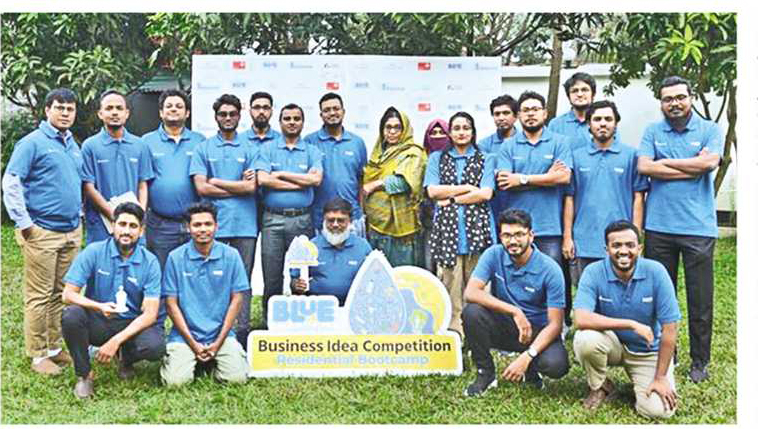
From a nationwide pool of 315 applicants, 60 ideas were evaluated through regional pitch events. Ultimately, 10 high-potential teams were selected for a three-day Residential Bootcamp at Hazari Cottage. The cohort represented a cross-section of Bangladeshi ingenuity, with startups addressing distinct challenges in Naogaon and Satkhira. In the water sector, Aquivira and Supergen focused on delivering affordable, location-specific safe drinking water through eco-friendly filtration. Tackling coastal salinity and energy poverty, HopeDrop introduced a portable, solar-powered RO purification system, while Siddique's Green Technology presented a chemical- and electricity-free bio-sand filter using innovative nylon-cement technology. In the waste management space, Black Soldier Int. proposed producing high-protein feed for poultry, fish, and livestock from Black Soldier Fly larvae. Meanwhile, Bloomboard aimed to transform unrecyclable plastic waste into durable, salt-resistant construction panels, and Green Fibre Innovation focused on creating eco-friendly materials from agricultural waste like banana trees.
The bootcamp was a stress test for these models. Facilitators Saiduzzaman Pulak,Private Sector Engagement Specialist - GO4Impact Project, WaterAid Bangladesh and Mostafezur Rahman, Manager - Policy & Advocacy, ASTHA, Swisscontact Bangladesh trained the teams on 'Why Water & Waste Management Startups Fail Locally', encouraging founders to confront operational blind spots. Samiur Rahman Bhuiyan, Chief Technology Officer, Catch Bangladesh focused on leveraging technology for scalability, while Omar Bin Reza Mahee, CEO & Principal Partner, CapeC. Consulting guided participants through financial logic and funding strategies.
A specialist jury panel - Abu Saif Ansari, Business Development Lead, WaterAid Bangladesh, Md. Irfan Ahmed Khan, Operation Manager, Programmes, WaterAid Bangladesh, Kazi Rashed Hyder, Technical Specialist, WaterAid Bangladesh, and Md. Farhan Shahriar, Principal Consultant & Managing Partner, DevCon& Associates Advisory Services - assessed the ventures on their potential to become scalable, investible businesses.
Highlighting the incubator's ultimate goal, Saief Manzoor-Al-Islam, Team Leader, GO4Impact Project, WaterAid Bangladesh, stated: "Locally led entrepreneurship can significantly strengthen public service delivery, particularly in water and waste management. He added, "By taking entrepreneurs to the grassroots and equipping them with the right institutional and financial support, innovative ideas can scale into meaningful, real-world impact."
Through these three distinct initiatives, the BLUE platform is proving that the WASH sector is fertile ground for economic growth. By treating water and sanitation issues as market opportunities, WaterAid is helping to create a sustainable business ecosystem where innovators act as the engines of development. Whether through upskilling individuals, redesigning infrastructure, or incubating startups, BLUE is demonstrating that the youth of Bangladesh are ready to lead as the architects of a cleaner, healthier, and more prosperous future.