
Call to adopt proactive and robust fraud management strategies
Monday, 13 April 2026
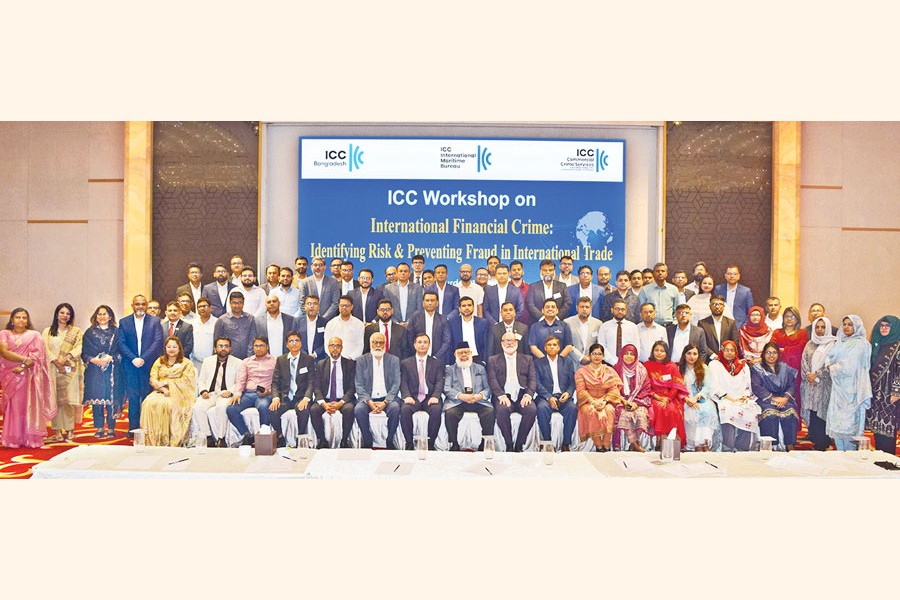
ICC Bangladesh President Mahbubur Rahman has stated that current global economic uncertainties have increased various risks in international trade, including fraud and malpractice.
He emphasised that the chances of recovering losses from such incidents are limited. Therefore, it is essential for bankers, exporters, and importers to understand the types of fraud prevalent today and how these can be prevented.
He was speaking at a workshop on "International Financial Crime: Identifying Risk & Preventing Fraud in International Trade" jointly organised by ICC Bangladesh and ICC Commercial Crime Services (CCS) of the ICC International Maritime Bureau (IMB), based in London, at a local hotel in Dhaka on Saturday.
Mr Mahbubur Rahman attended the workshop as the chief guest at the closing ceremony and distributed certificates among the participants. Workshop resource persons Michael Howlett, CEO of ICC Commercial Crime Services (CCS) and Cyrus Mody, Director of ICC CCS and Deputy Director of IMB, along with ICC Bangladesh Secretary General Ataur Rahman, also spoke during the closing session.
The ICCB President further noted that maritime trade remains a cornerstone of real economic activity and growth. The rise in reported maritime incidents underscores the importance of protecting seafarers and securing key shipping routes-not only for crew safety but also for the stability of global supply chains and dependent economies. Ensuring safe passage at sea requires sustained cooperation among regional and international partners to safeguard maritime commerce.
Highlighting the evolving nature of financial crime, he said that fraud and data security threats now emerge in multiple forms and through diverse channels. It is therefore crucial for financial institutions to develop a strong understanding of how criminals operate and how risk management practices are evolving. With such knowledge, supported by a strategic approach, institutions can better mitigate risks and identify threats before they cause significant damage.
While there is no single solution to completely eliminate fraud, all stakeholders-including consumers, merchants, and financial institutions-have a role to play in its prevention and detection. However, the role of financial institutions remains the most critical. Bankers, therefore, must adopt proactive and robust fraud management strategies, utilizing the latest detection and prevention technologies.
A total of 88 participants from 23 banks, including the central bank, along with two participants from the Bangladesh Institute of Bank Management (BIBM), attended the workshop in Dhaka. A similar workshop was held in Chattogram on Sunday, attended by 56 participants from 19 banks, including the central bank, along with 18 clients sponsored by Eastern Bank, Mutual Trust Bank and Prime Bank.