
Country braces for higher heat-related mortality
Friday, 27 March 2026
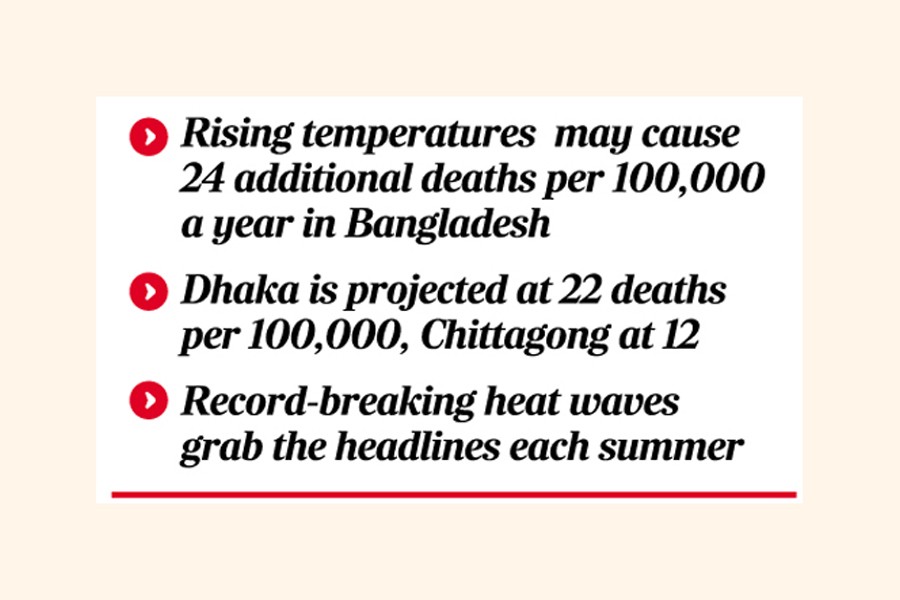
Bangladesh is likely to see an additional 24 deaths per 100,000 people each year due to rising temperatures by 2050, says a new report on Wednesday that places Bangladesh among the 25 most affected countries globally for, reports UNB.
The new report from the Climate Impact Lab finds that climate change is projected to increase these premature deaths and that more than 90 per cent of them are slated to occur in low- and middle-income countries.
In Khulna, that number rises to 36 deaths per 100,000, exceeding the current death rate from chronic obstructive pulmonary disease in the country, according to the report.
Dhaka is projected at 22 deaths per 100,000, Chittagong at 12, according to the report on the impact of rising temperatures on mortality underscores the need for targeted investments to help people and communities save lives.
The study is the first in a series to identify where and what climate adaptation investments will be most beneficial.
Record-breaking heat waves grab the headlines each summer because they cause tens of thousands of deaths.
The report underscores that targeted adaptation investments can substantially save lives, as temperature-related mortality will depend both on the direct impacts of a warming climate and on the investments that people and governments make to protect human health.
"This report uncovers one of climate change's cruelest ironies - it is projected to kill millions of people in the countries that have generally done the least to cause it. Further, their relatively low income levels mean that they are not as well positioned as people in rich countries to confront the new and unfolding risks from climate change," says Michael Greenstone, a co-founder of the Climate Impact Lab and the director of the Institute for Climate and Sustainable Growth and Energy Policy Institute at the University of Chicago.
"In this report, we've identified the regions around the world where climate adaptation investments can save the most lives."
The report is based on the Climate Impact Lab's landmark projections of temperature-related mortality.
These are the first projections of rising temperature's impacts on mortality, based on highly-localiSed data from around the world.
They highlight that the extent to which adaptation reduces temperature-related mortality hinges on the choices that governments and people make, including investments in air conditioning, cooling centers and other adaptive measures.