
WEEKLY MARKET REVIEW
Escalating Iran conflict sends stocks reeling
Tk 250b wiped off DSE market-cap in bloodbath
FE REPORT | Saturday, 7 March 2026
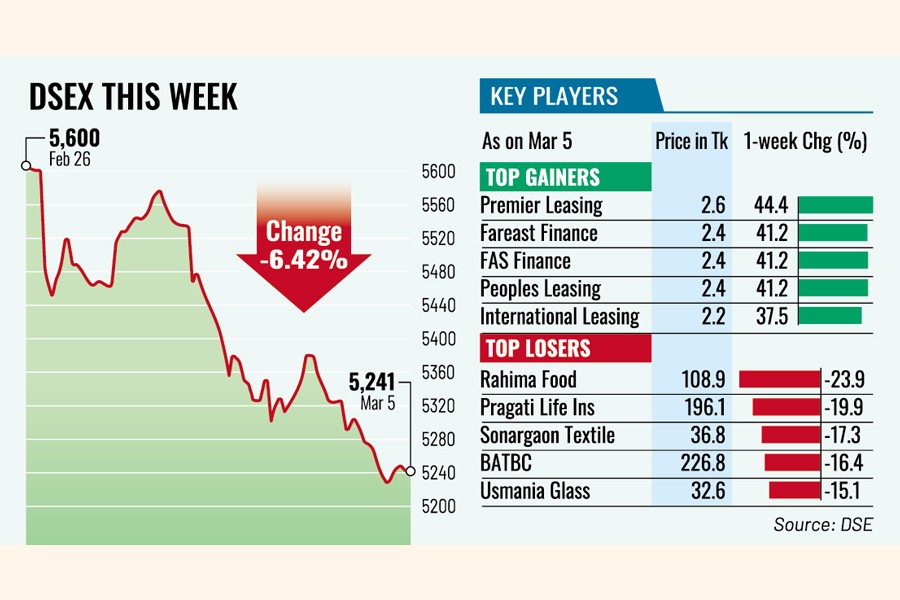
The benchmark index of the Dhaka Stock Exchange (DSE) tumbled this week, snapping a six-week winning streak, as investors were rattled by the escalating conflict in the Middle East.
Market analysts said stocks suffered a major setback amid rising geopolitical tensions in the region, prompting jittery investors to offload their holdings over fears of further erosion in asset values.
The turbulence followed strikes by the United States and Israel on Iran on February 28 that killed Iran's Supreme Leader Ayatollah Ali Khamenei along with several top security officials. In retaliation, Iran launched missiles targeting Israel and US military bases across the Middle East, escalating the conflict.
Economists and market insiders warned that if the conflict drags on, it could lead to longer shipping routes, higher freight charges, rising energy prices and ultimately increased production costs across the global economy.
Bangladesh's energy security remains heavily dependent on Middle Eastern suppliers such as Saudi Arabia, United Arab Emirates and Qatar, leaving the country vulnerable to potential disruptions in the Gulf.
Adding to concerns, Iran has reportedly closed the Strait of Hormuz in response to the attack. Nearly 90 per cent of Bangladesh's primary energy imports pass through the crucial waterway.
Akramul Alam, head of research at Royal Capital, said investors remained cautious over the potential macroeconomic fallout of the geopolitical tensions, particularly the risk of disruptions in domestic fuel and power supplies.
The news that Bangladesh's fuel oil reserves may last only about 15 days also shocked investors, he said, noting that the Iran conflict has already pushed up global gas and oil prices, raising concerns that the country's import costs could surge significantly.
Against this backdrop, the market opened the week sharply lower and remained largely in the red throughout, except for one session.
Persistent selling pressure dominated the market from the beginning of the week as the lack of visible progress toward resolving the conflict kept investors on edge.
On Tuesday, the benchmark index also recorded its biggest single-day fall in six years, as panicked investors rushed to exit the market amid the intensifying crisis.
By the end of the week, the DSE's benchmark index plunged 359 points, or 6.4 per cent, to 5,325, paring all the gains recorded in the previous three weeks.
Alongside the index decline, market capitalisation also dropped by Tk 205 billion during the week as major stocks came under heavy selling pressure.
EBL Securities, in its weekly analysis, said stocks suffered the brunt of intense bearish sentiment, as market participants remained wary of mounting concerns over the potential macroeconomic repercussions of ongoing Middle East tensions, particularly the risks of fuel and power supply disruptions within the country.
The market largely remained under sustained downward pressure in the absence of any visible signs of stability in the Gulf region, prompting aggressive selling pressure across the board, said the stockbroker.
The blue-chip DS30 index, a group of 30 prominent companies, also plunged 158 points to close at 2,011 while the DSES index, which represents Shariah-based companies, shed 67 points to 1,048.
The price fall of selective blue-chip stocks such as BRAC Bank, Islami Bank, BAT Bangladesh, Square Pharma and Beximco Pharma, largely contributed to the market plunge. These five stocks accounted for a 140-point fall in the DSEX.
BRAC Bank alone accounted for more than 42-point fall to the prime index as the bank's stock dropped around 12 per cent during the week.
Islami Bank accounted for 29.7-point fall in the major index, followed by BAT Bangladesh, and Square Pharma.
Market participation, however, remained subdued, as total market turnover stood at Tk 34.8 billion this week as against Tk 36.2 billion in the week before.
Accordingly, the average daily turnover stood at Tk 6.96 billion, a 4 per cent drop from the previous week's average of Tk 7.25 billion.
Losers strongly outnumbered the gainers on the DSE floor. Of the 392 issues traded, 325 closed lower and 59 ended higher while eight remained unchanged.
Major sectors posted negative returns. The food sector faced the highest correction of 11.5 per cent as the sector heavyweight BAT Bangladesh suffered more than 16 per cent due to historic-low dividend declaration during the week.
Orion Infusion became the most-traded stocks, with shares worth Tk 2.08 billion changing hands, closely followed by City Bank, Khan Brothers, BRAC Bank, and Robi Axiata.
The Chittagong Stock Exchange also closed sharply lower with its All Shares Price Index (CASPI) shedding 772 points to close at 14,825, while the Selective Categories Index (CSCX) lost 527 points to 9,060.
babulfexpress@gmail.com