
Govt urges energy conservation to avoid any crunch
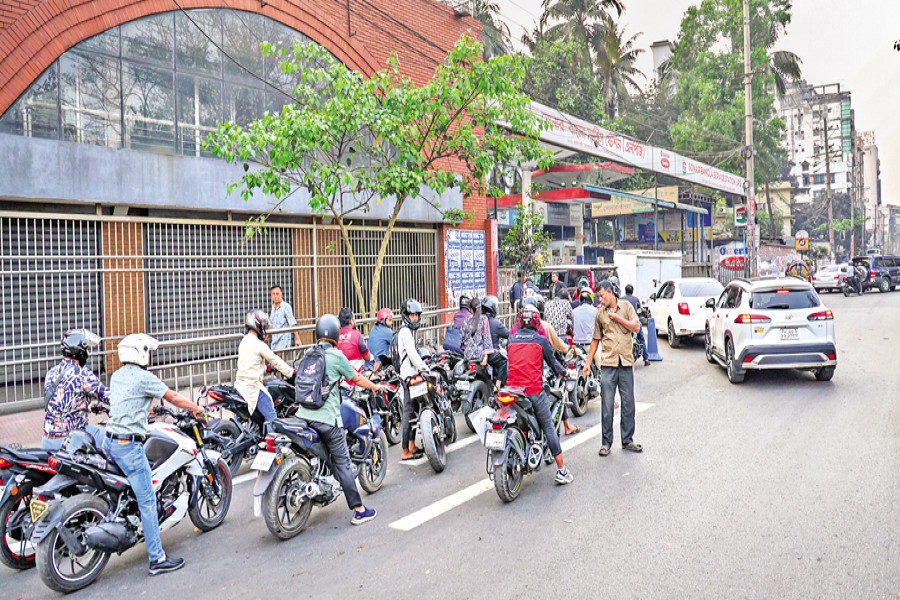
Vehicles queue up at filling stations for contingency fuel reserve
FE REPORT | Friday, 6 March 2026
A near-blockade of oil and gas sources in the gulf amid the Middle-East war situation prompts government authorities to send in a nationwide call for citizens, institutions and businesses to adopt strict energy-saving measures.
The Ministry of Power, Energy and Mineral Resources (MPEMR) issued Thursday a circular, signed by Information and Public Relations Officer of the MPEMR Muhammad Arif Sadeq, highlighting an urgent need to safeguard national energy security and ensure efficient use of resources.
The government called for "coordinated action across households, industries, transportation and government offices" to this end.
Regarding natural-gas conservation, the government has advised households to follow efficient cooking practices and industries to adopt production-planning strategies to minimize gas consumption.
The energy ministry has stressed the importance of preventing gas leakage in pipelines and commercial establishments, while urging citizens to raise awareness against unnecessary use.
To reduce dependence on petroleum, the government direction has encouraged greater use of public transport and car-pooling.
Citizens are also asked to avoid or limit non-essential travels to cut down fuel consumption.
Government offices, autonomous bodies, and private institutions have been instructed to implement energy-saving practices during and after office hours.
Commercial establishments have been urged to adopt efficient energy management and avoid excessive use.
The ministry emphasizes that these measures "are not only critical for managing the immediate crisis but also for raising awareness about responsible energy use".
"Ensuring national energy security requires the cooperation of all sectors and citizens," the firman reads.
The directive reflects Bangladesh's proactive stance in addressing global
energy challenges and underscores the importance of collective responsibility in conserving resources.
The country has to make huge import of liquefied natural gas and crude oil from gulf countries in the Middle East, now in turmoil following US-Israel strikes on Iran and retaliation by Tehran.
Meanwhile, vehicles, motorcycles and CNG-run auto-rickshaws rushed Thursday to filling stations in the capital, Dhaka, amid concern about running short of fuel supply following the war in the Middle East.
Visiting different gas stations one FE correspondent found different modes of transport, including cars, waiting outside in anticipation of possible fuel-supply disruption.
A manager of a filling station located at Jatrabari told the FE that long queues of vehicles outside his filling station were "significantly longer than on normal days".
Pump operators said demand for fuels surged throughout the day.
They said many drivers were attempting to refill their tanks earlier than usual amid uncertainty over global supply conditions.
The number of motorists queuing up at the filling stations since morning is growing as the day goes by.
Md Babul, a businessman living in Fakirerpool area, said his driver went to the filling station located at Motijheel and had to wait several hours in the queue for refueling.
Long queues of vehicles were seen at a filling station in Mirpur, Dhaka, too, significantly longer than on normal days, as consumers reportedly rushed to purchase petrol and diesel fearing potential shortage.
Earlier on February 28, Israel launched a "preemptive" attack against Iran.
Azizjst@yahoo.com
talhabinhabib@yahoo.com