
Inflation continues to outpace wage growth
GED sees investment, dev boost, job creation as key challenges
FE REPORT | Friday, 6 March 2026
Persistent inflationary pressures continue to outpace wage growth in Bangladesh, eroding household purchasing power and real income, according to the latest Economic Update and Outlook of the General Economics Division (GED) of the Planning Commission.
Released on Thursday, the February economic outlook highlighted that the headline inflation edged up to 8.58 per cent in January last, slightly up from 8.49 per cent in the previous month.
On the other hand, the wage growth remained almost stagnant at 8.08 per cent, widening the gap between income growth and the rising cost of living, the report revealed.
Apart from the sustained high inflation, the economy remained under multiple pressures, especially in respect of a large shortfall in revenue collection, slow implementation of development projects and uncertainty in investment, according to the report.
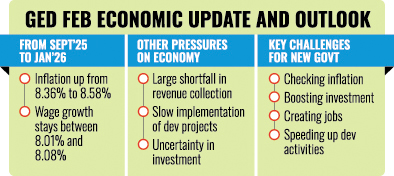
Checking inflation, boosting investment, generating employment and accelerating the development activities have now emerged as the key challenges facing the new government, it mentioned.
The GED expected that the new government would propel the economy prudently through ensuring macroeconomic stability, attracting more investment, generating more employment and reining in inflation to make a solid foundation for the economy.
"Restoring confidence among both local and foreign investors, boosting further foreign exchange reserves, and maintaining exchange rate stability will remain essential," the report said.
The planned rollout of the Family Card is expected to be a unique initiative towards universal social protection, improving support for marginalised groups and reducing leakages in social safety nets, it added.
Highlighting the erosion of the real income or purchasing power of the wage earners, the report revealed that the divergence between wages and prices had been persistent in recent months, while inflation consistently remained above wage since September last year.
During this period, inflation increased gradually from 8.36 per cent in September to 8.58 per cent in January, while wage growth hovered within a narrow band between 8.01 per cent and 8.08 per cent.
The GED report warned that the sustained mismatch between wages and inflation posed a mounting pressure on real incomes, particularly for lower-income households whose consumption baskets are dominated by essential food and services.
Rising prices of food and basic services gradually affected household purchasing power, as nominal wage adjustments failed to keep pace with inflationary dynamics, the report observed.
Food alone accounted for 43.06 per cent of total inflation in January, up from 40.00 per cent in December, indicating that price pressures increasingly concentrated in essential consumption items.
Within the food basket, rice price pressure eased notably during the month, it mentioned, adding that the contribution of rice to food inflation declined sharply to 22.16 per cent in January from 37.34 per cent in December, reflecting a slowdown in rice price growth.
Rice inflation dropped to 7.61 per cent in January from 11.92 per cent in December with medium rice inflation falling to 6.25 per cent, coarse rice to 6.08 per cent, and fine rice to 10.62 per cent, according to the report.
Despite having favourable harvest conditions, higher vegetable prices were partly driven by increased transportation costs and profit-taking by wholesale and intermediary traders, the report said.
The report laid emphasis on improving food supply chain management, particularly for essential items such as rice, vegetables and fish to help contain inflationary pressures more effectively. Alongside inflationary concerns, the report also highlighted weaknesses in fiscal performance.
Revenue collection by the National Board of Revenue (NBR) fell short of the revised target for January last.
Development spending also remained weak, while implementation of the ADP recorded its lowest mid-year performance in five years, the report mentioned.
Only Tk 505.56 billion or 21.18 per cent of the annual allocation had been utilized until January 2026. The report attributed such slowdown to weaknesses in project preparation, procurement delays, coordination problems and administrative bottlenecks.
jahid.rn@gmail.com