
Mango acreage shrinks in Rajshahi, C'nawabganj, slightly rises in Naogaon
Friday, 6 March 2026
ANAET KARIM
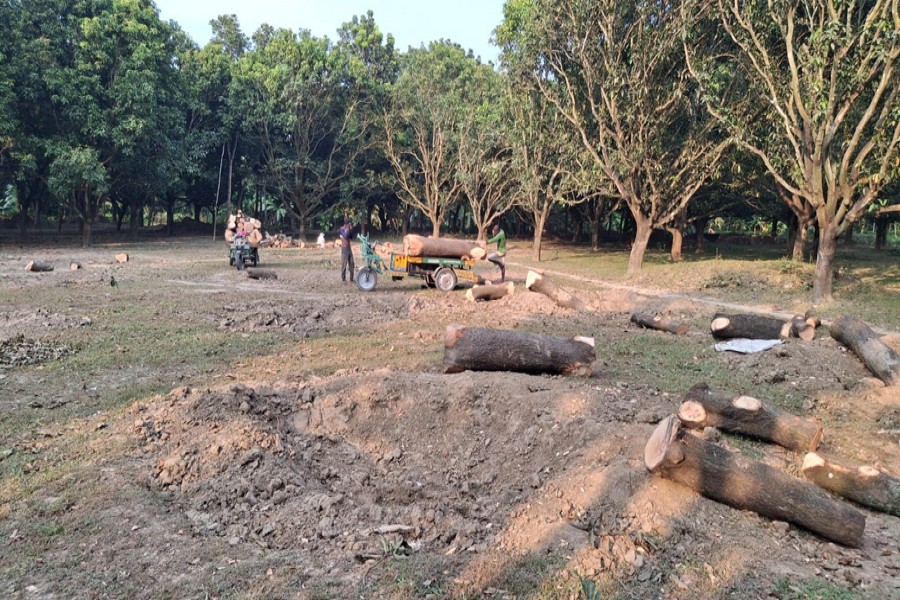
RAJSHAHI, Mar 05: The area of mango orchards has declined in Rajshahi and Chapainawabganj-the country's two traditional mango-producing hubs-while Naogaon has recorded a marginal increase in the current fiscal year, according to data from the Department of Agricultural Extension (DAE) and the Bangladesh Bureau of Statistics (BBS).
DAE statistics show that mango orchards in Rajshahi decreased from 19,603 hectares in FY2024-25 to 19,062 hectares in FY2025-26. The district currently has 3.7 million mango trees, with around 60 per cent already bearing blossoms.
In Chapainawabganj-widely known as the country's mango capital-the orchard area fell from 37,504 hectares last fiscal year to 37,487 hectares this year. However, about 70 per cent of the district's 9.24 million mango trees have already bloomed.
Farmers and agricultural officials attribute the decline primarily to unregulated pond excavation for fish farming. Rising production costs, increased pest attacks linked to climate change, and uncertainty over fair market prices have also discouraged growers. Many farmers are shifting from mango and paddy cultivation to aquaculture in pursuit of higher and quicker returns.
BBS data indicate that between 2015 and 2023, net cultivable land in Rajshahi district declined by 16,159 hectares. During the same period, inland water bodies expanded significantly-from 15,044 hectares in 2015 to 24,498 hectares in 2023-suggesting a steady conversion of farmland into ponds and water reservoirs.
Shahidul Hossain, a mango grower from Bagha Upazila in Rajshahi, said pest infestations and diseases have increased over the past decade. "Earlier, one round of fertiliser and pesticide application was enough. Now we need to spray twice as often. Costs have gone up, but returns have not kept pace," he said.
Experts have also raised concerns over the excessive use of hormones to boost short-term yields, which is reportedly damaging older trees and leading to the gradual loss of mature orchards.
An anonymous fish farmer claimed that aquaculture can generate 10 to 15 times more profit than traditional paddy or mango farming, with faster cash flow and comparatively lower risk.
In contrast, Naogaon saw a slight increase in mango orchard area-from 30,300 hectares last year to 30,310 hectares this fiscal year. Officials said relatively lower pond excavation and the profitability of early-season mango varieties have encouraged growers to retain orchards.
Agricultural experts warn that continued conversion of orchards and cropland into ponds and infrastructure could undermine the region's ecological balance and mango-based economy, with long-term implications for food security and seasonal employment.
Professor Md Mustafizur Rahman, chairman of the Department of Agronomy and Agricultural Extension at University of Rajshahi, warned that the growing trend of converting traditional paddy fields and mango orchards into fish enclosures could prove harmful in the long run.
"Although aquaculture may raise incomes in the short term, excessive pond excavation can alter soil structure and disrupt natural drainage systems," he said. "Once such changes occur, it becomes difficult to restore the land to orchards or crop fields in the future."
anaetru@gmail.com
He further noted that these practices may interfere with the soil's natural nutrient regeneration process, leading to permanent alterations in fertile land and posing risks to long-term food security.