
DCCI views-exchange meeting
Pvt sector flags red tape, law and order woes as key barriers to investment
Sunday, 1 March 2026
FE REPORT
Leaders of the country's private sector have identified a range of structural and governance-related bottlenecks -- particularly bureaucratic red tape, weak law and order, extortion and policy uncertainty -- that they say are constraining economic activity and discouraging new investment.
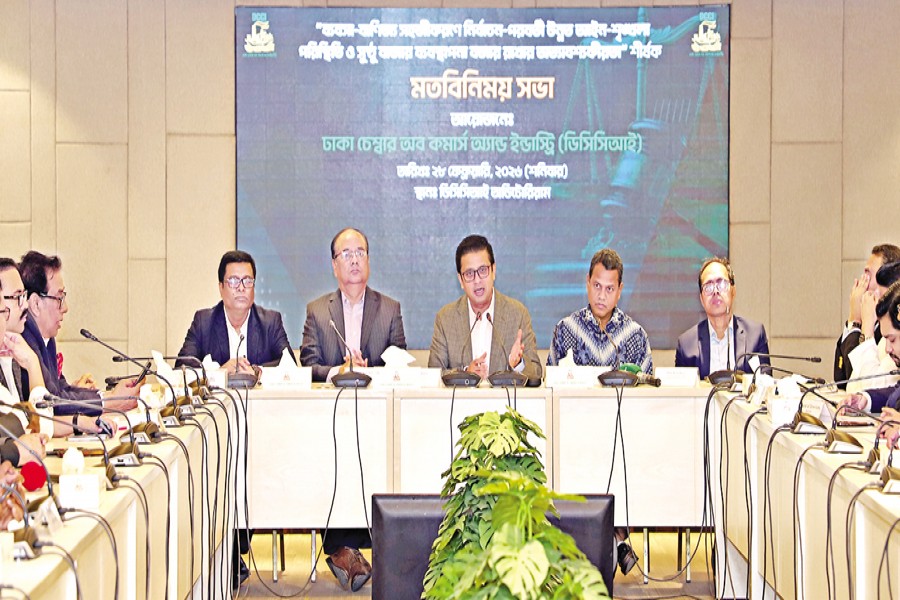
The concerns were raised at a views-exchange meeting held at the auditorium of the Dhaka Chamber of Commerce and Industry (DCCI) in the capital on Saturday.
In his welcome address, DCCI President Taskeen Ahmed said the private sector has failed to achieve the desired level of progress in recent years due to contractionary monetary policy, unexpected deterioration in law and order, illegal extortion, corruption, administrative complexities and entrenched bureaucratic red-tapism.
The meeting was attended by AHM Ahsan, chairperson of the Bangladesh Competition Commission, as chief guest, while Md Abdur Rahim Khan, administrator of the Federation of Bangladesh Chambers of Commerce and Industry (FBCCI), joined as special guest.
DCCI president expressed hope that the newly elected government would prioritise trade and investment facilitation, with particular emphasis on restoring law and order.
He also stressed the need for stronger coordination among the private sector, law enforcement agencies, policymakers and economic ministries to address the prevailing challenges.
During the open discussion, businessman Abul Hashem said traffic congestion and the deteriorating law-and-order situation have emerged as two of the most pressing concerns for entrepreneurs, calling for a more proactive government role in tackling both issues.
Another participant, Md Golam Mowla, observed that although market management becomes a focus during crises, meaningful reforms are often absent once conditions stabilise.
He added that the lack of accurate data on essential commodities hampers effective market oversight, while extortion during transportation pushes up prices, urging stricter enforcement to curb such practices.
Businessman Md Monir Hossain said improved traffic management could significantly reduce the cost of doing business.
At the event, another businessman, Mohammad Ali Bhutto, noted that despite repeated discussions on trade facilitation, allowing only a limited number of institutions to import essential commodities creates syndicates, leading to higher prices.
Tarikul Islam Khan, managing director of Nahar Cold Storage Limited, highlighted distress among potato farmers, saying prices have fallen sharply in northern regions, with potatoes selling at as low as Tk 8.0 per kilogram in some areas.
Although compensation for affected farmers has been discussed, he said it has yet to be ensured.
Speaking at the event, Bangladesh Competition Commission Chairperson AHM Ahsan underscored the importance of aligning supply and demand through accurate data on the production, use and distribution of essential goods.
He said a business-friendly environment lowers institutional costs for entrepreneurs, which ultimately helps stabilise consumer prices.
He also stressed cooperation with law enforcement agencies to maintain law and order.
FBCCI administrator Md Abdur Rahim Khan said improving law and order and ensuring proper market management are essential for the smooth functioning of business operations.
Shibir Bicitra Barua, additional secretary at the Ministry of Commerce, warned that instability in law and order erodes business confidence and discourages both domestic and foreign investment.
Abdul Jalil, director of the Directorate of National Consumer Rights Protection, said excessive use of fertilisers and pesticides has reduced the quality of domestically produced potatoes, preventing Bangladesh from meeting international standards and accessing export markets.
sajibur@gmail.com