
Some 266 factories at risk of labour unrest
Failure to pay wages, festival allowances before Eid predicted as key reasons
Monira Munni | Wednesday, 4 March 2026
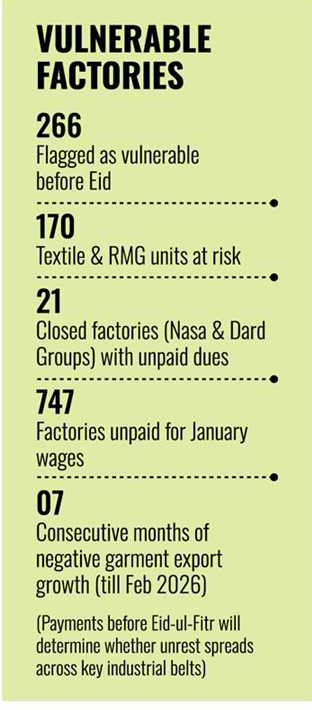
Around 266 factories, including textile and readymade-garment units, in different industrial zones are at risk of labour unrest as those units, according to law-enforcement agencies, might fail to pay wages and festival allowances before the upcoming Eid-ul-Fitr.
Non-payment of wages, festival allowance and other dues in time for the month of February, sudden declaration of relocation or closure or factory lay-off before Eid without clearing payments and lack of coordination between government-announced holidays and the holidays as per the labour law are among the reasons that might fuel labour unrests, people familiar with the situation said.
They also said a total of 21 permanently closed factories of Nasa Group and Dard Group could not pay dues to their respective workers, which also might fuel the possible workers' unrest.
Of the total vulnerable 266 factories, 170 are textile and readymade garment units. Some 85 are the members of Bangladesh Garment Manufacturers and Exporters Association (BGMEA), according to a list of the Industrial Police (IP).
As many as 37 units are registered with Bangladesh Knitwear Manufacturers and Exporters Association (BKMEA) while 36 others are affiliated with Bangladesh Textile Mills Association (BTMA) and nine are members of Bangladesh Export Processing Zones Authority (BEPZA).
The remaining are non-RMG factories while 10 other units, which are not covered by the regular monitoring of the IP and are located in Dhaka Metropolitan city, might not be able to pay monthly wages and festival allowance in time, according to IP sources .
The listed units are located in eight IP zones including Savar, Ashulia, Gazipur, Narayanganj, Chattogram, Mymensingh and Khulna areas, they mentioned.
When asked, an IP official said they have already informed the related trade bodies and concerned government authorities about the situation. Besides, they are also closely monitoring the vulnerable units and holding meetings with the factory management on ensuring the timely payments to avoid any untoward incidents.
However, labour leaders have identified absence of fixed festival allowance in garment factories, partial and non-payment of festival allowance, payment of wages and allowances on the last working day before Eid holidays, termination, non-payment of legal benefits and sudden closure or lay-off of factories as key reasons for the possible unrests.
When asked, President of Bangladesh Employers Federation (BEF) Fazlee Shamim Ehsan said the export-oriented sectors especially the garment factories have been undergoing a number of challenges, which have already been reflected in the export earnings data.
For the last seven consecutive months until February 2026, export earnings from garment products recorded negative growths, he said, adding that many factories either have either got less work orders or they are incurring losses.
He, however, said they are monitoring a total of 250 garment factories.
Mr. Ehsan, also the executive president of Bangladesh Knitwear Manufacturers and Exporters Association (BKMEA), urged the government to release the cash incentive ahead of Eid-ul-Fitr and provide loan to help pay workers' wages and festival allowances, taking the local and global challenges into consideration.
Many factories might not be able to pay wages unless they receive the cash incentive, he expressed the fear, adding that those factories are facing challenges not only for the payment of wages, but also clearing their outstanding utilities bills.
According to the IP sources, some 747 factories, including 357 RMG units, did not pay wages to their workers for the month of January while 149 others including 61 RMG units are yet to pay wages for the months of November and December.
Munni_fe@yahoo.com