
Stocks edge up amid US-Iran ceasefire
Banking sector powers market gains
FE REPORT | Saturday, 11 April 2026
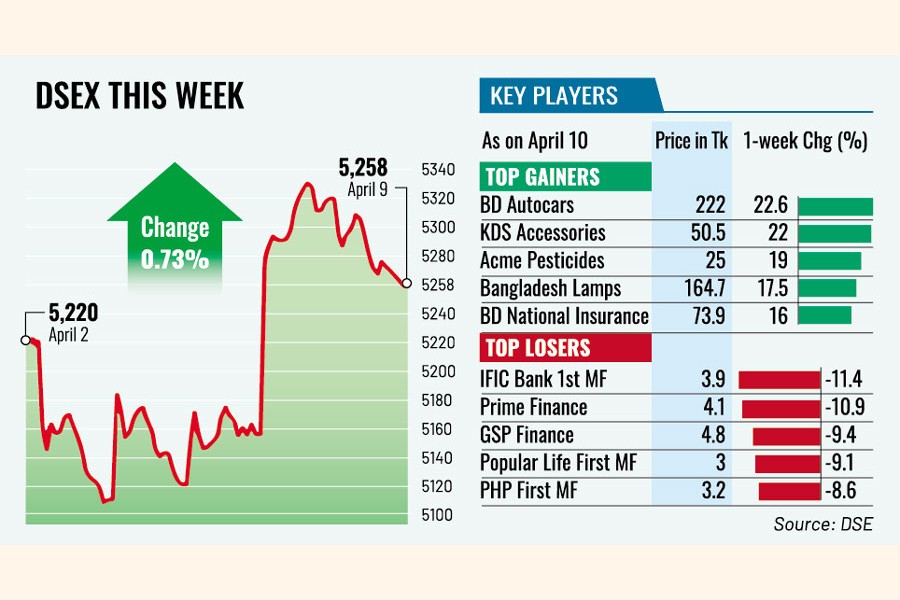
The benchmark equity index posted a marginal gain this week, as investors remained cautious amid shifting developments surrounding the US-Iran ceasefire and broader tensions in the Middle East.
Market sentiment moved closely with geopolitical headlines throughout the week, as investors reacted swiftly to both optimism and renewed uncertainty, market operators said.
The week began on a negative note, with broad-based sell-offs triggered by panic over newly announced government austerity measures aimed at addressing a potential energy crisis.
However, sentiment improved in subsequent sessions as bargain hunters took positions in oversold large-cap stocks after the government decided to keep fuel prices unchanged. Optimism over a possible ceasefire between the United States and Iran further supported a three-day recovery streak.
Despite the rebound, optimism proved short-lived. Fresh concerns over the sustainability of the ceasefire and fears of a possible blockade of the Strait of Hormuz dampened investor confidence once again.
Out of five trading sessions this week, three ended higher while two closed lower, resulting in a modest overall gain.
Finally, DSEX, the benchmark index of the Dhaka Stock Exchange (DSE), rose by 38 points or 0.73 per cent to close at 5,258, partially recovering from a 96-point loss in the previous week.
Although the market ended the week in positive territory, driven largely by strong gains in the fourth session, investors remained wary of the ceasefire's durability.
The market witnessed a sharp rally midweek, with the index surging 161 points on Wednesday following the announcement of a two-week ceasefire agreement between the US and Iran. The deal included provisions to allow shipping through the strategic Strait of Hormuz, boosting investor sentiment.
However, the positive momentum reversed the following day. Reports of intensified Israeli airstrikes in Lebanon, which resulted in over 250 deaths, reignited fears of escalating regional conflict and cast doubt over the ceasefire's durability.
The strikes came just hours after the ceasefire announcement had raised hopes of broader de-escalation in the regional conflict.
As a result, the DSEX fell by 60 points on Thursday, erasing a significant portion of the earlier gains.
Market analysts said the latest escalation underscored deep uncertainties surrounding the ceasefire agreement, raising concerns that it could collapse before any lasting resolution is achieved.
The fragile nature of the truce quickly undermined investor confidence, prompting many investors to adopt a wait-and-see approach amid persistent geopolitical risks, said a research analyst at a leading brokerage firm.
"Investors are currently more sensitive to external shocks, particularly energy supply risks and global oil price volatility linked to Middle East tensions," he said.
Market direction in the coming days will largely depend on developments in the Middle East and clarity regarding the US-Iran ceasefire.
"If the ceasefire holds and tensions ease, the market may see a gradual recovery driven by bargain hunting," he added.
Two other indices of the DSE also gained this week. The DS30 index, comprising blue-chip companies, advanced 22 points to 2,002, while the DSES index, which tracks Shariah-compliant stocks, gained 4 points to settle at 1,063.
Price surge of blue-chip stocks, including well-performing banks such as BRAC Bank, Pubali Bank, Prime Bank, City Bank, largely contributed to the market index rise. They jointly accounted for a 26-point rise in the DSEX.
However, market liquidity remained almost the same as total turnover on the DSE stood at Tk 33.48 billion, as against Tk 33.42 billion in the week before.
Subsequently, the average daily turnover on the prime bourse stood at Tk 6.69 billion, as against Tk 6.68 billion in the previous week.
Sector-wise, investors showed strong interest in pharmaceuticals, which accounted for 15.8 per cent of the week's turnover, followed by engineering (14 per cent) and banking (9.3 per cent).
Despite the index gain, decliners outpaced advancers. Of the 387 traded issues, 220 declined, 138 advanced, and 29 remained unchanged.
Among the sectors, banking sector led the gainers with a 1.5 per cent rise, followed by engineering, non-bank financial institutions, and pharmaceuticals. On the other hand, food, power, and telecom sectors ended in the red.
Khan Brothers PP Woven Bag Industries topped the turnover chart with Tk 1.35 billion, followed by Acme Pesticides, Lavello Ice-Cream, and Summit Alliance Port.
The Chittagong Stock Exchange also edged higher, with the All Shares Price Index (CASPI) rising 73 points to 14,774 and the Selective Categories Index (CSCX) rose 57 points to 9,039.
The port city bourse traded 94.5 million shares and mutual fund units, with turnover of Tk 2.43 billion.
babulfexpress@gmail.com