
The city eating into vitals of a nation
Matiur Rahman | Friday, 17 April 2026
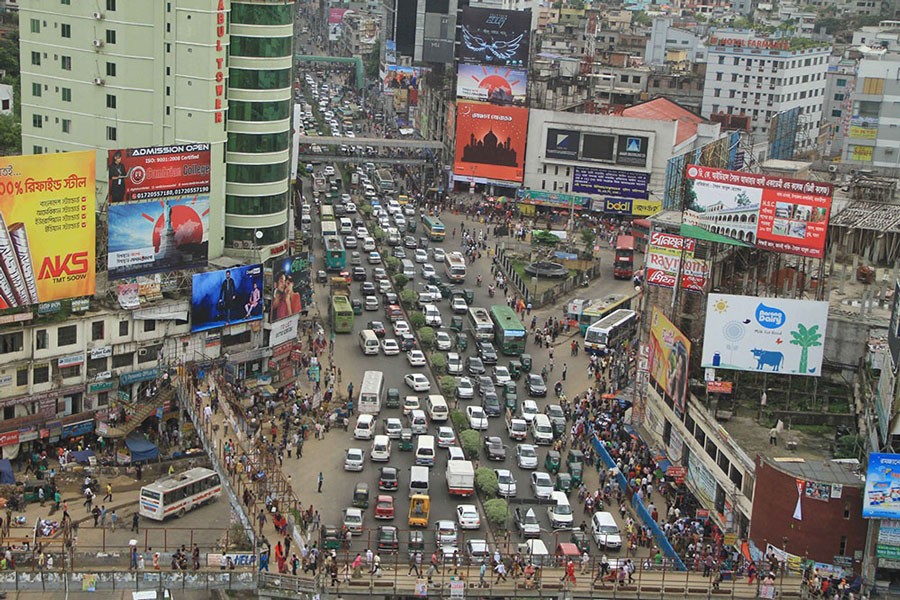
There is a concept in urban sociology that Saskia Sassen developed in her landmark work on the global city -- the idea that certain metropolises become command centres of the world economy, concentrating financial, informational, and professional power in ways that simultaneously generate enormous wealth and spectacular inequality. Sassen was writing primarily about New York, London, and Tokyo: cities that were, at least in theory, built for the roles they came to play, equipped with infrastructure, governance systems, and institutional depth commensurate with their ambition. Dhaka is something categorically different. Dhaka is what happens when a city becomes a global city's data point without ever receiving a global city's investment -- when a megacity grows not from design but from the accumulated failures of everywhere else. It did not build itself into what it became. It absorbed what Bangladesh could not distribute.
According to the United Nations World Urbanisation Prospects 2025, Dhaka is now the world's second most populous city, with approximately 36.6 million residents, having risen from ninth position in 2000 when its population stood at 17.4 million. Projections suggest it could become the world's largest city by 2050. That trajectory -- from ninth to first within half a century -- is not a story of urban success. It is a story of urban gravity, of a city so overwhelmingly dominant in a country's economic, political, and institutional life that it draws everything towards itself regardless of its capacity to receive it. In the Economist Intelligence Unit's Global Liveability Index 2025, Dhaka slipped three notches to 171st out of 173 cities -- a consistent decline that exposes the capital's deep-rooted urban dysfunction. The only cities ranked below it are Tripoli and Damascus, both devastated by protracted armed conflict. Dhaka is not at war. It is simply buckling under its own unplanned and unrelenting weight.
The numbers that describe this buckling are almost impossible to render without qualification. With over 44,500 people per square kilometre, Dhaka is one of the world's most crowded cities. It accounts for one-third of the country's total population, one-fifth of the national GDP, and one-third of all formal jobs. Economic activities in Bangladesh remain heavily concentrated in Dhaka and Chattogram, and this overconcentration leads to acute congestion in Dhaka, with traffic jams alone resulting in an estimated annual economic loss of four billion US dollars. Research presented at the Bangladesh Institute of Development Studies found that the direct effect of Dhaka's traffic congestion consumes approximately 2.9 per cent of national GDP, with an additional six to ten per cent lost indirectly. These are not the costs of productivity. They are the costs of dysfunction -- the price paid for having compressed into a single city everything that a nation of 170 million people requires.
To understand Dhaka properly, one must understand what it is not. It is not a global city in Sassen's original sense -- a hub of command functions servicing a networked global economy with specialised producer services and deep institutional infrastructure. It is what urbanists call a primate city: a settlement so disproportionately dominant in its national context that it distorts every spatial and economic relationship around it. There is no second city besides Dhaka in Bangladesh, and that is a serious problem. Chattogram is losing its importance: previously, it housed the main offices of the Railway and the Navy, but centralised policies have moved them elsewhere. The gap between Dhaka and other cities has grown abnormally due to deliberate policy decisions. Dhaka alone dominates the financial landscape, accounting for over 60 per cent of total banking deposits and nearly two-thirds of total credit distribution. Rajshahi, Khulna, Sylhet, Barishal, Rangpur, and Mymensingh -- cities with populations, histories, and economic potential -- have been structurally starved of the investment, governance authority, and institutional presence that might have made them genuine alternatives to migration to the capital.
This is the hidden sociology of Dhaka's overcrowding. Every person who arrives in the city seeking a hospital, a government office, a university, a formal sector job, or a legal proceeding does so not because Dhaka is intrinsically attractive but because the infrastructure of modern life has been deliberately -- or negligently -- concentrated there and nowhere else. Bangladesh's National Urban Policy 2025, the country's first comprehensive framework designed to steer rapid urban growth, was approved fifty-five years after independence, despite nearly 40 per cent of the population -- seven crore people -- now living in urban centres. The delay is itself a policy statement. It reflects the institutional indifference to urban planning that allowed Dhaka to absorb unmanaged urbanisation pressures that should have been distributed across a network of functional secondary cities.
Dhaka's 2025 liveability score of 41.7 out of 100 is especially revealing in its disaggregated form. Infrastructure scored 26.8 -- encapsulating crumbling roads, chaotic public transport, inadequate housing, unreliable utilities, and an absence of accessible public spaces. Healthcare scored 41.7, highlighting an overstretched system marked by insufficient public provision and high out-of-pocket costs. The low score in culture and environment is symptomatic of Dhaka's decline into an unbreathable, unwalkable, disjointed urban mass where pollution, noise, and congestion dominate public life. These scores are not accidents of geography. They are the measurable consequences of decades of underinvestment in urban governance, planning authority, and municipal finance -- compounded by a refusal to empower local governments with the fiscal and administrative tools to manage growth.
The average vehicle speed in Dhaka has lowered to 7 kilometres per hour -- as slow as the average walking speed, and is projected to reach 4 kilometres per hour by 2035. Traffic congestion is estimated to cause approximately 3.2 million business hours lost every day. The road network remains underdeveloped, with less than 12 per cent of roads of a primary standard quality suitable for bus services. Yet the city continues to expand vertically and horizontally, with the government's most recent revision of the Detailed Area Plan raising building height limits and floor area ratios -- a decision the Bangladesh Institute of Planners has characterised as serving developer interests at the expense of liveability, warning that raising population density from 250 to 300 is reckless by any global standard, and that areas around central Dhaka will turn into vertical slums of high-rises.
The analytical framework that best captures Dhaka's condition is not found in development economics alone. It requires attention to what sociologists call the agglomeration paradox: the observation that density, when properly governed, generates productivity gains, innovation, and shared infrastructure costs. When ungoverned, the same density produces congestion, exclusion, informality, and progressive erosion of urban services for those who can least afford alternatives. Dhaka has achieved density without governance. Despite high population density, the World Bank found that the economic density in Dhaka actually declined between 1996 and 2010, based on night-time light intensity and economic census data. Bangladesh is not reaping the benefits of agglomeration. It is bearing only the costs.
Between 2011 and 2022, the urban population increased by 11.5 million, driven in part by net rural-to-urban migration of approximately 6 million people. Because such urbanisation was largely unplanned, Bangladesh has not fully enabled its cities to become true engines of inclusive growth. The migration itself is a symptom of spatial injustice: of a development model that directed investment, credit, formal employment, and institutional capacity so overwhelmingly toward the capital that people had no rational alternative but to follow. Research shows that decentralising Dhaka could raise economic benefits by 60 per cent, and Chattogram's decentralisation could boost benefits by 20 per cent. These are not speculative figures. They represent the scale of value currently destroyed by concentration -- the productivity lost to gridlock, the talent extinguished by unliveable conditions, the investment deterred by an urban environment that cannot sustain it.
Sassen argued that the global city simultaneously concentrates power and generates a new geography of centrality and marginality. Applied to the Global South -- to cities like Dhaka that arrived at megacity scale without megacity infrastructure -- her framework describes something more starkly. Dhaka is not a command centre of international capitalism. It is the spatial expression of a state that has never adequately governed its own territory: that built a garment industry without planning its workers' housing, that grew a financial sector without distributing its branches, that educated its population without building universities outside the capital. Research suggests that Bangladesh may be, de facto, the most centralised country in the world for its size, and that it would not be possible to sustain economic development under such a centralised structure.
The city, in this reading, is not the problem. The city is the symptom -- the most visible expression of a spatial politics that has consistently preferred the concentration of power and investment over its distribution. Dhaka did not fail to plan for what it became. It was never planned at all. It simply absorbed, generation after generation, the consequences of decisions made -- and not made -- everywhere else. Until Bangladesh builds functional second-tier cities with genuine governance authority, fiscal autonomy, and competitive institutional infrastructure, the megacity will continue to expand. The liveability index will continue to fall, and the city will continue to buckle -- not from any particular crisis, but from the sheer, unrelenting weight of being everywhere at once.
Dr. Matiur Rahman is a researcher and development professional.
matiurrahman588@gmail.com