
Worst nightmare a top tennis player can have
Iga Swiatek struggles after Miami Open defeat
Friday, 27 March 2026
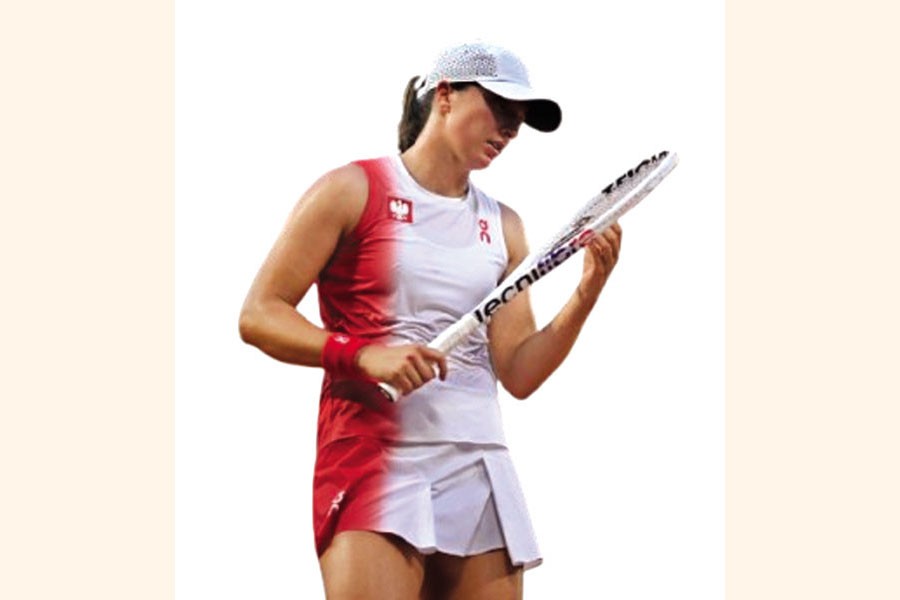
Iga Swiatek, one of the world's top tennis players, recently opened up about a tough phase in her career after an early exit from the Miami Open, report agencies.
She was visibly emotional after losing to No 50 Magda Linette in the round of 64 at the women's singles event, even stepping aside briefly to wipe away tears before facing the media.
Despite generally being happy in life, she admitted that tennis has started to feel confusing and mentally exhausting. "This is like the worst nightmare a top tennis player can have, dropping in matches in terms of the level," she said. "So I need to live through this, go forward, learn, and figure it out."
It came as no surprise on Sunday that, for Swiatek, the next step forward was for her to part ways with her coach, Wim Fissette. Having achieved so much in her sport at such a young age, Swiatek now stands at a crossroads in her career as the world No 3 tries to find a way to fully re-establish her position at the summit of her sport.
In the 19 months since she last held the No 1 ranking, her great rival Aryna Sabalenka has taken over as the leading figure of the WTA, but Swiatek remains the greatest player of their generation. A six-time grand slam title winner, with four at Roland Garros alone, she is already an all-time great at the age of 24.
Her success has been driven by the balance between her destructive weapons off both groundstrokes, her heavy topspin, and supreme athleticism. But her greatest asset has always been her formidable mental toughness. Her discipline, intensity and the methodical manner with which she has navigated her career are all remarkable traits.
However, the mental qualities that have driven her success are what have eaten her alive in recent months. Swiatek is also prone to chronic overthinking, worrying and second-guessing every decision she makes. Her recent difficulties began in the autumn of 2024 after her positive test for the banned substance trimetazidine and she was suspended for a month in December that year. But Swiatek proved categorically through laboratory testing that the permitted sleep medication she had taken, melatonin, was contaminated, allowing her to quickly return to the tour.
There were other consequences. Swiatek's inactivity in the final months of 2024 meant she could not realistically fight with Sabalenka to regain her No 1 ranking, something she struggled to move past for some time. Swiatek found relief under the most unlikely circumstances, her low expectations during the grass?court season allowing her to play with total freedom and pull off one of her greatest achievements by winning Wimbledon.
However, the anxiety surrounding her game soon returned in full force. Swiatek is still performing more consistently than all but a few players but her overwhelming stress in big matches has been visible for some time.
Swiatek's time with Fissette started in crisis with the doping case, and beyond the magical summer of 2025 things have been tough. Fissette began their partnership with good ideas for transforming Swiatek into a more well?rounded and balanced player, but she has just not been in the right frame of mind to accept and fully implement those changes.
With Swiatek struggling so much mentally, there has been ample focus on her work with her longtime sports psychologist, Daria Abramowicz, whose partnership laid the foundations for Swiatek's spectacular achievements. Swiatek has repeatedly rebutted some of the abhorrent messages she and her team receive. As Poland's most successful global athlete, the scrutiny can be unbearable.
However, regardless of the personnel around her, Swiatek can often seem over-reliant on them. As she considers her next direction, perhaps the most important thing she can do is take full ownership of her career and the decision?making that underpins it, and for the people around her to facilitate that.