
Bangladesh cement sector
An overview of how it fares
Saif Uddin | Tuesday, 30 September 2025
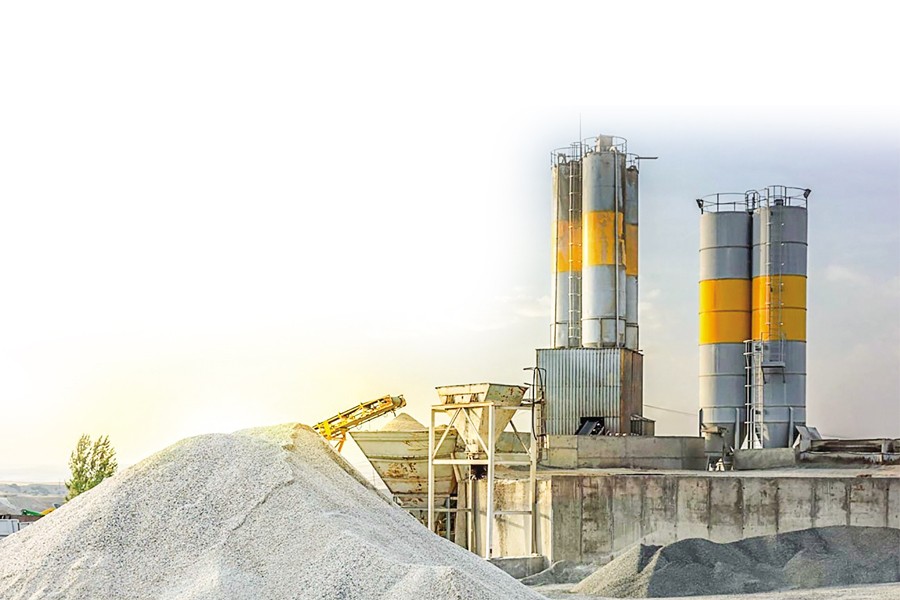
Relentless urban expansion, the emergence of large-scale infrastructure projects and flourishing private housing construction are seen as major drivers propelling cement into a position of critical importance within Bangladesh's economy. Over the past decade or so, the industry has witnessed a remarkable transformation, with domestic production capacity surging to new highs. This growth has been primarily led by major players aggressively expanding their factory capacities and diversifying the product ranges apace with the country's development needs.
Beneath this success story, however, lies a complex web of dependencies and vulnerabilities. The industry's continued overwhelming reliance on imported raw materials, exposure to global price volatility, and lower demand due to economic sluggishness in the recent times are creating trouble for them.
Bangladesh's leading local cement manufacturers, including Shah Cement, Premier Cement, Akij Cement, Bashundhara, and Crown Cement, have made significant investments to ramp up their production capacities in the last two and a half decades. These expansions have been instrumental in increasing the local availability of finished cement, bypassing the need to import the final product. There are around 40 companies operating in the country who have made investments worth Tk 600 billion.
Yet, this achievement is overshadowed by different adversities. One of them is the import of different raw materials along with clinker, the primary intermediary product in cement manufacturing. Notwithstanding increased local grinding capacity, the country still relies heavily on clinker imports to fill the domestic supply gap. The financial magnitude of this dependency is staggering. According to an article published by the Foreign Investors' Chamber of Commerce & Industry (FICCI), the value of clinker imported into Bangladesh in 2024 was approximately $877 million--a figure that underscores the industry's massive scale and its underlying import appetite.
An analysis of central bank data reveals that clinker-import cost stood near $1.164 billion in the 2022-23 fiscal year. The figure fell to about $939 million in 2023-24. This fluctuation can be attributed to a combination of government tariff policies, shifting global prices, and the availability of foreign currency. Such volatility directly impacts the industry's supply-chain planning and cost-calculation models, creating an environment of uncertainty. The country procures different raw materials, including clinker, granulated slag, limestone flux, gypsum and fly ash, from countries like Thailand, Vietnam, China and Pakistan.
The cost of cement at the retail level is largely dependent on the global price of clinker and other ingredients as well as associated shipping fees. When global clinker prices or freight costs surge, the ripple effects are felt almost immediately by Bangladeshi consumers and construction firms alike.
Data available with IndexBox, a market-intelligence platform, indicate that the average import price for clinker in 2024 hovered around $38 per tonne.
The demand for cement in Bangladesh is largely divided between the public and private sector. In the public sector there is government-led infrastructure development, encompassing mega-projects like the metro-rail systems, extensive highway networks, and other civil-engineering works. This public-sector investment accounts for roughly half of the total cement consumption in the country.
The second one is the private real- estate sector, which includes both private residential housing and commercial construction. This segment caters to the needs of a growing urban population and a rising middle class. This mixed-demand profile, while driving growth, also introduces volatility. Pricing, inventory management, and supply-chain logistics must constantly adapt to the project-based nature of public works, which can lead to periods of intense demand followed by relatively slower demand.
According to the Bangladesh Cement Manufacturers Association (BCMA), the cement industry has experienced negative growth since 2022. In 2021, domestic consumption stood at approximately 39 million tonnes. Demand slightly dipped to just over 38 million tonnes in both 2022 and 2023, before falling further to 37.66 million tonnes in 2024. This downturn contrasts sharply with the sector's effective annual production capacity of around 83 million tonnes, highlighting significant underutilization among manufacturers. Whatever the demand situation, operators have to continue to run the mills to sustain the business in the long term.
Cement manufacturing is inherently energy-intensive, relying heavily on natural gas, which leads to high production costs and significant carbon emissions. The industry is facing increasing pressure, both internationally and domestically, to go green. The path forward involves reducing carbon intensity, improving energy efficiency, and exploring the production of "green cement" that incorporates alternative materials like post-industrial waste, fly ash, and slag.
While the vision is clear, the local implementation remains limited. The transition is hampered by the high initial investment required for new technologies and limited access to advanced production methods. In this context, adopting energy-saving technologies and increasing the use of recyclable raw materials are not just environmental imperatives but are becoming essential for the long-term sustainability and cost-competitiveness of the industry.
The industry's reliance on imported raw materials exposes it to several ancillary challenges. Fluctuations in the foreign-exchange rate directly impact the cost of imports. Furthermore, global shipping container availability and freight costs, coupled with efficiency at Chittagong Port, have a direct bearing on input costs.
Internally, weaknesses in the logistics network-including road congestion and inadequate rail connectivity for bulk goods-add up significant costs to the distribution chain. These inefficiencies ultimately inflate the final retail price of cement. Compounding this is the volatility in electricity and natural gas prices, which directly increases the cost of production, putting further pressure on construction budgets and affecting affordability for low-and middle-income homebuilders.
These challenges put apart, the long-term outlook for Bangladesh's cement sector remains positive, based on the country's vision of economic development which will require huge infrastructure development.
Currently Bangladesh's per-capita cement consumption is estimated at around 210 kilograms. The figure lags significantly behind the leading markets of India at 400kg and China at nearly 1700kg.
According to Business Wire, the domestic cement market is projected to expand at a Compound Annual Growth Rate of 4.3 per cent during the period between 2025 and 2029. By the end of 2029, the cement market is projected to expand from its 2024 value of $500.3 million to approximately $619.5 million.
The opportunities are substantial. To harness this potential, a coordinated focus on several key areas is imperative. The must-haves are boosting local clinker production, strengthening the country's logistics ecosystem, promoting energy efficiency and Green Technology, ensuring policy consistency and predictability.
In conclusion, Bangladesh's cement sector stands at a crossroads. It possesses the inherent potential to be a cornerstone of the nation's continued economic development, fully capable of meeting the demands of its infrastructure and housing ambitions. However, realizing this potential is contingent upon strategic shifts.
The future of the industry depends entirely on a concerted effort to build a resilient local raw-material base, embrace sustainable production technologies, and fortify the foundational supply-chain infrastructure. If policymakers and industry leaders can align on these fronts, the cement sector will not only satisfy domestic demand but could also evolve into a significant regional player.
saif.febd@gmail.com